Do Plants Emit Oxygen and Carbon Dioxide at Night?
Plants do emit both oxygen and carbon dioxide at night, though the processes involved vary by plant type and metabolic activity.

Do Plants Emit Oxygen and Carbon Dioxide at Night?
Plants do emit both oxygen and carbon dioxide at night, though the processes involved vary by plant type and metabolic activity.
Carbon Dioxide Emission
All plants release small amounts of carbon dioxide both day and night as a by-product of cellular respiration. While plants absorb carbon dioxide during the day for photosynthesis—typically in amounts that far exceed what they release through respiration—this uptake ceases at night when sunlight is unavailable.12
Oxygen Emission
Most plants release oxygen only during the day, as the process is powered by solar energy. However, certain plants that utilize an alternative pathway called crassulacean acid metabolism (CAM)—such as cacti, bromeliads, and various succulents—are exceptions. These plants keep their leaf stomata closed during the day to conserve water and open them at night, allowing them to release oxygen during the nighttime hours.1
What is the CAM photosynthesis pathway?
Crassulacean acid metabolism (CAM) is a specialized photosynthetic pathway used by many succulent plants, such as cacti, orchids, and bromeliads, to fix carbon dioxide efficiently while minimizing water loss.45
Unlike C3 and C4 plants, which typically open their stomata during the day, CAM plants exhibit a temporal separation of carbon fixation stages. The process functions as follows:45
- Nighttime: The plant opens its stomata when the air is cooler and more humid. It fixes carbon dioxide into the four-carbon acid oxaloacetate, which is then converted into malate and stored in large cell vacuoles.45
- Daytime: The stomata remain closed to prevent water loss. The stored malate is released and decarboxylated, providing a high concentration of carbon dioxide for the Calvin-Benson cycle to produce sugars using Rubisco.45
Because CAM plants keep their stomata closed during the heat of the day, they require significantly less water than other plants to fix the same amount of carbon dioxide, making them highly adapted to arid environments.45
How does cellular respiration differ from photosynthesis?
Cellular respiration and photosynthesis are complementary metabolic processes that sustain life by cycling energy and matter. While they are often viewed as opposites, they serve distinct roles in the energy economy of organisms.
Cellular Respiration
Cellular respiration is the process by which cells break down food molecules, such as glucose, to release stored chemical energy in the form of adenosine triphosphate (ATP).65
- Purpose: To convert energy from chemical bonds into a usable form (ATP) to fuel cellular activities.6
- Inputs: Typically requires oxygen and organic fuel (foodstuffs).65
- Outputs: Produces carbon dioxide and water as waste products.65
- Location: Primarily occurs in the mitochondria of eukaryotic cells.6
Photosynthesis
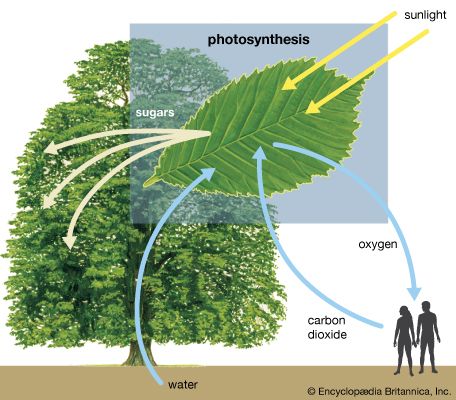
Photosynthesis is the process used by plants and other organisms to convert light energy into chemical energy, effectively storing it in sugar molecules.2
- Purpose: To synthesize organic molecules (sugars) from inorganic carbon dioxide using light energy.2
- Inputs: Requires carbon dioxide, water, and light energy.27
- Outputs: Produces sugars and releases oxygen as a byproduct.27
- Location: Occurs in chloroplasts.2
In essence, photosynthesis builds energy-rich sugars, while cellular respiration breaks them down to power the organism.
Why do plants need to conserve water?
Plants must conserve water primarily because they lose significant amounts through transpiration, a process where water evaporates from the stomata of leaves. While stomatal opening is essential for gas exchange—allowing carbon dioxide to enter for photosynthesis and oxygen to escape—it inevitably leads to water loss.8910
Conserving water is critical for several reasons:
- Structural Integrity: Many plants rely on turgor pressure within their cells to remain erect. When water loss exceeds intake, cells collapse, causing the plant to wilt.9
- Survival: Excessive transpiration can lead to dehydration, which retards growth and can be fatal to the plant.89
- Metabolic Balance: In hot or arid conditions, plants may close their stomata to save water. While this prevents dehydration, it limits carbon dioxide intake, which can slow photosynthesis and increase the risk of photorespiration.10
To manage this, plants have evolved various adaptations, such as waxy cuticles, specialized leaf structures, and the crassulacean acid metabolism (CAM) pathway, which allows them to fix carbon at night when temperatures are lower.811
Sources
- Do Plants Emit Oxygen and Carbon Dioxide at Night? — Encyclopædia Britannica
- Photosynthesis - Photorespiration — Encyclopædia Britannica
- Photosynthesis - Regulation of the cycle — Encyclopædia Britannica
- Photosynthesis - Carbon fixation via crassulacean acid metabolism (CAM) — Encyclopædia Britannica
- Plant - Specific variations in photosynthesis — Encyclopædia Britannica
- cellular respiration — Encyclopædia Britannica
- cellular respiration — Merriam-Webster
- Transpiration — Encyclopædia Britannica
- Photosynthesis - Water — Encyclopædia Britannica
- Stomate — Encyclopædia Britannica
- Succulent — Encyclopædia Britannica
- Why Do Plants Wilt? — Encyclopædia Britannica
- Plant - Essential elements and minerals — Encyclopædia Britannica
- Fertilizer - Essential plant nutrients — Encyclopædia Britannica
Published on · 3 min read