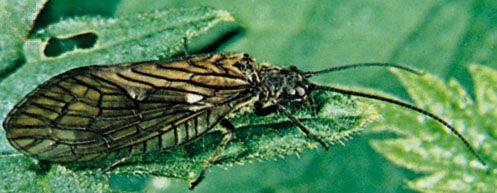
Dobsonfly
Dobsonflies are a group of insects within the subfamily Corydalinae, comprising nine genera and several dozen species distributed across North and South…
What are the different species of dobsonflies found around the world?
Dobsonflies are a group of insects within the subfamily Corydalinae, comprising nine genera and several dozen species distributed across North and South America, Asia, Australia, and Africa. These insects are organized into four primary lineages: Protohermes, Neuromus, Corydalus, and Chloroniella.1
Key groups and species include:
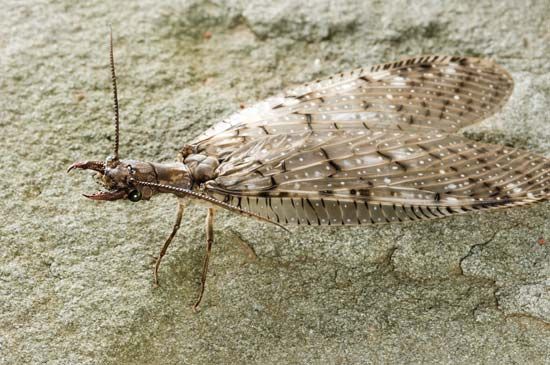
- Corydalus: This lineage includes the well-known eastern dobsonfly (Corydalus cornutus), recognized for its significant sexual dimorphism, where males possess elongated mandibles.1
- Platyneuromus: Found in Mexico and Central America, these are distinguished from Corydalus by the presence of postocular flanges—plates located behind the eyes. They often inhabit higher elevations than their Corydalus counterparts.1
- Chloronia: Also part of the Corydalus lineage, these dobsonflies are notable for the bright yellow coloration of the adults.1
These insects are valued as biotic environmental indicators because their aquatic larvae, often called hellgrammites, are highly intolerant of pollution.1
How do male and female dobsonflies differ in appearance?
Dobsonflies exhibit significant sexual dimorphism, a primary difference being the size and development of their mandibles.
In many species, such as the eastern dobsonfly (Corydalus cornutus), the male possesses exceptionally long, well-developed mandibles that can exceed 2.5 cm (1 inch) in length. These structures are used by the males for fighting and defense. In contrast, the female’s mandibles are considerably smaller and less prominent.1
Beyond these jaw differences, the general body structure of the adult dobsonfly is characterized by a long, cylindrical body with four net-veined wings of similar size and shape.1
What role do dobsonflies play in their ecosystem?
Dobsonflies play a significant role in their ecosystems, primarily through their aquatic larval stage, known as hellgrammites. These larvae serve as an essential component of the macroinvertebrate fauna in streams, acting as ferocious predators that feed on other aquatic insects and small invertebrates. Because they are highly intolerant of water pollution, they are widely recognized as important biotic environmental indicators, helping scientists assess the health of freshwater habitats.1
Furthermore, these larvae are a vital food source for fish, particularly bass, which makes them a significant link in the aquatic food web. Due to their size and predatory nature, they are also frequently utilized by anglers as fish bait. By occupying these roles as both predator and prey, dobsonflies contribute to the balance and biodiversity of the stream environments they inhabit.13
What are the key physical characteristics of dobsonflies?
Dobsonflies, belonging to the family Corydalidae, are characterized by several distinct physical features:
- Body Structure: They possess a long, cylindrical body with short legs.1
- Wings: Adults have four net-veined wings that are similar in size and shape. These wings have a span ranging from 40 to 100 mm.15
- Head and Mouthparts: They have a prognathous head (projecting forward) with biting mouthparts and three ocelli (simple eyes). Their antennae are threadlike (filiform).5
- Sexual Dimorphism: A key characteristic is the difference in mandible size between sexes. Males often possess well-developed, enlarged mandibles used for fighting and defense, which can exceed 2.5 cm (1 inch) in some species, while female mandibles are significantly smaller.15
- Larval Form: Known as hellgrammites, the larvae are elongated and aquatic. They feature biting mandibles, eight pairs of lateral abdominal filaments, and two anal prolegs.15
Some species, such as those in the genus Platyneuromus, are further distinguished by the presence of postocular flanges—plates located behind the eyes.1
Sources
- dobsonfly — Encyclopædia Britannica
- dobsonfly — Merriam-Webster
- Diptera - Adults — Encyclopædia Britannica
- hellgrammite — Merriam-Webster
- neuropteran - Annotated classification — Encyclopædia Britannica
Published on · 3 min read