Donatia
Donatia is the sole genus within the plant family Donatiaceae, which belongs to the aster order (Asterales). It consists of two species of small cushion…
What is Donatia?
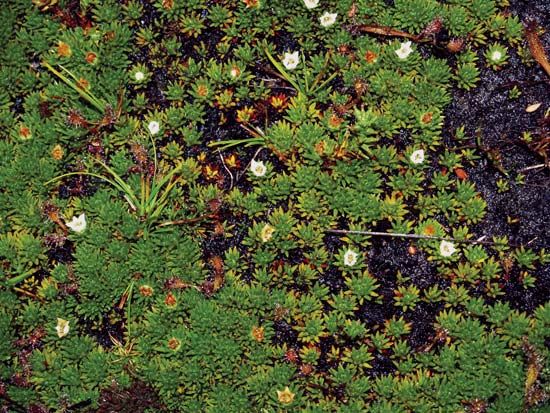
Donatia is the sole genus within the plant family Donatiaceae, which belongs to the aster order (Asterales). It consists of two species of small cushion plants native to subalpine regions in Tasmania, New Zealand, and South America.1
These plants are characterized by their dense, spiral growth patterns consisting of narrow, thick, and leathery leaves. Their flowers, which grow singly at the tips of short stems, feature 5 to 7 sepals and 5 to 10 petals, while their top-shaped fruits contain a small number of fleshy seeds.1
What are cushion plants and how do they survive in harsh climates?
Cushion plants are specialized vegetation that grow in dense, compact, cushion-like tufts. They are particularly common in harsh environments, such as the windswept ridges of Arctic and alpine tundra ecosystems.34
These plants survive in extreme climates through several key adaptations:
- Moisture Retention: Their dense, tufted growth form helps prevent excessive transpiration, allowing the plants to conserve water in dry or exposed conditions.3
- Microclimate Regulation: By growing close to the ground in a compact shape, cushion plants create their own localized microclimates. This structure helps them trap heat and protect themselves from the drying and cooling effects of high winds.4
- Thermal Advantage: In tundra environments, plants that remain low to the ground benefit from warmer air layers near the soil surface, which is crucial for completing their life cycles during the short growing season.4
It is important to distinguish these vascular cushion plants from “cushion mosses” (genus Leucobryum), which are non-vascular plants that form similar pincushion-like tufts in moist, swampy areas to retain water.5
What other types of plants are in the order Asterales?
The order Asterales is a diverse group of flowering plants comprising 11 families and approximately 26,870 species. These plants are united by shared genetic markers, such as the presence of inulin, and morphological traits like plunger pollination.6
The order includes the following families:
- Asteraceae: The largest family, which includes the daisy.6
- Campanulaceae: A major family that includes the Lobeliaceae.6
- Goodeniaceae: A family of flowering plants.6
- Stylidiaceae: Known for their unique trigger-like pollination mechanisms.6
- Menyanthaceae: A family of aquatic and wetland plants.6
- Calyceraceae: A family of herbaceous plants.6
- Rousseaceae: Includes the Carpodetaceae.6
- Pentaphragmataceae: A small family of tropical plants.6
- Alseuosmiaceae: A family of shrubs.6
- Phellinaceae: A family of woody plants.6
- Argophyllaceae: A family of shrubs and small trees.6
These families represent a significant portion of the core asterid clade within the classification of flowering plants.6
How do plants adapt to subalpine environments?
Plants in subalpine environments—the transitional zone between lower forests and the alpine tundra—face significant environmental stressors, including high winds, frost damage, desiccation, and a short growing season. To survive these harsh conditions, plants have developed several specialized adaptations:5
- Growth Form: In the subalpine, trees often take on a stunted, deformed, shrub-like form known as krummholz. This growth pattern helps them survive exposure to windblown snow and ice. At higher elevations, some species that grow as erect trees elsewhere are restricted to prostrate, creeping forms that hug the ground to stay protected from wind and benefit from the insulating layer of snow.58
- Desiccation Resistance: High-elevation plants often possess physiological defenses against winter drying. For example, certain pines have needles coated in thick wax and cuticle layers, which help them retain moisture when exposed to harsh, drying winds.8
- Resource Allocation: To cope with limited energy and nutrients, these plants often grow more slowly and allocate a larger proportion of their carbon resources to their roots rather than their stems or leaves.8
- Reproductive Strategies: Because the growing season is brief and energy is limited, many subalpine and alpine plants rely heavily on asexual reproduction, such as runners or underground stems, rather than depending solely on seed production, which may not be successful every year.98
Sources
- Donatia — Encyclopædia Britannica
- donkey orchid — Encyclopædia Britannica
- cushion plant — Merriam-Webster
- cushion moss — Encyclopædia Britannica
- Tundra - Plant life — Encyclopædia Britannica
- Asterales — Encyclopædia Britannica
- Asterales — Merriam-Webster
- Mountain ecosystem - Environment — Encyclopædia Britannica
- tree - Tree lines — Encyclopædia Britannica
- Mountain ecosystem - Flora — Encyclopædia Britannica
Published on · 3 min read