Dungeness Crab
The Dungeness crab (Cancer magister or Metacarcinus magister) is a large, edible crab belonging to the order Decapoda. It is one of the most commercially…
What is Dungeness crab?
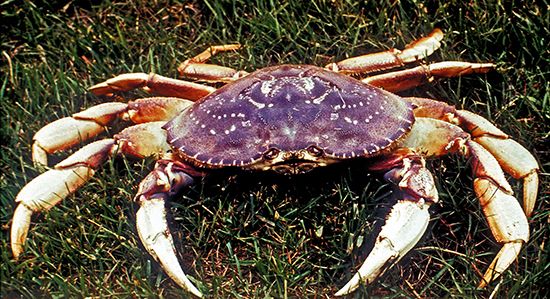
The Dungeness crab (Cancer magister or Metacarcinus magister) is a large, edible crab belonging to the order Decapoda. It is one of the most commercially significant species found along the Pacific coast of North America, ranging from Alaska to lower California.12
These crabs typically inhabit sandy bottoms located below the low-tide mark. Physically, they are characterized by a reddish-brown upper shell that lightens toward the back, while their legs and undersurface are yellowish. Males generally reach widths of 18 to 23 centimeters (about 7 to 9 inches). The species is named after Dungeness, a village located on the Strait of Juan de Fuca in Washington state.12
The Dungeness crab is related to other edible species, such as the Jonah crab and the red crab, though their commercial importance varies by region.1
What other types of crabs are commonly eaten?
Beyond the Dungeness crab, several other species are commercially significant and widely consumed globally:
- Blue crab (Callinectes sapidus): Found along the Atlantic coast of North America, these crabs are prized as delicacies and typically inhabit muddy shores, bays, and estuaries.31
- Edible crab (Cancer pagurus): Also known as the common crab, this species is the most important commercially fished crab along the coasts of Great Britain and Europe.34
- King crab (Paralithodes camtschatica): These are commercially valuable anomurans found in the waters off Japan, the Bering Sea, and Alaska.3
- Swimming crabs (Scylla and Portunus): Related to the American blue crab, these are among the most important seafood sources in the Indo-Pacific region.3
- Other edible species: Various related crabs are consumed, though their commercial importance varies. These include the Jonah crab and red crab found in North American coastal waters, as well as the Atlantic rock crab.4
How do crabs grow and shed their shells?
Crabs grow through a process called molting, or ecdysis, which is necessary because their rigid exoskeleton prevents continuous growth. This process is hormonally controlled and occurs in four distinct stages:56
- Proecdysis (Premolt): The crab prepares for the molt by resorbing calcium from its old shell into its blood. The epidermis separates from the old exoskeleton, and a new, soft shell begins to form underneath.56
- Ecdysis: The actual shedding occurs when the old shell splits along preformed lines. The crab pulls itself out of the old skeleton, often using muscle contractions and the intake of water to increase internal pressure and assist in the exit.76
- Metecdysis (Postmolt): The crab is soft and vulnerable immediately after shedding. It expands its size by taking in water and begins to harden its new cuticle through tanning and the deposition of calcium carbonate.56
- Intermolt: This is the period between molts where the crab lives in its hardened shell. Unlike some arthropods that stop molting at maturity, crabs continue to molt throughout their lives.56
During the postmolt phase, crabs are often referred to as “soft-shell crabs” because their new exoskeleton has not yet calcified.6
What are the main threats to crab populations in the wild?
Crab populations in the wild face several significant threats, primarily driven by human activity and environmental changes. The main pressures include:
- Commercial Fishing and Overharvesting: Many crab species are heavily targeted for human consumption or used as bait. For example, the commercial fishing industry uses horseshoe crabs as bait to capture whelks and eels, which contributes to population declines. Additionally, accidental capture, known as bycatch, in fishing nets designed for other species further reduces numbers.310
- Habitat Loss and Degradation: The destruction of critical breeding and living environments is a major threat. Beachfront property development, particularly along the Atlantic coast of the United States, has significantly reduced the sandy beaches that horseshoe crabs require for their reproductive cycles.310
- Ocean Acidification: As the oceans absorb increasing amounts of carbon dioxide, the resulting rise in acidity reduces the availability of carbonate ions. This makes it difficult for marine calcifiers—organisms that rely on calcium carbonate to build and maintain their shells and skeletons—to grow properly. Smaller, weaker individuals are more susceptible to predation, and severe acidification can threaten the stability of entire marine food chains.11
- Biomedical Harvesting: Some species, such as the horseshoe crab, are harvested for their blood, which contains a unique clotting agent used in medical testing. While the bleeding process is intended to be non-lethal, mortality rates from this practice can be significant.310
Sources
- Dungeness crab — Encyclopædia Britannica
- Dungeness crab — Merriam-Webster
- crab — Encyclopædia Britannica
- blue crab — Encyclopædia Britannica
- Ecdysis - Ecdysis — Encyclopædia Britannica
- crustacean - Exoskeleton — Encyclopædia Britannica
- cirripede - Reproduction and life cycles — Encyclopædia Britannica
- Integument - Arthropods — Encyclopædia Britannica
- arthropod - The exoskeleton and molting — Encyclopædia Britannica
- Horseshoe Crab: A Key Player in Ecology, Medicine, and More — Encyclopædia Britannica
- ocean acidification — Encyclopædia Britannica
- horseshoe crab — Encyclopædia Britannica
- crustacean - Importance to humans — Encyclopædia Britannica
Published on · 3 min read