Dunlin
The dunlin (Calidris alpina) is a circumpolar breeder that nests in the Arctic and sub-Arctic regions, including areas around the North Pole, the British…
What is the migration pattern of dunlins and how far do they travel?
The dunlin (Calidris alpina) is a circumpolar breeder that nests in the Arctic and sub-Arctic regions, including areas around the North Pole, the British Isles, and the Baltic region.1
Contrary to the implication that they are long-distance travelers, the dunlin is classified as a short-distance migrant. During the winter months, these birds migrate to coastal environments, where they congregate in large numbers on tidal flats, sand beaches, and rocky shores to feed on worms, snails, and crustaceans.1
Where can dunlins be found and what are their typical habitats?
The dunlin (Calidris alpina) is a widely distributed bird found across circumpolar regions. During the breeding season, these birds inhabit the Arctic and sub-Arctic zones, including areas surrounding the North Pole, the British Isles, and the Baltic region.1
Typical Habitats
The habitat of the dunlin shifts significantly based on the time of year:
- Breeding Grounds: During the breeding season, they favor wet tundra environments. They construct shallow, scrape-style nests lined with grass and leaves, which are typically concealed within hummocks.1
- Wintering Grounds: In the winter, dunlins migrate to coastal areas. They are commonly found in large, sociable flocks on tidal flats, sand beaches, and rocky shores, where they use their bills to probe the mud for food.1
What are the physical characteristics and appearance of a dunlin?
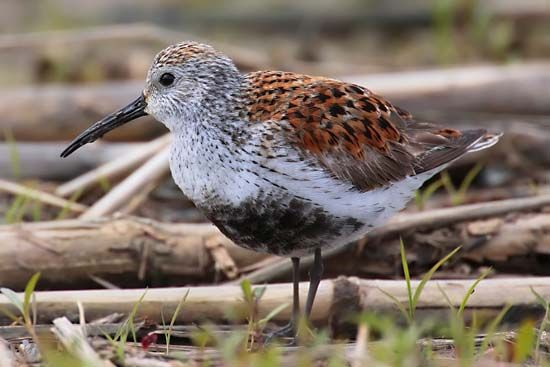
The dunlin (Calidris alpina) is a small member of the sandpiper family, typically measuring about 20 cm (8 inches) in length. Its most distinctive physical feature is its bill, which is notably curved downward at the tip, an adaptation used for probing mud in a rapid “stitching” motion.1
The bird’s appearance changes significantly depending on the season:
- Breeding Plumage: During the breeding season, the dunlin displays vibrant colors. Its back is reddish or cinnamon to rusty brown, while its underparts are white with a prominent black patch on the belly. The name “dunlin” is derived from its dun-coloured back.12
- Winter Plumage: In the winter, the plumage becomes much more subdued, appearing as a dull gray above and white below.1
What do dunlins eat and how do they forage for food?
The diet of the dunlin (Calidris alpina) varies significantly depending on its location and the time of year. During the breeding season on the tundra, these birds primarily consume insects. When they migrate to their wintering grounds along seacoasts, their diet shifts to include worms, snails, and crustaceans.1
To forage for food in these coastal environments, dunlins utilize a specialized probing technique. They use their slender, downward-curved bills to probe the mud in a rapid, rhythmic motion often described as “stitching.” As members of the sandpiper group, they possess a highly adapted bill with a mobile tip containing a concentration of tactile sense organs. This allows them to effectively grasp and extract prey, such as larvae or worms, from beneath the surface of the mud before swallowing.13
Sources
- Dunlin — Encyclopædia Britannica
- dunlin — Merriam-Webster
- Charadriiform - Adaptations for feeding — Encyclopædia Britannica
Published on · 2 min read