Ecosystem Services
Ecosystem services are defined as the outputs, conditions, or processes of natural systems that directly or indirectly benefit human welfare. While the…
How do cultural ecosystem services differ from other types of ecosystem services?
Ecosystem services are defined as the outputs, conditions, or processes of natural systems that directly or indirectly benefit human welfare. While the provided search results do not explicitly categorize services into “cultural” versus other types (such as provisioning or regulating), they establish that all ecosystem services must be linked to identifiable human beneficiaries and be accessible to them.1
Generally, ecosystem services are distinguished by how they contribute to human well-being:
- Functional and Material Services: Many services, such as pollination, flood attenuation, or water filtration, provide tangible inputs for production or physical protection. These are often easier to quantify through biophysical models or market-based economic valuation.12
- Cultural Services: These typically encompass the non-material benefits people obtain from ecosystems, such as aesthetic, spiritual, or recreational experiences. Because these benefits are often subjective and inherently difficult to quantify, they present unique challenges for traditional economic valuation compared to services like timber production or nutrient recycling.1
What role do biodiversity and ecological processes play in maintaining ecosystem services?
Biodiversity and ecological processes are fundamental to the health and functionality of ecosystem services, which are the outputs and conditions of natural systems that benefit human welfare.31
The Role of Biodiversity
Biodiversity maintains ecosystem health by supporting productivity—the conversion of energy into biomass—and ensuring the quality of services such as soil maintenance, water purification, and food supply. It provides the structural complexity necessary for ecosystems to function; when species are lost, the roles they play in food chains and nutrient cycling are diminished or eliminated. High biodiversity also fosters ecological resilience, allowing ecosystems to recover from disturbances. Beyond a critical threshold of species loss, an ecosystem may destabilize, collapse, or undergo rapid, irreversible restructuring into a different state.3
The Role of Ecological Processes
Ecological processes, such as photosynthesis and biogeochemical cycling, underpin the services that sustain life.45
- Energy Flow: Photosynthesis by primary producers (like plants and algae) transforms solar energy into chemical energy, forming the base of all food chains and providing essential oxygen.4
- Nutrient Cycling: Complex interactions between elements like carbon, nitrogen, and phosphorus regulate the environment. These processes are interconnected; for instance, the availability of one nutrient often influences the uptake of others.5
When human activities disrupt these processes—such as through deforestation or excessive fertilization—they can undermine the natural equilibrium of ecosystems, leading to consequences like cultural eutrophication or the enhancement of the greenhouse effect. Ultimately, these ecological functions serve as the foundation for both intermediate and final services that directly support human society.51
What policies or initiatives exist to protect and enhance ecosystem services globally?
Global efforts to protect and enhance ecosystem services involve a combination of international treaties, national policies, and economic incentives designed to integrate natural capital into decision-making processes.1
International and National Frameworks
- Convention on Biological Diversity: This international treaty promotes the conservation of biodiversity and the sustainable use of genetic resources. It encourages nations to preserve sensitive ecosystems and rehabilitate degraded ones. The Aichi Biodiversity Targets were a significant initiative under this framework, aiming to mainstream biodiversity protection into economic markets and society, with goals such as protecting specific percentages of terrestrial and marine environments.67
- Governmental Planning: Many countries, including members of the European Union and various Latin American nations, have integrated ecosystem services information into their governmental planning and sustainable development strategies. In the United States, reports from the President’s Committee of Advisors on Science and Technology have advocated for federal agencies to incorporate ecosystem services valuation into their decision-making.1
Economic and Management Initiatives
- Payments for Ecosystem Services (PES): These programs incentivize private landowners to manage their land in ways that provide ecosystem services, with national-level implementations found in countries like China and Costa Rica.1
- Global Projects: Initiatives such as the World Bank’s Wealth Accounting and Valuation of Ecosystem Services (WAVES) and The Economics of Ecosystems and Biodiversity (TEEB) project work to standardize the valuation of natural capital to guide public and private investment.1
- Ecological Restoration: Restoration efforts—ranging from passive recovery to active interventions like soil rehabilitation and reforestation—are essential strategies for maintaining the ecological processes that underpin services like water filtration and flood protection.82
Despite these advancements, the formal and systematic use of ecosystem services data in policy remains an evolving field, often still at a proof-of-concept stage.1
What are some examples of supporting ecosystem services and why are they important?
Supporting ecosystem services are the fundamental processes and conditions that underpin the production of all other ecosystem services, such as food, water, and climate regulation. Unlike final services that provide direct benefits to humans, supporting services act as the essential “infrastructure” of the natural world.1
Examples of Supporting Services
- Nutrient Cycling: Soil organisms, such as bacteria, fungi, and earthworms, are critical to the nitrogen cycle, carbon cycle, and sulfur cycle. By breaking down organic matter, these organisms release nutrients into forms that plants can absorb, which maintains soil fertility and supports plant growth.9
- Primary Production: Through photosynthesis, green plants and algae transform solar energy into chemical energy (sugars). This process serves as the base of all food chains, providing the energy necessary to support nearly all life on Earth.10
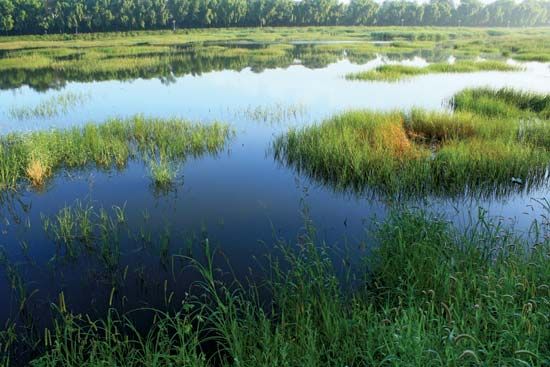
- Habitat Provision: Ecosystems like wetlands provide essential living spaces for diverse species. By serving as transition zones, they support high levels of biodiversity, which in turn sustains the biological processes required for other services.4
Why They Are Important
Supporting services are vital because they maintain the integrity and resilience of ecosystems. Without these underlying processes, ecosystems would lose their ability to provide the “final” services humans rely on, such as clean water, flood attenuation, and food production. For instance, the nutrient cycling performed by soil organisms ensures that ecosystems remain productive, while the water-cleansing and storage functions of wetlands protect human communities from water scarcity and flooding.194
Sources
- ecosystem services — Encyclopædia Britannica
- water scarcity - Environmental policy — Encyclopædia Britannica
- biodiversity loss - Ecological effects — Encyclopædia Britannica
- plant - Importance — Encyclopædia Britannica
- Biosphere - Links among the cycles — Encyclopædia Britannica
- biodiversity loss - Solutions to biodiversity loss — Encyclopædia Britannica
- ecological restoration - Implementation — Encyclopædia Britannica
- Convention on Biological Diversity — Encyclopædia Britannica
- soil organism — Encyclopædia Britannica
- Wetland - Wetland functions and ecosystem benefits — Encyclopædia Britannica
Published on · 5 min read