Egret
Egrets are members of the heron family found globally in a variety of wetland environments, including marshes, lakes, and humid forests. Their distribution…
Where are egrets commonly found in the world?
Egrets are members of the heron family found globally in a variety of wetland environments, including marshes, lakes, and humid forests. Their distribution varies by species:1
- Great white egret: Found across both hemispheres.1
- Cattle egret: Originally native to Europe, Africa, and Asia, this species has significantly expanded its range to include Australia and the Americas.12
- Snowy egret: Native to the New World, ranging from the United States south to Chile and Argentina.13
- Reddish egret: Primarily inhabits the warm coastal regions of North America.1
- Little egret: Found throughout the Old World.1
These birds are typically associated with shallow waters where they hunt for small fish, amphibians, and crustaceans, though the cattle egret is unique for spending much of its time on land near grazing animals. Due to their vulnerability and historical overhunting for their ornamental plumes, many populations are now protected by strict conservation measures.1
What are the different species of egrets, and how do they differ?
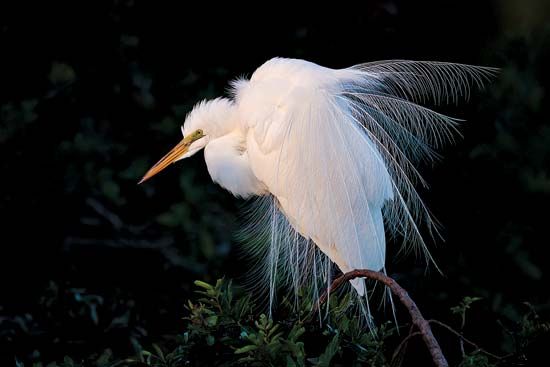
Egrets are members of the heron family (Ardeidae) and are primarily distinguished by their white plumage and the development of long, ornamental nuptial plumes during the breeding season. While they share similar wetland habits, different species exhibit unique physical traits and behaviors:
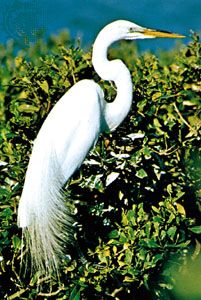
- Great white egret: A large species (about 90 cm long) found in both hemispheres, characterized by plumes that grow only on the back.1
- Cattle egret: A smaller, compact bird (50 cm) that is unique for its terrestrial habits. It associates with grazing animals to feed on insects and ticks, rather than relying solely on aquatic hunting.14
- Little egret: An Old World species (55 cm) featuring firm plumes on the head and lacy plumes on the back.1
- Snowy egret: A New World species (60 cm) known for its filmy, recurved plumes on both the head and back.1
- Reddish egret: Found in North American coastal regions, this species is distinct for having two color phases: white and dark.1

What are the mating and nesting habits of egrets?
Egrets exhibit specific mating and nesting behaviors characteristic of their family, the Ardeidae. Their reproductive habits include the following:
- Mating Displays: During the breeding season, egrets develop long, ornamental nuptial plumes. Some species perform elaborate mating displays using these plumes to attract partners.6
- Nesting Habits: Egrets are colonial nesters, often gathering in large breeding groups. They construct large, untidy nests typically located in trees and bushes, though they may also nest on the ground.6
- Parental Care and Competition: Parental care is a significant investment, but it can lead to intense sibling competition. In great egrets, for example, the first-hatched chick often kills its younger sibling, a behavior that is only mitigated in years when food resources are particularly abundant. Young birds use signals such as begging, colorful gapes, or specific plumage displays to induce parents to deliver food, with the most vigorous or best-positioned chicks often receiving the most attention.1
What are the main differences between egrets and other types of herons?
Egrets are not a distinct biological family but are members of the heron family (Ardeidae). The primary distinction between egrets and other herons is largely based on appearance and terminology rather than fundamental biological classification.10111
The main differences include:
- Plumage: Most egrets are characterized by their predominantly white plumage. While many herons have more varied or cryptic coloration—such as the gray or reddish-brown tones found in typical herons or the barred patterns of tiger herons—egrets are specifically noted for their white feathers.110
- Nuptial Plumes: Egrets are defined by the development of long, ornamental nuptial plumes during the breeding season. While some other herons also develop showy plumes, the term “egret” is specifically applied to those species where these plumes are a prominent, defining feature.11110
- Terminology: The name “egret” (or aigrette) is often used interchangeably to describe both the bird and the ornamental plumes themselves, which were historically prized in the millinery trade.1
Despite these differences, egrets share the same basic anatomy, wading habits, and colonial nesting behaviors as other members of the Ardeidae family.101
Sources
- Egret — Encyclopædia Britannica
- Snowy egret — Encyclopædia Britannica
- Ciconiiform - Migration — Encyclopædia Britannica
- Eagle — Encyclopædia Britannica
- Ciconiiform - Relations with humans — Encyclopædia Britannica
- Charadriiform - Shorebirds (suborder Charadrii) — Encyclopædia Britannica
- Animal social behavior - Social interactions involving the costs and benefits of parental care — Encyclopædia Britannica
- Reproductive behaviour - Caring for offspring — Encyclopædia Britannica
- Reproductive behaviour - Parental care — Encyclopædia Britannica
- Heron — Encyclopædia Britannica
- egret — Merriam-Webster
Published on · 3 min read