Emu
The emu (Dromaius novaehollandiae) is a large, flightless bird native to Australia and is the second-largest living bird species in the world.
What are the physical characteristics of emus, including their size and appearance?
The emu (Dromaius novaehollandiae) is a large, flightless bird native to Australia and is the second-largest living bird species in the world.12
Size and Build
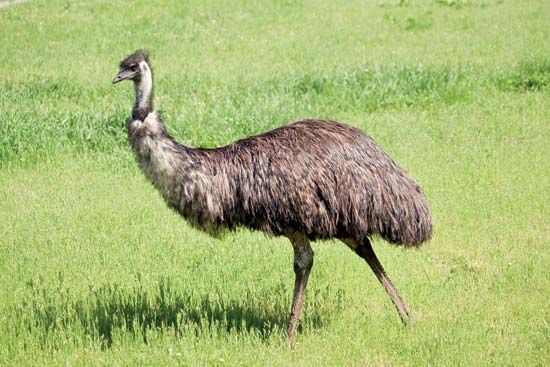
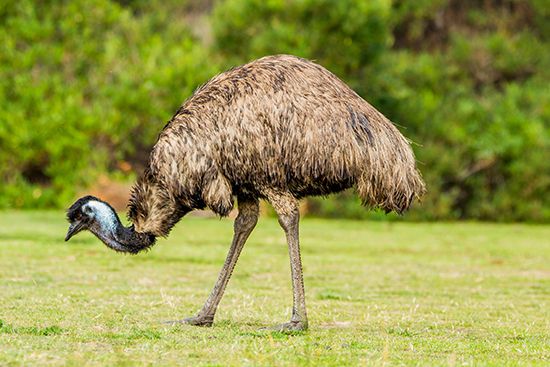
Emus are stout-bodied and long-legged, standing between 1.5 and 1.8 metres (5 to 6 feet) tall. While weights can vary significantly, they typically weigh between 36 and 55 kg (80 to 120 pounds), with females generally being slightly larger than males. Their anatomy is adapted for running, featuring powerful legs and three-toed feet, having lost the hind toe.123
Appearance
- Plumage: Their feathers are sombre brown or brownish black and have a loose, hairlike texture due to the lack of interlocking barbules.2
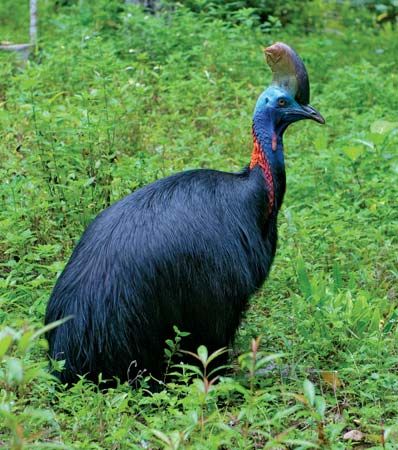
- Head and Neck: The head and neck are dark gray or blue, and unlike their relative the cassowary, emus lack a horny casque (helmet) and pendulous wattles.124
- Beak: The beak is flattened dorsoventrally.4
- Specialized Features: A unique physical characteristic is the emu’s trachea, which includes an aperture leading to an inflatable neck sac, allowing the bird to produce a loud booming note during the breeding season.14
What is the diet of emus, and how do they find and consume their food?
Emus are primarily vegetarian, subsisting on a diverse diet that includes fruits, seeds, and various types of vegetation. In addition to plant matter, they also consume insects, such as grasshoppers and caterpillars, particularly when these insects are present in large numbers.18
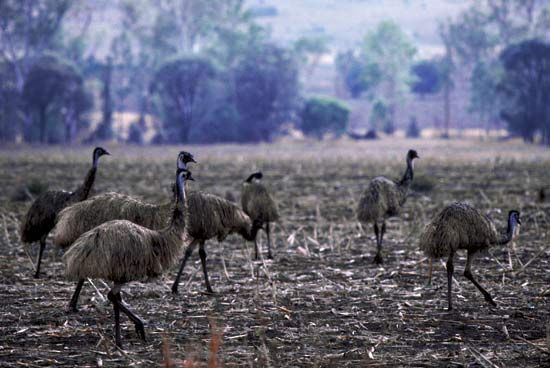
When foraging, emus typically move in small flocks to search for food. They are known for their curious nature and may be attracted to human activities, a behavior that has historically been utilized by Indigenous Australians to lure them for hunting. In agricultural regions, emus are sometimes considered pests because they may trample and consume crops, such as wheat.189
What is the cultural and economic significance of emus, especially in Australia?
The emu holds a complex place in Australian culture and history, evolving from a traditional food source to a national symbol and, at times, an agricultural pest.
Cultural Significance
For Indigenous Australians, the emu has long been a source of food and cultural material. Its feathers were historically used for personal adornment, and emu plumes became a notable part of Australian military tradition, famously worn on the slouch hats of Australian cavalry regiments during World War I. Today, the bird is a recognized national icon, featuring prominently on the Australian coat of arms. Its status as a symbol was solidified by its perceived “victory” in the Emu War, a 1932 military operation that ended in failure for the government and earned the birds a reputation for resilience and pluck.
Economic Impact
Economically, the emu has been a source of both benefit and conflict:
- Agriculture: In wheat-farming regions, emus are often viewed as pests. Their migrations can lead to the destruction of crops through consumption and trampling, as well as damage to fencing that allows other pests to enter fields.
- Management: Following the unsuccessful military intervention in 1932, the government shifted to providing farmers with ammunition and implementing bounty systems to manage populations.
- Conservation: While once hunted to the point of extermination in some island regions, wild emus are now formally protected under the Environment Protection and Biodiversity Conservation Act of 1999.
How fast can emus run, and how does their speed compare to other flightless birds?
Emus are remarkably fast runners, capable of reaching speeds of nearly 50 km (30 miles) per hour. When running, they can maintain a stride of nearly 3 meters (10 feet) and are known to keep pace with an automobile traveling at 40 to 50 km per hour for significant distances.114
While the provided search results highlight the emu’s impressive speed, they do not offer a direct comparative analysis of the running velocities of other flightless birds, such as the ostrich or the rhea. However, it is well-documented that emus are among the fastest runners in the avian world, a trait that serves as a primary defense mechanism in their native Australian habitats.114
Sources
- Emu — Encyclopædia Britannica
- Casuariiform - Form and function — Encyclopædia Britannica
- Emu War — Encyclopædia Britannica
- Plumage — Encyclopædia Britannica
- Casuariiform - Reproduction — Encyclopædia Britannica
- Casuariiform - Classification — Encyclopædia Britannica
- Integument - Birds — Encyclopædia Britannica
- Casuariiform - Importance to humans — Encyclopædia Britannica
- Seed dispersal - Zoochory: animal dispersal — Encyclopædia Britannica
- Seed - Dispersal by animals — Encyclopædia Britannica
- Casuariiform - Ecology — Encyclopædia Britannica
- Today in History—December 10: The Great Emu War Ends (Badly, for Humans) — Encyclopædia Britannica
- emu — Merriam-Webster
- Extreme birds: 7 wonders of the avian world — Encyclopædia Britannica
Published on · 3 min read