Long-legged Fly
A long-legged fly is any member of the family Dolichopodidae, which belongs to the fly order, Diptera. These insects are typically tiny and feature a…
What is long-legged fly?
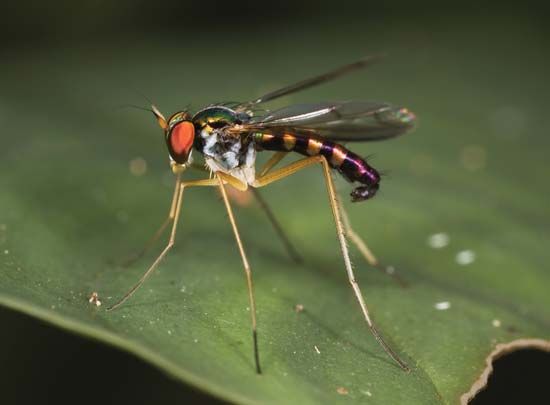
A long-legged fly is any member of the family Dolichopodidae, which belongs to the fly order, Diptera. These insects are typically tiny and feature a metallic blue, green, or copper coloration. They are commonly found in damp, marshy environments, where they sit on leaves in large numbers and prey upon smaller insects.12
The biology of these flies includes several unique characteristics:
- Mating Behavior: Males possess conspicuous genitalia at the end of the abdomen and specialized cuplike structures on their legs, which are used to cover the female’s eyes during mating. Many species are known for performing complex, stylized mating dances.1
- Larval Development: The elongated larvae have little external head structure and develop in habitats such as mud, decaying vegetation, and water.12
What kind of mating dances do long-legged flies perform?
Many species of long-legged flies (family Dolichopodidae) perform highly stylized and complicated mating dances to attract potential mates. While specific movements vary by species, these displays are a form of courtship behavior, which serves as a mechanism for mate choice and species recognition.15
In addition to these dances, male long-legged flies exhibit specialized physical adaptations for mating. They possess conspicuous genitalia at the end of the abdomen and unique cuplike structures on their legs. During the mating process, the male uses these leg structures to cover the female’s eyes, a behavior that may be integrated into their broader reproductive interactions.1
How do the larvae of long-legged flies survive in mud and water?
The larvae of long-legged flies (family Dolichopodidae) are elongated and characterized by having almost no external head structure. They inhabit environments such as mud, decaying vegetation, and water, as well as areas under bark.1
While specific respiratory mechanisms for Dolichopodidae larvae are not detailed in the provided search results, dipterous larvae generally adapt to their environments through specialized tracheal systems. Many aquatic fly larvae obtain oxygen by surfacing to breathe atmospheric air, while others may extract it directly from the water through their skin or specialized structures like tracheal gills. Some larvae in oxygen-poor mud environments, such as certain midges, utilize respiratory pigments like hemoglobin to survive.91011
What are some other types of predatory flies found in nature?
Beyond the long-legged flies (family Dolichopodidae), nature features several other groups of predatory flies within the order Diptera. These insects have evolved various strategies for capturing prey, ranging from aerial hunting to specialized larval predation.
Notable predatory flies include:
- Robber flies (family Asilidae): These are the largest of all flies, with some species reaching nearly 8 cm in length. They are aggressive aerial predators that capture other flying insects, using a specialized “moustache” of bristles to protect their eyes from struggling prey. They inject a fluid into their victims to break down muscle tissue.
- Dance flies (family Empididae): Named for their erratic, swarming flight patterns, these flies are predatory as adults, feeding on smaller insects. Males often engage in complex courtship rituals, presenting captured prey to females as a prerequisite for mating.
- Horseflies and Deerflies (family Tabanidae): While many are known for bloodsucking, the larvae of several genera (such as Tabanus and Haematopota) are carnivorous and live in mud or wet soil.
- Shore flies (family Ephydridae): This family exhibits diverse habits, including the petroleum fly (Psilopa petrolei), whose larvae are carnivorous and live in pools of crude petroleum, preying on other trapped insects.
- Dung flies (family Scatophagidae): These flies are frequently found around dung and decaying materials, where both the adults and larvae often act as predators of other insects.
- Tachinid flies (family Tachinidae): These are ecologically significant because their larvae are parasitic, developing inside other insects, spiders, and centipedes, which makes them valuable in biological control efforts.
Sources
- long-legged fly — Encyclopædia Britannica
- neuropteran - Annotated classification — Encyclopædia Britannica
- Diptera - Annotated classification — Encyclopædia Britannica
- Diptera: Top Questions — Encyclopædia Britannica
- Animal social behavior - Social interactions involving sex — Encyclopædia Britannica
- Dolichopodidae — Merriam-Webster
- malacostracan - Reproduction and life cycles — Encyclopædia Britannica
- apterygote - Life cycle — Encyclopædia Britannica
- Diptera - Larvae — Encyclopædia Britannica
- Diptera - Ecology — Encyclopædia Britannica
- Diptera - General features — Encyclopædia Britannica
- Animal development - The larval stage — Encyclopædia Britannica
- Odonata - The larval stage — Encyclopædia Britannica
- insect - Aquatic insects — Encyclopædia Britannica
- robber fly — Encyclopædia Britannica
- dance fly — Encyclopædia Britannica
- Diptera - Molts and larval stages — Encyclopædia Britannica
- robber fly — Merriam-Webster
- Coleoptera - As predators — Encyclopædia Britannica
- Empididae — Merriam-Webster
- Diptera - Adults — Encyclopædia Britannica
Published on · 3 min read