Eusthenopteron
The fins of Eusthenopteron, an extinct lobe-finned fish from the late Devonian Period, were distinct from those of most other fish of its time due to their…
How did the fins of Eusthenopteron differ from those of other fish of its time?
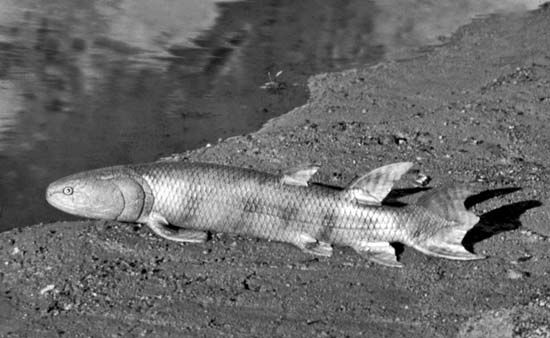
The fins of Eusthenopteron, an extinct lobe-finned fish from the late Devonian Period, were distinct from those of most other fish of its time due to their complex internal skeletal structure. While typical fish fins were primarily supported by bony rays, the fleshy fins of Eusthenopteron contained a series of stout bones that correspond to the limb bones found in modern land vertebrates, including the humerus, radius, ulna, femur, tibia, and fibula.1
Despite these robust internal elements, the fins still terminated in a series of bony rays similar to those seen in ray-finned fishes. This unique anatomy allowed Eusthenopteron to clamber among rocks and plants in shallow waterways, though it was not built for life on land. Unlike the fins of many other contemporary fish that functioned solely as stabilizing keels for locomotion in water, the structure of Eusthenopteron’s fins represents a significant evolutionary step toward the development of tetrapod limbs.12
How is Eusthenopteron significant in the study of evolutionary biology?
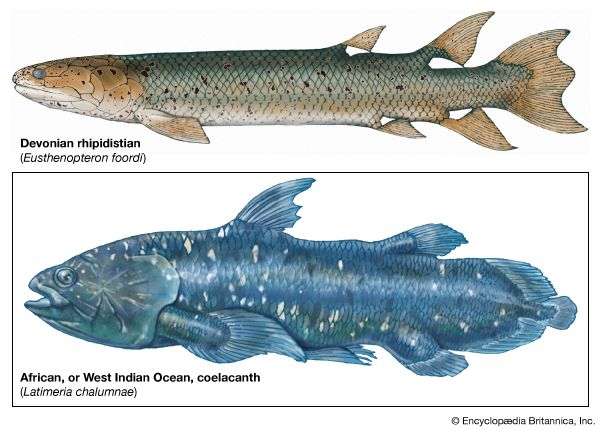
Eusthenopteron is a pivotal figure in evolutionary biology because it serves as a critical link between aquatic lobe-finned fishes and the first tetrapods, or land-dwelling vertebrates.1
Its significance lies in several key anatomical features that bridge the gap between fish and land animals:
- Limb Homology: Its fleshy fins contain internal bones—the humerus, radius, ulna, femur, tibia, and fibula—that correspond directly to the limb structures of modern land vertebrates.1
- Skull Morphology: The arrangement of its skull bones closely resembles that of early tetrapods, providing evidence of the transition from aquatic to terrestrial head structures.1
- Respiratory Adaptations: Eusthenopteron possessed both gills and lungs, illustrating an evolutionary stage where organisms were beginning to utilize atmospheric oxygen while still inhabiting shallow, aquatic environments.1
- Evolutionary Positioning: While it was not a land animal itself, its position near the main line of evolution leading to tetrapods helps scientists understand the gradual modifications required for life on land, such as the later development of robust vertebral columns and pelvic attachments seen in more advanced forms like Ichthyostega.16
What is Eusthenopteron and when did it live?
Eusthenopteron is a genus of extinct lobe-finned fishes that lived during the late Devonian Period, approximately 370 million years ago.1
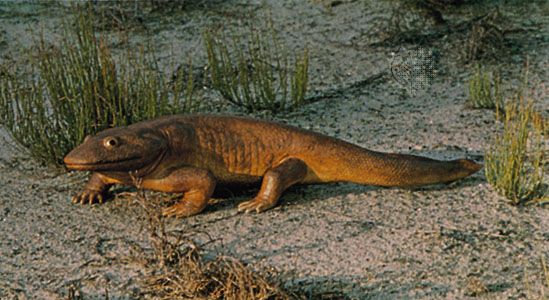
Measuring between 1.5 and 1.8 meters (5 to 6 feet) in length, this active carnivore inhabited shallow fresh to brackish waterways. It is highly significant in evolutionary biology because it represents a transitional form near the main line of evolution leading to the first terrestrial vertebrates, or tetrapods. While Eusthenopteron was not adapted for life on land, its anatomy featured a skull pattern similar to early tetrapods and fleshy fins containing internal bones—such as the humerus, radius, and ulna—that correspond to the limbs of modern land vertebrates. Additionally, it possessed both lungs and gills, allowing it to breathe both air and water.1
How has our understanding of Eusthenopteron changed since its first discovery?
Our understanding of Eusthenopteron has evolved significantly since its initial discovery, shifting from a simple classification as an extinct fish to its recognition as a vital evolutionary bridge between aquatic life and tetrapods.1
Early studies focused on its basic morphology, but modern analysis has highlighted its role as a transitional form. Researchers now emphasize that while Eusthenopteron was not a land animal, it possessed a unique combination of traits that prefigured terrestrial life. Key shifts in understanding include:
- Anatomical Homology: Scientists have identified that its fleshy fins contain internal bones—the humerus, radius, ulna, femur, tibia, and fibula—which are homologous to the limbs of modern land vertebrates, despite ending in fish-like bony rays.1
- Respiratory Dualism: Recognition that it utilized both lungs for air-breathing and gills for aquatic respiration has clarified how early vertebrates navigated oxygen-poor, shallow-water environments.1
- Evolutionary Context: By comparing Eusthenopteron with later, more advanced fossils like Ichthyostega, biologists have mapped the gradual development of skeletal features, such as the fusion of the vertebral column and the detachment of the shoulder girdle from the skull.14
Sources
- Eusthenopteron — Encyclopædia Britannica
- skeleton - General features — Encyclopædia Britannica
- Carboniferous Period - Fishes — Encyclopædia Britannica
- Eusthenopteron — Merriam-Webster
- lobe-finned — Merriam-Webster
- Ichthyostega — Encyclopædia Britannica
- A Journey Through Time Since the Precambrian - Devonian Period: 419.2 million to about 359 million years ago — Encyclopædia Britannica
Published on · 3 min read