Ichthyostega
Our understanding of Ichthyostega has evolved as paleontologists have refined its position in the transition from aquatic vertebrates to land-dwelling…
How has our understanding of Ichthyostega changed since its initial discovery?
Our understanding of Ichthyostega has evolved as paleontologists have refined its position in the transition from aquatic vertebrates to land-dwelling tetrapods. Initially recognized as one of the earliest known tetrapods from the late Devonian Period, it was long viewed as a pivotal link between lobe-finned fishes like Eusthenopteron and later land vertebrates.12
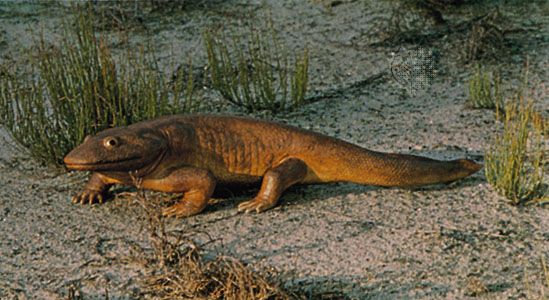
Modern analysis highlights Ichthyostega as a mosaic of traits. While it possesses advanced tetrapod features—such as robust limbs, strong ribs, and a lack of gills—it retains significant aquatic characteristics, including a tail with bony supports typical of fishes, a small dorsal fin, and a preopercular bone in the cheek region. Current scientific consensus places Ichthyostega and its relative Acanthostega as largely aquatic animals that lived in shallow water and dense vegetation, rather than fully terrestrial creatures. This shift in perspective emphasizes that the transition from fins to limbs occurred while these animals were still primarily aquatic, with limbs initially serving to navigate complex underwater environments rather than to support weight on land.12
When and where did Ichthyostega live, and what was its environment like?
Ichthyostega lived during the late Devonian Period, approximately 370 million years ago. Its fossil remains have been discovered in rocks located in eastern Greenland.1
Regarding its environment, Ichthyostega represents a transitional form between aquatic vertebrates and the first land-dwelling tetrapods. While it possessed advanced features such as robust limbs and strong ribs, it retained significant aquatic traits, including a tail with bony supports typical of fishes, a small dorsal fin, and a preopercular bone in the cheek region. These characteristics suggest that Ichthyostega was not a fully terrestrial animal but rather inhabited shallow-water environments, likely navigating through dense vegetation. The broader Devonian landscape was characterized by the “Age of Fishes,” with a proliferation of primitive fish in both fresh and marine waters, and the rise of the first in-place forests.13
How did Ichthyostega’s limbs and fins differ from those of its fish ancestors?
Ichthyostega represents a significant evolutionary step between lobe-finned fish ancestors and later land-dwelling tetrapods. Its limbs and fins differed from those of its ancestors in several key ways:
- Limb Structure: Unlike the fins of ancestral fish such as Eusthenopteron, Ichthyostega possessed robust bones that provided internal support for its fleshy limbs. These limbs were adapted for navigating shallow water and dense vegetation, marking a transition toward the weight-bearing structures required for life on land.12
- Loss of Fin Rays: While its ancestors relied on bony fin rays for swimming and steering, Ichthyostega began to lose these structures as its limbs evolved to support its body.25
- Retention of Aquatic Traits: Despite these advancements, Ichthyostega retained several primitive features. It kept a small dorsal fin along its tail, and its tail possessed bony supports similar to those found in fish. Additionally, it retained a preopercular bone in the cheek region, a structure that serves as part of the gill cover in fish.1
While Ichthyostega had developed strong ribs and lacked gills, its anatomy suggests it was still primarily an aquatic animal that used its limbs to push itself along the bottoms of watercourses rather than for fully terrestrial locomotion.12
How does Ichthyostega’s anatomy compare to modern amphibians and fish?
Ichthyostega serves as a significant evolutionary bridge between ancient lobe-finned fishes and the first land-dwelling tetrapods. Its anatomy reflects a mosaic of aquatic and terrestrial traits that distinguish it from both its ancestors and modern amphibians.
Comparison to Fish Ancestors
Ichthyostega retained several primitive features characteristic of its aquatic ancestors, such as a small dorsal fin, a tail with bony supports, and a preopercular bone in the cheek region (a remnant of the gill cover). However, it diverged from fish like Eusthenopteron by possessing robust, limb-supporting bones, strong ribs, and a lack of gills, which allowed it to navigate shallow water and dense vegetation more effectively than its predecessors.12
Comparison to Modern Amphibians
It is inaccurate to view Ichthyostega as a direct ancestor or a close relative of modern amphibians like frogs or salamanders. While modern amphibians evolved from the same lineage of lobe-finned fishes, they possess specialized adaptations—such as specific respiratory mechanisms and skeletal structures—that differ significantly from the heavy, fusiform body and primitive limb structure of Ichthyostega. Unlike modern amphibians, Ichthyostega and its relatives represent an early, distinct phase in the emergence of vertebrates onto land.62
Sources
- Ichthyostega — Encyclopædia Britannica
- amphibian - Evolution and classification — Encyclopædia Britannica
- Devonian Period - Devonian life — Encyclopædia Britannica
- Devonian Period - Invertebrates — Encyclopædia Britannica
- skeleton - General characteristics — Encyclopædia Britannica
- Tiktaalik roseae — Encyclopædia Britannica
Published on · 3 min read