Fallow Deer
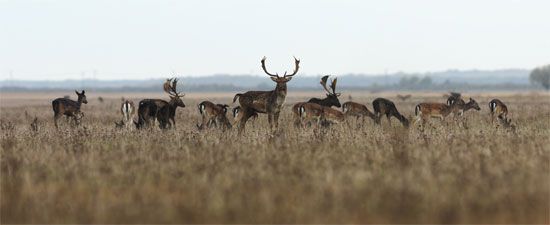
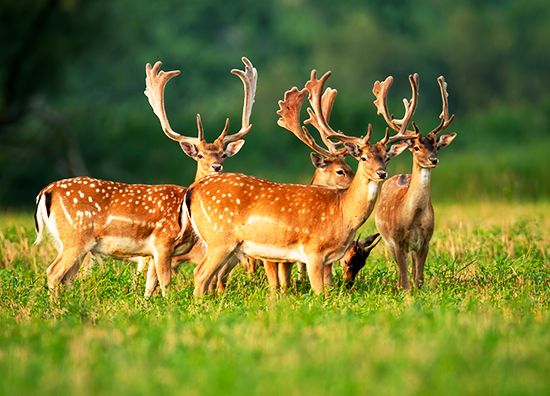
Fallow deer (Dama dama) are medium-sized members of the family Cervidae with several distinct physical characteristics.
What are the distinctive physical characteristics of fallow deer?
Fallow deer (Dama dama) are medium-sized members of the family Cervidae with several distinct physical characteristics.1
- Size: They typically stand about 90 cm (3 feet) at the shoulder. Adult bucks can weigh up to 100 kg (220 pounds), while females generally weigh around 45 kg (100 pounds).1
- Coat: In the summer, their coat is usually yellowish-brown with white spots. During the winter, the coat becomes a more uniform grayish-brown.1
- Antlers: Fallow bucks are the only Old World deer to possess flat, palmate antlers. These antlers are the largest relative to the animal’s body size among Old World deer, measuring approximately 60 cm (2 feet) in length, and are broad with flattened ends and several short tines.12
- Anatomy: During the rutting season, the buck develops a conspicuous Adam’s apple that moves up and down the throat when it vocalizes. Additionally, the end of the buck’s penis sheath becomes swollen during this period.1
Where are fallow deer native to, and where have they been introduced?
The common fallow deer (Dama dama dama) is native to the eastern Mediterranean region, while the Mesopotamian fallow deer (D. dama mesopotamica) is native to Iran.1
Since the Neolithic Period, the common fallow deer has been widely introduced to many areas outside its original range. Today, these deer occur in the wild across Europe and various other locations globally, and they are also frequently kept in captivity on deer farms, in parks, and in zoos.12
How long do fallow deer live in the wild and in captivity?
How do fallow deer differ from other deer species like red deer or white-tailed deer?
Fallow deer (Dama dama) are distinct from other deer species, such as red deer or white-tailed deer, primarily due to their unique physical characteristics and specialized behaviors.
Physical Distinctions
- Antler Structure: Fallow deer are the only Old World deer with flat, palmate (broad and flattened) antlers. While red deer and elk possess complex, multi-pronged antlers that can have five or six points, fallow deer antlers are characterized by their flattened ends and short tines.14
- Size and Appearance: Fallow deer are medium-sized, standing about 90 cm (3 feet) at the shoulder. Their coats often feature white spots in the summer, a trait that varies significantly among other species.1
- Vision: Research indicates that both fallow deer and white-tailed deer share similar dichromatic vision, meaning they are particularly responsive to blue and green wavelengths but struggle to distinguish red and orange hues.3
Behavioral Differences
- Locomotion: When fleeing from predators, fallow deer utilize a unique form of stiff-legged jumping and running known as stotting.1
- Mating Rituals: Fallow bucks exhibit distinct courtship behaviors, including vocalizing loudly while dipping their antlers and forming territory clusters called leks. Unlike many other deer that may roll in urine-soaked earth, fallow bucks use urine to mark scrapes but do not engage in this rolling behavior.1
Sources
- fallow deer — Encyclopædia Britannica
- fallow deer — Merriam-Webster
- deer - Morphology and behaviour — Encyclopædia Britannica
- deer - Old World deer — Encyclopædia Britannica
- Are deer colorblind? — Encyclopædia Britannica
Published on · 2 min read