Gemsbok
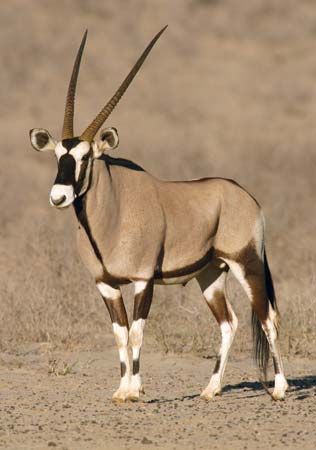
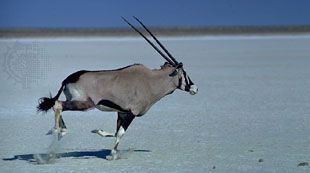
The gemsbok (Oryx gazella) is the largest species of oryx, a type of large antelope native to the desert regions of Africa.
What is gemsbok?
The gemsbok (Oryx gazella) is the largest species of oryx, a type of large antelope native to the desert regions of Africa.12
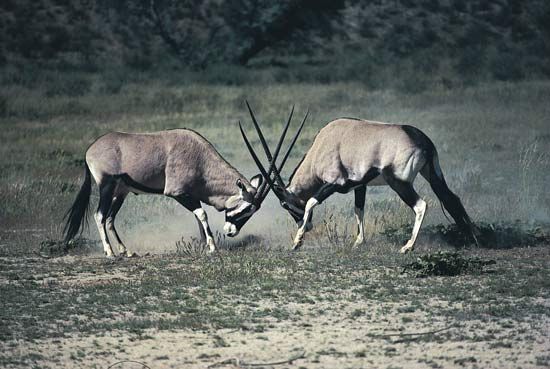
These powerfully built animals are characterized by their striking gray-brown coats with contrasting black and white facial and leg markings, as well as their long, straight, backward-pointing horns. Both males and females possess these horns, which can reach lengths of 120 cm (47 inches) and serve as defensive weapons against predators like lions and hyenas.1
Gemsbok are highly adapted to arid environments, such as the Kalahari Desert. They primarily graze on grasses and are capable of surviving for long periods without drinking by digging for water-storing roots and tubers. They typically live in herds of 10 to 40 individuals and can reach up to 20 years of age.12
How do gemsbok survive in the desert without regular water?
Gemsbok are exceptionally well-adapted to surviving in hot, arid environments, such as the Kalahari Desert, by minimizing their need for standing water.1
Their survival strategy relies on several key behaviors and physiological traits:
- Dietary Water Sources: While gemsbok primarily graze on grasses, they actively dig for roots and tubers that store moisture, allowing them to obtain necessary hydration directly from their food.1
- Reduced Water Dependency: Like other oryx species and certain gazelles, gemsbok are noted for their ability to go for long periods without drinking.13
- Environmental Adaptation: They are physically built to thrive in dry, rocky plains and hills, where they can endure harsh conditions that would be unsustainable for many other animals.1
These adaptations allow the gemsbok to maintain its health and vitality in environments where water is scarce or unavailable.1
What are the main differences between the three types of oryx?
The genus Oryx consists of three distinct species of large antelopes, each adapted to arid environments in Africa and the Arabian Peninsula. While they share a similar build, they differ significantly in size, coloration, and horn shape.2
Species
Height
Weight
Key Characteristics
Gemsbok
(
O. gazella
)
Up to 138 cm
~238 kg
Largest species; gray-brown coat with bold black and white facial/leg markings; long, straight horns.
Scimitar-horned oryx
(
O. dammah
)
~120 cm
~200 kg
Mostly white with a distinctive reddish-brown neck and chest; listed as an
endangered species
.
Arabian oryx
(
O. leucoryx
)
~102 cm
~75 kg
Smallest species; primarily white with faint dark markings; possesses long, straight horns; listed as an
endangered species
.
The gemsbok and Arabian oryx are noted for their long, straight horns, whereas the scimitar-horned oryx is distinguished by its unique coloration and horn shape. All three species are highly resilient, capable of surviving in harsh desert conditions by foraging for water-storing roots and tubers when standing water is unavailable.21
How do gemsbok defend themselves against predators like lions?
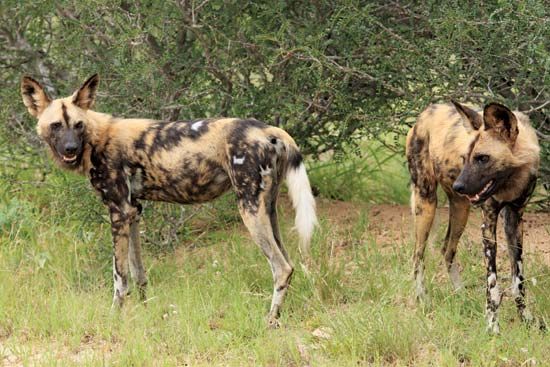
Gemsbok are powerfully built animals that rely on their impressive physical attributes to defend themselves against formidable predators such as lions, African wild dogs, and hyenas.
Their primary defensive weapons are their remarkable horns. These horns are long, straight, and backward-pointing, reaching lengths of up to 120 cm (47 inches). Because both males and females possess these sturdy, sharp appendages, they are well-equipped to fend off attacks from carnivores in their desert habitats.1
Sources
- gemsbok — Encyclopædia Britannica
- oryx — Encyclopædia Britannica
- springbok — Encyclopædia Britannica
- artiodactyl - Digestive system — Encyclopædia Britannica
- oryx — Merriam-Webster
Published on · 3 min read