Feather-duster Worm
A feather-duster worm is a large, segmented marine worm belonging primarily to the family Sabellidae, though the name is sometimes used for the related…
What is feather-duster worm?
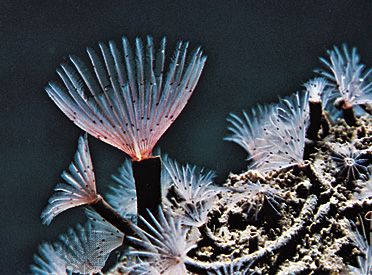
A feather-duster worm is a large, segmented marine worm belonging primarily to the family Sabellidae, though the name is sometimes used for the related family Serpulidae. These worms are characterized by a vibrant, multicoloured crown of finely divided tentacles attached to their heads, which they use for both respiration and feeding.1
These organisms live within protective tubes constructed from mud or sand cemented with mucus, or in the case of serpulids, from calcareous materials. When feeding, the worm extends its feathery tentacles into the water to trap suspended organic and inorganic particles, which are then transported to the mouth via beating cilia. If a predator approaches, the worm can rapidly retract its tentacles into the safety of its tube. Their life cycle begins as a microscopic, free-living larva that eventually settles and metamorphoses into an adult.12
How do these worms build their protective tubes?
Feather-duster worms build their protective tubes using materials gathered from their environment, which are then bound together by secretions from the worm’s body. The specific construction method depends on the family of the worm:
- Sabellidae: Members of this family construct long, flexible tubes using mud or sand particles. These particles are cemented together with mucus secreted by the worm.15
- Serpulidae: These worms build more rigid, protective tubes composed of calcareous (calcium-based) materials.1
To gather the necessary materials, the worm extends its feathery tentacles into the water to trap suspended organic and inorganic particles. These particles are then transported down the tentacles by beating cilia. While some of these particles are consumed as food, others are utilized for the ongoing construction and maintenance of the tube.5
What do feather-duster worms eat?
Feather-duster worms are filter feeders that use their specialized, feathery tentacles to obtain nourishment. By extending these tentacles into the water, they trap suspended organic and inorganic particles. Once captured, these food particles are transported to the worm’s mouth via the action of beating cilia.1
What are polychaetes and where do they live?
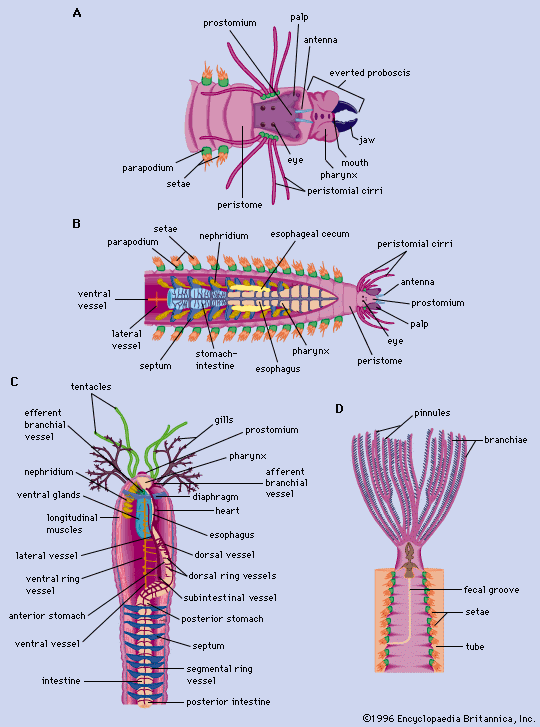
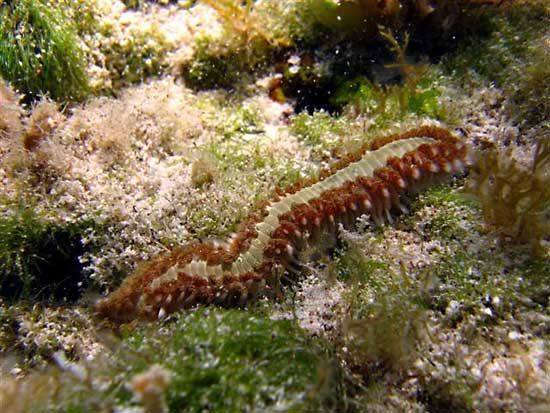
Polychaetes are a class of annelid worms, commonly known as bristle worms due to the tiny, hair-like bristles called setae that cover their paired, lobelike appendages known as parapodia. These worms are characterized by well-defined body segmentation and can range in size from a few millimeters to about 3 meters (10 feet).78
Most polychaetes are marine organisms that inhabit the ocean, where they exhibit diverse lifestyles: some are free-moving (errantia), while others are sedentary and live in tubes they construct themselves. They are found in various oceanic environments, where they may float, burrow into the sea floor, or wander along the bottom. While the vast majority are marine, there are exceptions, such as the feather duster (Manayunkia speciosa), which inhabits the Great Lakes and certain rivers in the United States.79
Polychaetes play a vital ecological role by turning over bottom sediments in the sea. Unlike some other annelids, they lack known mechanisms for adapting to adverse environmental conditions.710
Sources
- feather-duster worm — Encyclopædia Britannica
- Sabellariidae — Merriam-Webster
- sabellariid — Merriam-Webster
- peacock worm — Encyclopædia Britannica
- annelid - Behaviour and associations. — Encyclopædia Britannica
- beard worm — Encyclopædia Britannica
- polychaete — Encyclopædia Britannica
- annelid - Critical appraisal — Encyclopædia Britannica
- bristle worm — Merriam-Webster
- annelid - Ecology — Encyclopædia Britannica
- annelid - Distribution and abundance — Encyclopædia Britannica
Published on · 2 min read