Why Do Crabs Walk Sideways?
Crabs walk sideways primarily due to their unique body plan and the structure of their legs. The shoulder joints of a crab have limited front-to-back…
Why do crabs walk sideways?
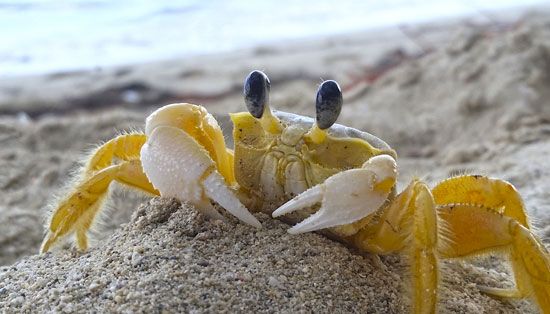
Crabs walk sideways primarily due to their unique body plan and the structure of their legs. The shoulder joints of a crab have limited front-to-back mobility, while the second joint in each leg bends most efficiently in a lateral direction. This sideways movement prevents their legs from becoming entangled, which would otherwise cause the animal to trip.1
From an evolutionary perspective, this sidelong gait provides a significant survival advantage. It allows the animal to move with nearly equal speed to either the left or the right, facilitating a rapid escape from predators. Furthermore, this gait, combined with a flattened body shape, allows crabs to inhabit diverse ecological niches, such as narrow rock crevices or sandy pits.1
It is important to note that not all crabs move this way. While most true crabs (infraorder Brachyura) exhibit lateral locomotion, other decapod crustaceans like hermit crabs and king crabs typically move forward or backward.1
How do hermit crabs differ from true crabs?
Hermit crabs and “true” crabs (infraorder Brachyura) differ significantly in their physical structure and behavior. While both belong to the order Decapoda, they are classified into different groups: true crabs are brachyurans, whereas hermit crabs are anomurans.23
Key differences include:
- Body Protection: True crabs possess a broad, hard carapace that protects their bodies. In contrast, hermit crabs have soft, vulnerable exoskeletons and must occupy empty snail shells or other hollow objects for protection.412
- Abdomen Structure: True crabs have short tails that are curled underneath their thorax. Hermit crabs have asymmetrical, flexible abdomens that are adapted to curl and fit inside their chosen shells.42
- Locomotion: Most true crabs are characterized by a lateral, or “sideways,” gait, which helps them avoid leg entanglement and escape predators. Hermit crabs generally move forward or backward rather than sideways.23
- Adaptations: Because hermit crabs rely on external shells, they must constantly search for larger homes as they grow, leading to intense competition for suitable shells. Some species have even evolved to live in non-shell environments like bamboo or coral.42
What are some other unique defense mechanisms crabs use?
Beyond their ability to move sideways to escape predators, crabs employ a variety of sophisticated defense mechanisms to survive in their environments:
- Camouflage and Decoration: Some species, known as decorator crabs, actively enhance their concealment by picking up materials from their surroundings—such as algae and sponges—and attaching them to their carapace. These organisms continue to live on the crab’s shell, effectively masking the crab’s appearance from predators.15
- Physical Armor: The rigid exoskeleton provides a primary line of defense. While this shell is essential for protection, it also necessitates periodic molting, a vulnerable stage during which the crab must hide until its new shell hardens.67
- Aggressive Displays: Many crabs use their claws for more than just feeding. They engage in ritualized threat displays, such as waving enlarged claws or snapping them to produce sound, which serves to establish identity, intent, and dominance without always resorting to physical combat.8
- Autotomy: Like some other arthropods, crabs possess the ability of autotomy, allowing them to voluntarily release a limb if it is grasped by a predator, potentially saving the rest of the animal’s body.9
How does a crab’s exoskeleton help it survive?
A crab’s exoskeleton—also known as the cuticle or integument—is essential for its survival, providing both structural support and physical protection.613
Protection and Support
The exoskeleton acts as a rigid, protective armor, specifically through the carapace, which shields the crab’s soft internal tissues from predators and environmental hazards. Beyond protection, the exoskeleton serves as a vital anchor for muscles. By providing a rigid base for the insertion of extensor and flexor muscles, the skeleton facilitates complex movement and locomotion.14136
Composition and Hardness
The structure is primarily composed of chitin fibers embedded in a protein matrix. To achieve its characteristic hardness, the cuticle is often mineralized with calcareous substances like calcite or aragonite. For areas requiring maximum durability, such as the tips of the claws and the mandibles, the crab utilizes sclerotin, a naturally occurring, plastic-like protein that is harder than calcite.15
Growth and Molting
Because the exoskeleton is rigid and does not grow, crabs must undergo molting (ecdysis) to increase in size. This process is hormonally regulated by substances like ecdysone. During the molting cycle, the crab sheds its old shell and secretes a new, larger one. This period is a critical time for the animal, as it remains soft and vulnerable until the new cuticle fully hardens and calcifies.6131015
Sources
- Why do crabs walk sideways? — Encyclopædia Britannica
- hermit crab — Encyclopædia Britannica
- 14 Questions About Aquatic Animals Answered - Which animals live inside empty seashells? — Encyclopædia Britannica
- crab — Encyclopædia Britannica
- coloration - Background matching — Encyclopædia Britannica
- crustacean - Exoskeleton — Encyclopædia Britannica
- malacostracan - Defense and aggression — Encyclopædia Britannica
- Autotomy — Encyclopædia Britannica
- Chemoreception - Predator chemical cues and prey escape — Encyclopædia Britannica
- exoskeleton — Encyclopædia Britannica
- Chemoreception - Defensive tastes — Encyclopædia Britannica
- mollusk - Features of defense — Encyclopædia Britannica
- Endocrine system - Molting — Encyclopædia Britannica
- skeleton - Comparative study of skeletal systems — Encyclopædia Britannica
- Integument - Arthropods — Encyclopædia Britannica
Published on · 3 min read