Fingerfish
The term "fingerfish" primarily refers to any of the half-dozen species of fish in the family Monodactylidae, rather than a starfish as sometimes suggested…
What is fingerfish?
The term “fingerfish” primarily refers to any of the half-dozen species of fish in the family Monodactylidae, rather than a starfish as sometimes suggested in dictionary entries.
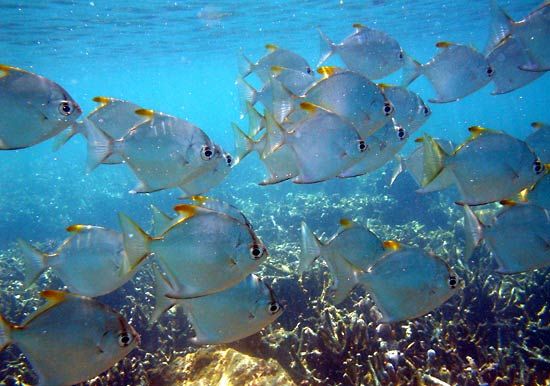
These fingerfish are found in waters ranging from the Atlantic coast of western Africa to the Indo-Pacific region, typically inhabiting inshore or estuarine environments. They are characterized by their extremely compressed, deep bodies, which are often taller than they are long. Due to this unique shape and their silvery color, they are frequently referred to as moonfishes.
Two species are particularly popular in the aquarium trade:
- The moonfish or mono (Monodactylus argenteus): Found from eastern Africa to Malaysia, this species can reach lengths of 20 cm (8 inches) and features two vertical black bands on its head.
- The striped fingerfish (M. sebae): Native to western Africa, this species is also commonly kept as an aquarium fish.
What are the characteristics of estuarine environments?
Estuarine environments are defined as partly enclosed coastal bodies of water where river water mixes with and dilutes seawater. Rather than strict geographic boundaries, these areas are primarily characterized by their salinity gradients, where fresh water meets the sea.34
Key characteristics include:
- Circulation and Mixing: The interaction between tidal flow and river flow creates unique water circulation patterns. Fresh water, being less dense, often forms a surface layer, while salt water may form a “salt wedge” at depth. This movement traps nutrients, making estuaries highly productive ecosystems.345
- Biological Productivity: Estuaries are among the most biologically productive environments, supporting diverse populations of invertebrate animals, fish, and plants. They serve as vital nursery grounds where juveniles find food and protection in habitats like mangrove forests, salt marshes, and sea grass beds.65
- Human Significance: Historically, these environments have been centers for commerce and shipping, with many major cities developing at the seaward margins of river systems. However, their proximity to urban centers makes them vulnerable to pollution, as the same circulation that traps nutrients can also retain contaminants.74
Why are fingerfish popular in home aquariums?
Fingerfish, particularly the moonfish (Monodactylus argenteus) and the striped fingerfish (M. sebae), are popular in home aquariums primarily due to their striking physical appearance. These fish are noted for their unique, extremely compressed, and deep-bodied shapes, which are often taller than they are long. This distinctive profile, combined with their characteristic silvery coloration, makes them visually appealing additions to an aquarium.
The moonfish is especially favored for its aesthetic features, such as the two vertical black bands that extend down its head. While they are native to inshore and estuarine waters ranging from western Africa to the Indo-Pacific, their adaptability to captive environments has helped maintain their status as a common choice for hobbyists.
How do fish use their body shape to survive in the wild?
Fish have evolved a vast array of body shapes that are intricately linked to their ecological niche and survival strategies. These adaptations allow them to navigate diverse environments, capture prey, and evade predators.910
Locomotion and Body Form
- Fusiform (Streamlined): Active, open-water swimmers like tunas and herrings possess streamlined bodies that minimize turbulence, enabling rapid, sustained movement.911
- Lateral Compression: Fish with flattened sides, such as sunfish and angelfish, are adapted for life in quiet, weedy waters. This shape allows for quick, agile turns to navigate through vegetation or escape predators.912
- Depressed (Flattened Top-to-Bottom): Bottom-dwelling species, such as many catfishes, often have depressed bodies, allowing them to rest securely on the substrate or hide under rocks.12
- Elongated: Eel-like forms are specialized for maneuvering through narrow crevices, soft mud, or sandy bottoms.12
Survival and Camouflage
Body shape often works in tandem with coloration to provide protection. Many species, such as scorpion fishes, possess fleshy appendages and irregular body contours that mimic their rocky or coral-covered surroundings, rendering them virtually invisible. Additionally, body shape can dictate defensive behaviors; for example, deep-bodied fish often feature vertical banding to break up their outline, while elongated fish typically display horizontal stripes, patterns that align with their respective swimming habits.131014
Sources
- fingerfish — Encyclopædia Britannica
- fingerfish — Merriam-Webster
- estuary — Encyclopædia Britannica
- estuary - Primary productivity — Encyclopædia Britannica
- estuary - Salt wedge estuaries — Encyclopædia Britannica
- estuary - Commercial importance — Encyclopædia Britannica
- river - Estuaries — Encyclopædia Britannica
- seawater - Salinity distribution — Encyclopædia Britannica
- fish - Locomotion — Encyclopædia Britannica
- ostariophysan - Swimming — Encyclopædia Britannica
- Locomotion - Carangiform and ostraciiform locomotion — Encyclopædia Britannica
- scorpaeniform - Camouflage and coloration — Encyclopædia Britannica
- coloration - The role of shape in relation to coloration — Encyclopædia Britannica
- protacanthopterygian - Departures from the generalized body plan — Encyclopædia Britannica
- fish - Structural diversity — Encyclopædia Britannica
Published on · 3 min read