Flower Chafer
Flower chafer beetles (subfamily Cetoniinae) undergo complete metamorphosis, a four-stage life cycle consisting of the egg, larva, pupa, and adult.
What is the life cycle of a typical flower chafer beetle?
Flower chafer beetles (subfamily Cetoniinae) undergo complete metamorphosis, a four-stage life cycle consisting of the egg, larva, pupa, and adult.12
- Egg: The life cycle begins when the adult female deposits her eggs in a suitable environment, typically in soil rich in organic matter.13
- Larva: Upon hatching, the larvae—often referred to as white grubs—feed on organic matter in the soil and may occasionally damage plant roots. Unlike many other scarab larvae, which are strongly C-shaped, flower chafer larvae are often shorter, hairier, and more active. They are uniquely capable of locomotion on their backs by using muscular pads on their segments rather than their legs.1324
- Pupa: After completing their larval growth, the insects enter the pupal stage. This is an inactive, nonfeeding phase where the larva undergoes a transformation, breaking down larval tissues and developing adult structures, such as wings.256
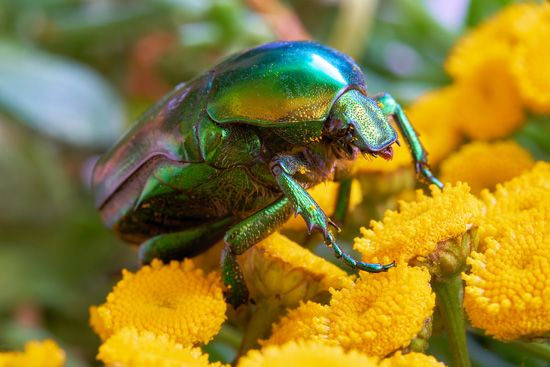
- Adult: The adult beetle eventually emerges from the pupal skin. Adults are often noted for their brilliant coloration and are frequently found visiting flowers to feed on pollen and nectar.13
In which regions of the world are flower chafers commonly found?
Flower chafer beetles (subfamily Cetoniinae) are distributed worldwide, meaning they can be found in various regions across the globe.2
While they are present globally, their distribution and characteristics vary by environment:
- Tropical Regions: The majority of the iridescent species within this subfamily are found in the tropics.2
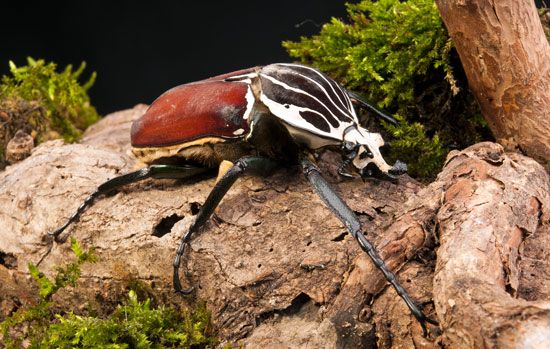
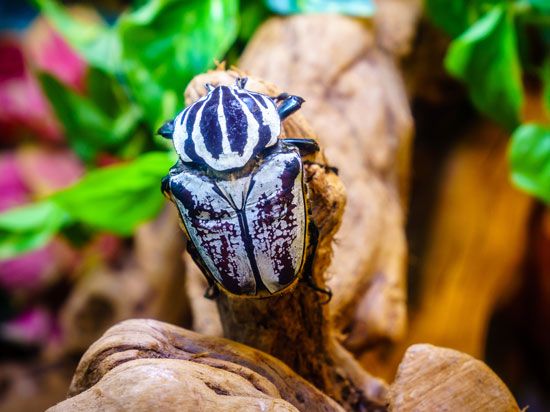
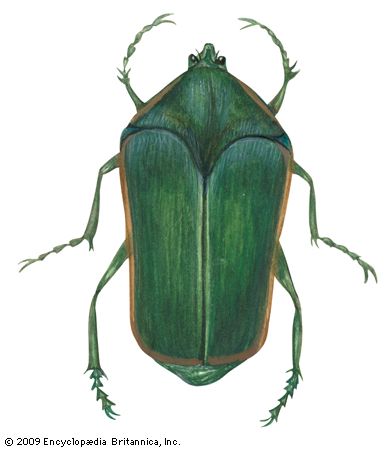
- Specific Examples: The subfamily includes diverse species across different continents, such as the African goliath beetle in Africa, the green June beetle in North America, and Heterorhina sexmaculata in Sumatra.2
These beetles are closely associated with flowering plants, which they visit to feed on pollen, nectar, or petals.2
Are there any flower chafer species that are considered pests in agriculture?
While many flower chafers (subfamily Cetoniinae) are beneficial as pollinators, some species are considered agricultural pests because they feed on crops.1
The most notable example is the green June beetle (Cotinis nitida), a North American species that feeds on figs and other fruits, often causing significant damage to harvests. It is important to distinguish these from the “rose chafer” (Macrodactylus subspinosus), which is frequently cited as a destructive pest for roses and grapes; however, the rose chafer belongs to the subfamily Melolonthinae rather than the flower chafer subfamily.12
While flower chafers are generally associated with feeding on pollen, nectar, and petals, their impact on agriculture is primarily linked to their consumption of ripening fruit.1
How do flower chafers differ from other types of scarab beetles?
Flower chafers (subfamily Cetoniinae) are a distinct group within the scarab beetle family (Scarabaeidae), sharing the family’s characteristic antennae that terminate in three flattened, club-like plates. However, they differ from other scarab subfamilies in several key ways:14
Larval Behavior and Locomotion
While most scarab larvae are typically C-shaped and crawl using their legs, flower chafer larvae are often less C-shaped and more hairy. Uniquely, they are capable of locomotion while on their backs, utilizing muscular pads on their backs rather than their legs to move.14
Diet and Feeding Habits
Unlike many other scarabs that feed on manure, roots, or decomposing materials, adult flower chafers are primarily associated with flowering plants. They are specialized to feed on pollen, nectar, and petals, which makes them effective pollinators. Their mouthparts are adapted for consuming soft or liquid food.42
Physical Appearance
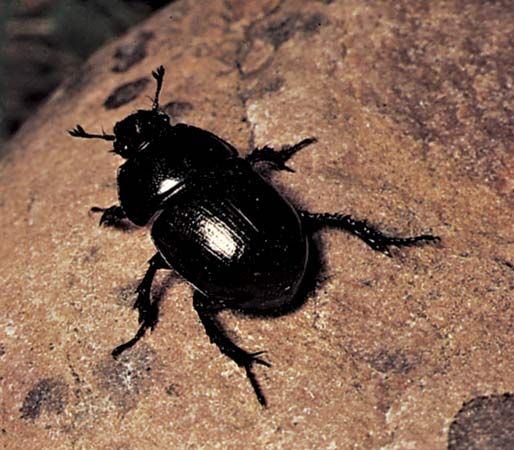
Flower chafers are noted for their often brilliant, iridescent coloration, which makes them popular with insect collectors. While some species possess horns similar to those found in rhinoceros beetles or dung beetles, most flower chafers have only small protuberances on their heads and prothorax.14
Sources
- chafer — Encyclopædia Britannica
- flower chafer — Encyclopædia Britannica
- Coleoptera - Feeding habits and habitats — Encyclopædia Britannica
- scarab beetle — Encyclopædia Britannica
- Metamorphosis — Encyclopædia Britannica
- Coleoptera - General features — Encyclopædia Britannica
- Coleoptera - Larvae — Encyclopædia Britannica
- Cetoniidae — Merriam-Webster
Published on · 3 min read