Fraser River
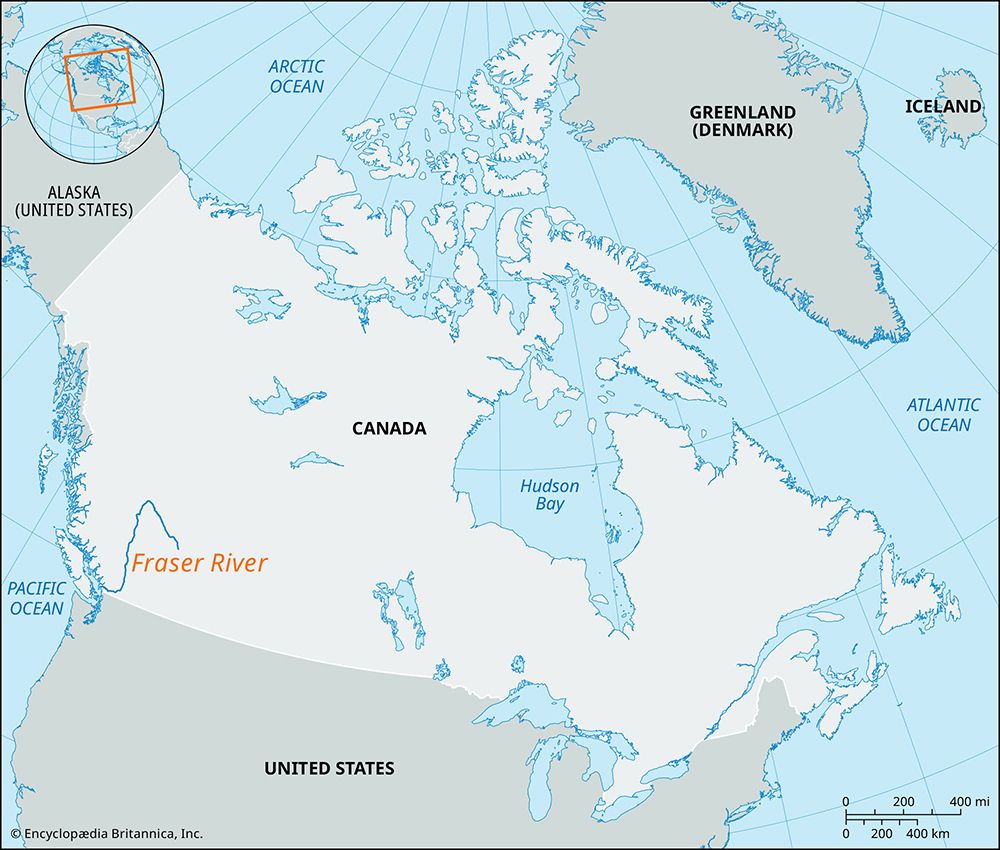
The Fraser River is the primary producer of salmon in British Columbia, serving as a vital habitat for several species. Its tributaries and headwater lakes…
How does the Fraser River contribute to the salmon population and fishing industry in British Columbia?
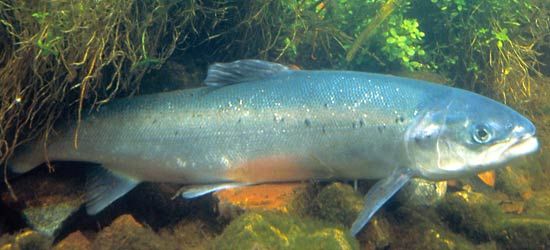
The Fraser River is the primary producer of salmon in British Columbia, serving as a vital habitat for several species. Its tributaries and headwater lakes provide essential spawning grounds where adult salmon return to reproduce after spending years in the ocean.1
This biological cycle directly supports the regional fishing industry. Because salmon migrate to and from the ocean, commercial and sport fishing activities are concentrated primarily off the river’s mouth rather than within the river basin itself, where fishing rights are reserved for Indigenous peoples.12
The health of these salmon populations is a significant environmental and economic concern. While the river remains a major natural resource, the potential for future hydroelectric development poses a threat to salmon migration routes. Protecting these migratory paths is critical, as evidenced by the historical challenges dams have posed to fish populations on other North American rivers, where conservation measures like fish ladders have been necessary to mitigate population declines.13
What role has the Fraser River played in the history and development of British Columbia?
The Fraser River has been a central artery in the history and development of British Columbia, serving as a primary route for exploration, economic expansion, and settlement.
Exploration and Early Trade
Named after the explorer Simon Fraser, who first descended its length to the Pacific Ocean in 1808, the river provided a critical corridor for the fur trade. Early trading posts, such as the one established at McLeod Lake in 1805, relied on the river’s network to penetrate the interior of the region.18
Gold Rushes and Settlement
The river was the catalyst for the province’s transition into a settled society. The 1858 gold strike on the lower Fraser and the subsequent Cariboo gold rush drew thousands of prospectors to the region. This influx transformed the frontier, necessitating the development of transportation networks like the Cariboo Road and steamship links, which eventually formed the foundation for permanent towns and the province’s entry into the Dominion of Canada in 1871.192
Economic and Geographic Significance
Today, the river remains vital to the province:
- Transportation: Its valley serves as a primary corridor for roads, railways, and pipelines, dictating the settlement patterns of the population.6
- Natural Resources: While the river itself is not used for log transport, the basin supports a massive forestry industry.
- Ecology: It is the primary producer of salmon in British Columbia, supporting both ecological health and the regional fishing industry.110
How is the Fraser River used for transportation and commerce in modern times?
In modern times, the Fraser River serves as a critical corridor for commerce and transportation, though its role varies significantly along its course.
Navigation and Shipping
Direct navigation on the river is primarily limited to its tidal estuary. In this lower section, New Westminster functions as a key port capable of accommodating deep-sea ships, facilitating the movement of goods to and from international markets.1
Land-Based Transportation
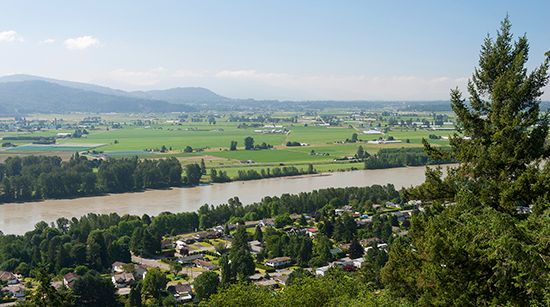
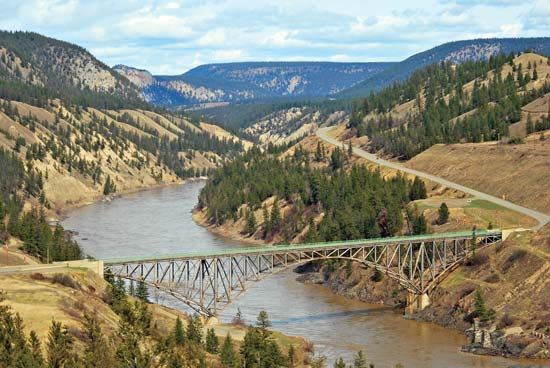
While the river itself is not used for the transport of logs or other bulk commodities, its valley acts as the primary geographic spine for British Columbia’s infrastructure. The river’s route through the Coast Mountains and across the interior plateau dictates the placement of essential transportation networks, including:
- Railways: Major rail lines follow the river’s path, serving as vital conduits for moving forest products and other resources to Vancouver for export or eastward to the rest of Canada and the United States.111
- Roads and Pipelines: Highways, oil, and gas pipelines are constructed in close proximity to the river, utilizing the natural passage it provides through the province’s rugged mountainous terrain.12
What major cities and towns are located along the Fraser River?
Several cities and towns are situated along the Fraser River, serving as vital hubs for transportation, industry, and regional administration. These settlements include:
- Prince George: Located at the confluence of the Nechako and Fraser rivers in central British Columbia, this city serves as a primary focus for the region’s transportation systems and forest industries.1
- Lillooet and Lytton: These communities are situated along the river’s canyon and valley, acting as important service centers within the interior.14
- Hope: Positioned along the Fraser, this town serves as a key service center in the southern part of the province.14
- New Westminster: Located on the river’s estuary, this city is one of western Canada’s busiest ports and a major industrial and marketing center within the Vancouver metropolitan area.1115
- Yale: Historically significant as the terminus of the coach road during the gold rush era, this community played a foundational role in the development of the lower Fraser region.9
Sources
- Fraser River — Encyclopædia Britannica
- British Columbia - Agriculture, forestry, and fishing — Encyclopædia Britannica
- salmon — Encyclopædia Britannica
- British Columbia - History of British Columbia — Encyclopædia Britannica
- Why do salmon die after spawning? — Encyclopædia Britannica
- British Columbia - Manufacturing and services — Encyclopædia Britannica
- dam - Fish passes — Encyclopædia Britannica
- British Columbia - Explorations and trading posts — Encyclopædia Britannica
- British Columbia - Gold rush and permanent settlements — Encyclopædia Britannica
- Cariboo gold rush — Encyclopædia Britannica
- British Columbia - Settlement patterns — Encyclopædia Britannica
- railroad - Canadian railroads — Encyclopædia Britannica
- Strait of Georgia — Encyclopædia Britannica
- New Westminster — Encyclopædia Britannica
- Prince George — Encyclopædia Britannica
Published on · 4 min read