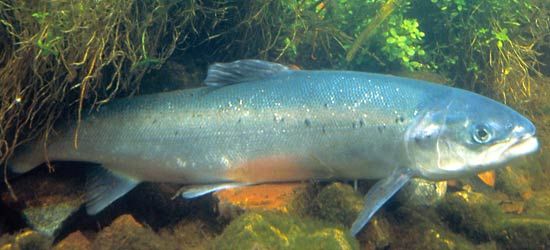
Why Do Salmon Die After Spawning?
Salmon die after spawning due to a biological strategy called semelparity, where an organism exhausts its total energy reserves in a single, massive…
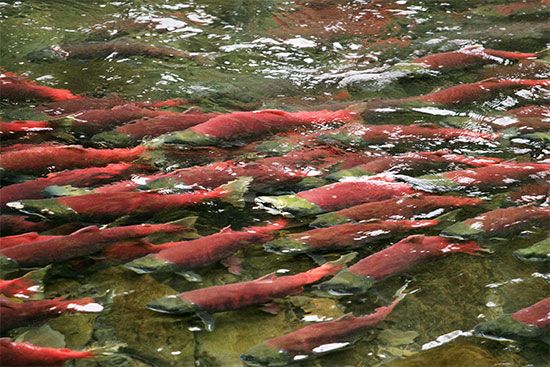
Why do salmon die after spawning?
Salmon die after spawning due to a biological strategy called semelparity, where an organism exhausts its total energy reserves in a single, massive reproductive effort.1
During their migration from the ocean to freshwater spawning grounds, salmon cease eating and rely entirely on stored energy. This energy is consumed by the arduous journey—which can span over 2,000 miles—and the development of secondary sex characteristics, such as the hooked jaws seen in males.1
By the time spawning occurs, these reserves are depleted. The process is further exacerbated by environmental stressors, including changes in water chemistry and temperature. Ultimately, this sacrifice is a natural mechanism that ensures the survival of the next generation.1
What is the difference between semelparity and iteroparity?
The fundamental difference between semelparity and iteroparity lies in the frequency and timing of an organism’s reproductive efforts throughout its life span.2
Semelparity
Semelparous organisms engage in a single, massive reproductive act, typically occurring near the end of their lives. This strategy involves allocating all available energy reserves into this final effort, which is often followed by rapid senescence and death.2
- Examples: Many insects, annual and biennial plants, salmon, and eels.2
- Characteristics: The onset of aging is closely coupled with the completion of reproduction and is often governed by specific, genetically controlled mechanisms.2
Iteroparity
Iteroparous organisms reproduce recurrently over a reproductive span that usually covers a significant portion of their total life. Unlike semelparous species, they do not need to survive to the end of their reproductive phase to be successful, and their senescence is typically gradual.2
- Examples: Most vertebrates, perennial plants, crustaceans, spiders, and mollusks.2
- Characteristics: Senescence manifests early as a decline in reproductive performance, and there is no evidence of specific, systemic initiating mechanisms for death.2
How do salmon navigate back to their original spawning grounds?
Salmon navigate back to their original spawning grounds through a remarkable combination of sensory mechanisms, with olfaction playing the most critical role once they approach their home stream.56
The Role of Olfactory Imprinting
During their early development, young salmon undergo a process of imprinting, where they learn the unique chemical signature of their natal stream. This signature is created by the specific vegetation, substrate, and even the presence of other salmon in the water. While this memory is formed early, the salmon’s sensitivity to these specific odors increases only when they are ready to return to spawn, a process regulated by thyroid and reproductive hormones.5
Long-Distance Navigation
Before reaching their specific stream, salmon must navigate vast distances across the ocean. While the exact mechanisms for this long-range phase are still being studied, researchers believe salmon may utilize:
- Geomagnetic orientation: Using the Earth’s magnetic field to guide their path.57
- Celestial cues: Steering by the position of the Sun.56
- Topographical features: Recognizing large-scale environmental landmarks.6
What role do salmon carcasses play in the forest ecosystem?
Sorry, the Britannica knowledge base does not contain this information.
Sources
- Why do salmon die after spawning? — Encyclopædia Britannica
- Animal - Reproduction and life cycles — Encyclopædia Britannica
- aging - Reproduction and aging — Encyclopædia Britannica
- semelparous — Merriam-Webster
- Chemoreception - Homing — Encyclopædia Britannica
- Migration - Anadromous fish — Encyclopædia Britannica
- Homing — Encyclopædia Britannica
Published on · 2 min read