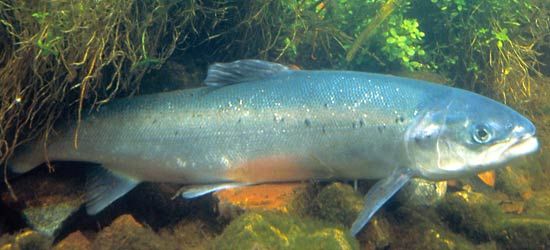
Sockeye Salmon
Sockeye salmon (Oncorhynchus nerka) are native to the North Pacific region. Their natural range extends from the northern Bering Sea to Japan in the west…
Where are sockeye salmon typically found in their natural habitat?
Sockeye salmon (Oncorhynchus nerka) are native to the North Pacific region. Their natural range extends from the northern Bering Sea to Japan in the west, and from Alaska southward to California in the east.12
As anadromous fish, they spend the majority of their lives in the open ocean before migrating over 1,600 km (1,000 miles) upriver to spawn in freshwater lakes or tributary streams. While most sockeye are migratory, there is a nonmigratory freshwater form known as the kokanee (O. nerka kennerlyi) that remains in lakes. During their life cycle, young sockeye typically dwell in freshwater lakes for one to five years before migrating seaward. In North America, they are notably found in river systems such as the Columbia River and the Fraser River.12
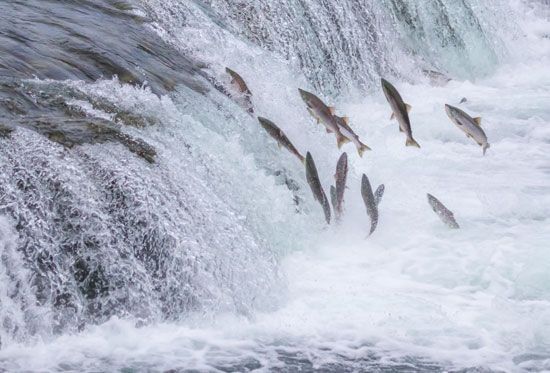
How do sockeye salmon adapt during their migration from saltwater to freshwater?
To successfully migrate from the saltwater of the ocean to freshwater spawning grounds, sockeye salmon (Oncorhynchus nerka) undergo significant physiological and behavioral adaptations.
Osmoregulation
The most critical challenge is managing osmotic pressure, as the salt concentration in the ocean is much higher than in freshwater. To survive this transition, salmon must adjust their osmoregulatory systems. While in the ocean, they actively pump excess salts out through their gills. Upon entering freshwater, they reverse this process, pumping ions in to maintain internal balance and producing large quantities of dilute urine to excrete excess water that diffuses into their bodies. Because this conversion takes time, salmon often linger in brackish estuarine waters to avoid physiological shock.13
Physical and Metabolic Changes
As they transition to freshwater, sockeye salmon undergo striking external transformations:
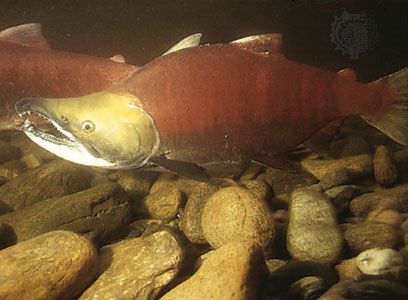
- Coloration: They shift from a silvery-blue ocean appearance to a distinct red body with a greenish head.4
- Secondary Sex Characteristics: Males develop hooked jaws, which are used to compete for mates.25
- Metabolism: Once they enter freshwater, sockeye salmon stop feeding entirely, relying exclusively on stored energy reserves to fuel their arduous upstream journey and the physical demands of spawning.5
What is the life cycle of a sockeye salmon, from egg to adult?
The life cycle of the sockeye salmon (Oncorhynchus nerka) is a complex journey that transitions between freshwater and marine environments.
- Spawning: Adult sockeye return from the ocean to the specific freshwater stream or lake where they were hatched. The female digs a pit in the gravel, and she and a male release eggs and milt simultaneously. The female then covers the eggs with gravel to protect them. Adult Pacific salmon die shortly after this process.2
- Incubation and Hatching: Eggs typically hatch in late winter, with incubation taking between 60 and 200 days depending on water temperature.2
- Fry Stage: After hatching, the young salmon, or fry, remain in the gravel while consuming the yolk from their attached sac. Once the yolk is absorbed, they emerge to seek food.2
- Freshwater Residency: Unlike some other salmon species that migrate to the sea quickly, young sockeye typically dwell in freshwater lakes for one to five years before migrating seaward.21
- Ocean Life: Sockeye spend the majority of their lives in the open ocean, where they grow to maturity.2
- Return Migration: Guided by Earth’s magnetic field and their sense of smell, mature adults navigate back to their home streams to spawn, completing the cycle.21
How do sockeye salmon navigate back to their natal streams for spawning?
Sockeye salmon (Oncorhynchus nerka) utilize a sophisticated, multi-stage navigation system to return from the open ocean to their natal streams for spawning.
Oceanic Navigation
While the exact mechanisms for long-distance travel from the open ocean remain a subject of ongoing research, it is widely accepted that sockeye salmon navigate by sensing differences in Earth’s magnetic field. This geomagnetic orientation allows them to traverse thousands of kilometers to reach the general vicinity of their home river systems.93110
Riverine Navigation
Once the salmon enter their specific river drainage, they transition to using their highly developed sense of smell, or olfaction, to pinpoint their original spawning grounds. This process relies on imprinting, where the young salmon learn the unique chemical signature of their home stream—derived from local substrate, vegetation, and other salmon populations—during their early development.9101112
As the adult salmon prepare to spawn, hormonal changes increase the sensitivity of their olfactory receptors, enabling them to detect and follow these specific chemical cues back to the exact location where they hatched.1110
Sources
- sockeye salmon — Encyclopædia Britannica
- salmon — Encyclopædia Britannica
- Migration - Anadromous fish — Encyclopædia Britannica
- clupeiform - Physiology — Encyclopædia Britannica
- Biosphere - Salinity — Encyclopædia Britannica
- sockeye salmon — Merriam-Webster
- Why do salmon die after spawning? — Encyclopædia Britannica
- protacanthopterygian - Life cycle and reproduction — Encyclopædia Britannica
- Chemoreception - Homing — Encyclopædia Britannica
- Homing — Encyclopædia Britannica
- protacanthopterygian - Behaviour and locomotion — Encyclopædia Britannica
Published on · 4 min read