Gallinule
Gallinules are marsh birds belonging to the rail family (Rallidae). They are found in temperate, tropical, and subtropical regions worldwide, characterized…
What are the different species of gallinules found around the world?
Gallinules are marsh birds belonging to the rail family (Rallidae). They are found in temperate, tropical, and subtropical regions worldwide, characterized by their compressed bodies, long toes for traversing floating vegetation, and a prominent frontal shield on the forehead.1
Key species and groups include:
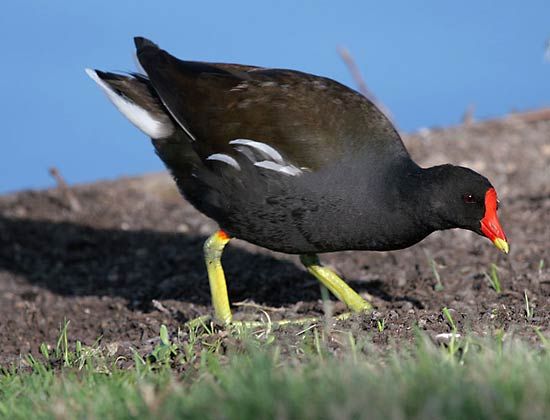
- Common Gallinule (Gallinula chloropus): Also known as the moorhen or water hen, this blackish bird with a scarlet shield is found in Europe and Africa. Its North American race is sometimes called the Florida gallinule.1
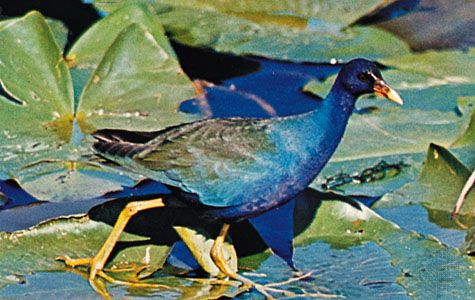
- American Purple Gallinule (Porphyrula martinica): A bright olive green and purplish-blue bird with a light blue shield, found from the United States to Argentina.1
- Lesser Purple Gallinule (P. alleni): A related species native to Africa.1
- Purple Swamphen (Porphyrio porphyrio): A larger species (about 45 cm) distributed across the Mediterranean, Africa, southern Asia, and Australia. The genus Porphyrio also includes the takahe, a nearly extinct flightless bird](https://www.britannica.com/animal/takahe), a nearly extinct flightless bird.12
What are the feeding habits and diet of gallinules?
It is important to clarify that gallinules are members of the order Gruiformes and should not be confused with galliforms (such as pheasants or quail), which belong to a different taxonomic order with distinct dietary habits.45
Gallinules are generally omnivorous, though their diet consists largely of aquatic vegetation. Their feeding habits are well-adapted to their marshy environments:1
- Vegetation: They consume a significant amount of water plants. For example, the purple swamphen is primarily vegetarian; it often utilizes a feeding platform to pull up surrounding aquatic plants and will climb reeds to reach and consume flower heads.1
- Animal Matter: Like other members of the rail family, they also incorporate animal matter into their diet, including small marsh animals such as snails, crustaceans, frogs, and various water insects.1
While they share the omnivorous nature of the broader rail group, their specific reliance on aquatic vegetation distinguishes them from many of their relatives that focus more heavily on animal prey.1
How do gallinules reproduce and care for their young?
Gallinules, which belong to the order Gruiformes, exhibit specific reproductive behaviors adapted to their marshy habitats.
Nesting and Incubation
Gallinules typically construct simple nests made of grass and aquatic plants. These are often situated in thick tufts of vegetation, where the birds pull down surrounding blades to conceal the nest from predators. While clutch sizes in the order generally vary, some gallinules and coots have been recorded with exceptional clutches of 15 to 20 eggs; such large numbers may result from multiple females laying eggs in the same nest. The eggs are usually white, buff, or pale green, often marked with brown spots or blotches. Incubation typically lasts about three weeks, and in most families within this order, both parents share the responsibility of incubating the eggs.
Care of the Young
Upon hatching, young gallinules are covered in down—typically plain black in the case of rails—and are highly mobile, often leaving the nest immediately or very shortly after hatching. Both parents generally participate in the care and protection of the chicks. This cooperative parental involvement is a standard trait for most gruiform families, ensuring the survival of the precocious young in their wetland environments.6
How do gallinules differ from other members of the rail family?
While gallinules are members of the rail family, they differ from other rails in several distinct ways:
- Behavior and Temperament: Gallinules are notably more ostentatious, noisy, and inquisitive than other rails. While most rails are secretive birds that hide among reeds and are rarely seen, gallinules are less furtive and often swim in open water or waddle conspicuously on shore, behaving more like ducks in their flocking habits.12
- Physical Characteristics: Gallinules possess a prominent frontal shield—a fleshy plate located on the forehead—which is not a feature of typical rails. Additionally, many gallinule species exhibit brightly colored plumage or skin, whereas most rails are characterized by duller, camouflaging colors in shades of gray and brown, often featuring irregular barred patterns.12
- Adaptations: Like other members of the Rallidae family, gallinules have long, thin toes that allow them to traverse floating vegetation. However, their tendency to occupy open water environments distinguishes them from the more reclusive, reed-dwelling rails.12
Sources
- Gallinule — Encyclopædia Britannica
- Rail — Encyclopædia Britannica
- Porphyrio — Merriam-Webster
- Galliform - Habitat selection and food habits — Encyclopædia Britannica
- Gruiform - Food habits — Encyclopædia Britannica
- Charadriiform - Shorebirds (suborder Charadrii) — Encyclopædia Britannica
- Galliform - Nesting — Encyclopædia Britannica
- Galliform - Care of the young — Encyclopædia Britannica
- Gruiform - Nesting — Encyclopædia Britannica
- Gruiform - Annotated classification — Encyclopædia Britannica
- gallinule — Merriam-Webster
Published on · 3 min read