Garter Snake
Garter snakes, belonging to the genus Thamnophis, are a group of approximately 35 species of nonvenomous, small to moderate-sized snakes native to North…
What are the defining characteristics of garter snakes?
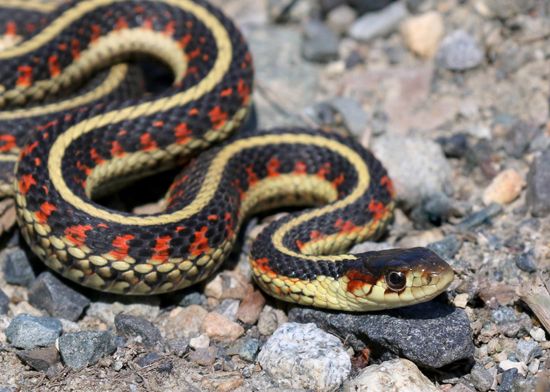
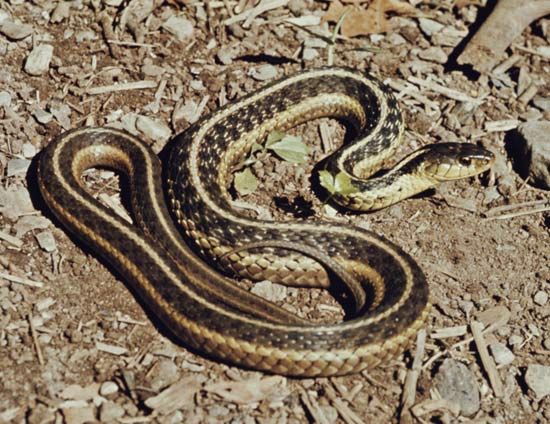
Garter snakes, belonging to the genus Thamnophis, are a group of approximately 35 species of nonvenomous, small to moderate-sized snakes native to North America. They are widely recognized by their distinct longitudinal stripes—typically one to three yellow or red lines—often accompanied by checkered blotches.12
Key characteristics of garter snakes include:
- Size and Temperament: They are generally harmless and typically measure less than 100 cm (39 inches) in length. When handled, they may strike or discharge a foul-smelling secretion from their anal glands.1
- Reproduction: Unlike many other snakes, garter snakes are viviparous, meaning they do not lay eggs but instead give birth to live young, usually in late summer.12
- Diet: They are primarily predators that feed on insects, earthworms, and amphibians, such as frogs.1
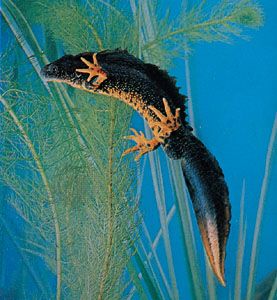
- Unique Physiology: While they are nonvenomous, they are sometimes described as “poisonous” in a specific context: they can absorb and store toxins from the poisonous prey they consume, such as newts and salamanders.3
Where are garter snakes typically found in the wild?
Garter snakes of the genus Thamnophis are widely distributed across North America, ranging from Canada down to Central America. They are considered the most common serpent in many of these regions.1
Their geographic range is extensive, with some species found as far north as 55° N latitude in western Canada. While they are present throughout the continent, their distribution varies by region:5
- Western North America: This region, including areas like California’s Central Valley, contains a higher diversity of garter snake species compared to the eastern United States.15
- Eastern North America: While garter snakes are present, this region generally hosts a higher number of other snake species, such as water snakes, rather than a high concentration of garter snake varieties.5
Specific populations, such as the giant garter snake, are localized to specific habitats like California’s Central Valley, while others are found in central Mexico.1
Are there any species of garter snakes that are endangered or threatened?
While most of the approximately 35 species of garter snakes are classified as species of least concern by the International Union for Conservation of Nature (IUCN), some populations face significant conservation challenges.1
As of 2020, the IUCN has identified four species that are considered threatened:1
- Vulnerable Species: The giant garter snake (Thamnophis gigas), native to California’s Central Valley, and Thamnophis saliger of central Mexico are both classified as vulnerable.1
- Endangered Species: Two species found in central Mexico, Thamnophis mendax and Thamnophis melanogaster, are classified as endangered species.1
These classifications highlight the importance of protecting specific regional habitats to ensure the survival of these unique reptiles.1
What are some common misconceptions about garter snakes?
Garter snakes are often misunderstood, leading to several common misconceptions regarding their nature and biology:
- “Poisonous” vs. Venomous: A frequent error is labeling snakes as “poisonous.” Technically, a poisonous animal is one that is toxic when consumed. While most snakes are not poisonous, the garter snake is a rare exception; it can absorb and store toxins from the newts and salamanders it eats, making the snake itself poisonous to predators.1
- Aggression: Like many snakes, garter snakes are often perceived as dangerous or aggressive. In reality, they are nonvenomous and generally harmless to humans. If handled, they may struggle, strike, or release a foul-smelling secretion from their anal glands as a defensive measure, but they do not actively hunt or attack people.26
- Reproduction: There is a common assumption that all snakes lay eggs. Unlike many other species, garter snakes are ovoviviparous; they do not lay eggs but instead retain them in the oviduct until the young are ready to be born live.27
Sources
- garter snake — Encyclopædia Britannica
- snake - Snakes and humans — Encyclopædia Britannica
- garter snake — Merriam-Webster
- snake - Mating — Encyclopædia Britannica
- reptile - North temperate zone — Encyclopædia Britannica
- snake - Egg formation and laying — Encyclopædia Britannica
- reptile - Odours — Encyclopædia Britannica
Published on · 3 min read