Salamander
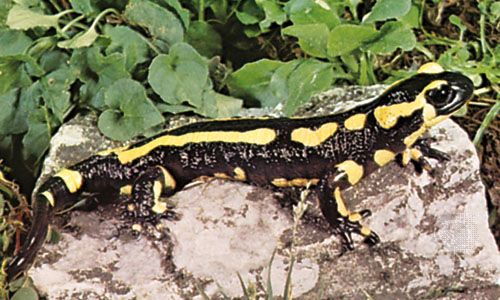
Salamanders (order Caudata) are distinguished from other amphibians—anurans (frogs and toads) and caecilians—primarily by their body plan. Most salamanders…
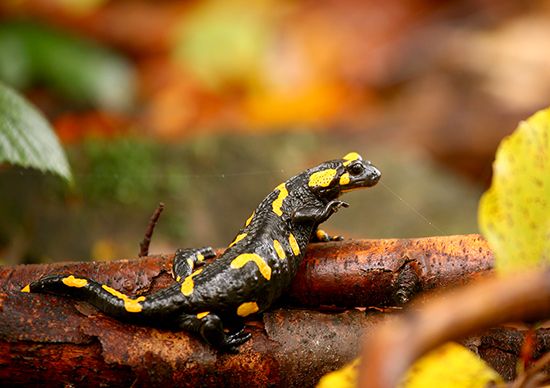
What are the main characteristics that distinguish salamanders from other amphibians?
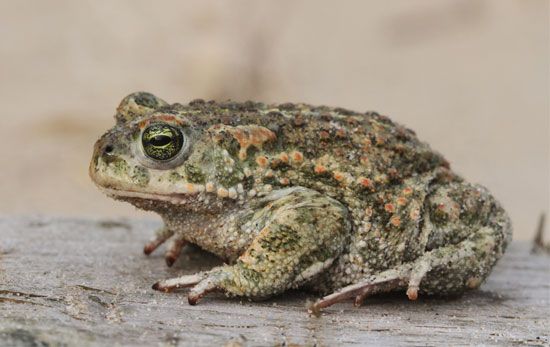
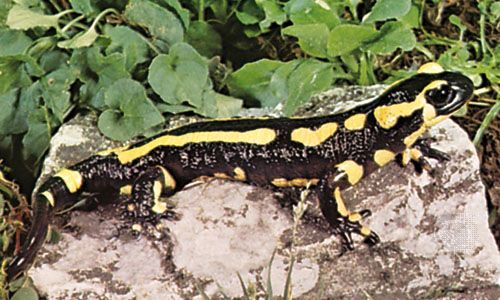
Salamanders (order Caudata) are distinguished from other amphibians—anurans (frogs and toads) and caecilians—primarily by their body plan. Most salamanders possess a long tail and two pairs of limbs of roughly equal size, a morphology that is less specialized than that of their relatives.123
Key structural and functional differences include:
- Skeletal Structure: Unlike other amphibians, most terrestrial salamanders have skulls with an extra set of articulations with the vertebral column, which helps stabilize the head.1
- Locomotion: They generally utilize a generalized, methodical walking gait, whereas anurans are specialized for leaping and caecilians are adapted for burrowing.13
- Sensory Adaptations: Because they do not rely on vocalization, their auditory apparatus is less specialized than that of anurans.1
- Feeding: They use a hyoid apparatus to project their tongues to capture prey, a mechanism that does not require the highly specialized jaw muscles or teeth found in other groups.1
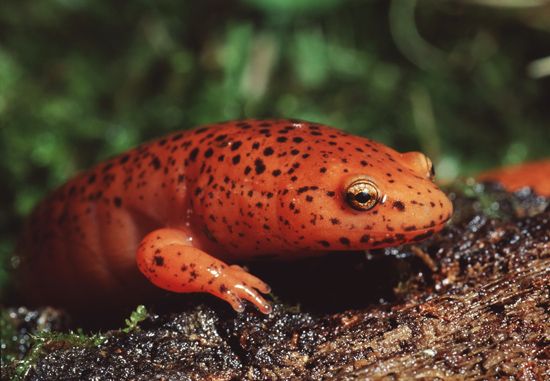
What are some of the most common habitats where salamanders can be found?
Salamanders are primarily found in the Northern Hemisphere, where they thrive in cool, moist environments. Because they absorb water through their skin, they are highly dependent on habitats that remain sufficiently damp to prevent dehydration.267
Common habitats for these amphibians include:
- Forests and Woodlands: Many species inhabit the floors of forests, where they find refuge under fallen logs, rocks, leaf litter, and within soil crevices.289
- Aquatic Environments: Numerous species frequent freshwater habitats, including ponds, rivers, slow-moving streams, springs, and swamps. Some species are entirely aquatic throughout their lives, while others are semiaquatic.21078
- Subterranean and Specialized Sites: Salamanders often utilize caves or underground burrows during dry or cold periods. Some species are arboreal, living in trees or within moisture-retaining plants like bromeliads.87
- Diverse Tropical and Alpine Regions: While most common in temperate zones, some lungless salamanders (Plethodontidae) have successfully adapted to tropical cloud forests, high-altitude alpine areas, and even desertlike environments where they occupy rock crevices.768
How do salamanders reproduce and what is unique about their life cycle?
Salamander reproduction and life cycles are remarkably diverse, ranging from external fertilization in primitive species to complex internal processes and even live birth in others.
Reproduction
In primitive families like Cryptobranchoidea, fertilization is external; females deposit eggs that males then fertilize with milt. Most other salamanders utilize internal fertilization, often involving a spermatophore—a sperm-containing capsule deposited by the male. The female takes this mass into her cloaca for fertilization. While many species breed in water, others, particularly in the family Plethodontidae, breed on land, sometimes storing sperm for months before laying eggs.27
Life Cycle and Metamorphosis
Most salamanders pass through an aquatic larval stage characterized by external gills and a lack of eyelids. Through metamorphosis, they transition to a terrestrial form, losing their gills and developing structures like eyelids and a projectile tongue.27
Unique variations include:
- Paedomorphosis: Some species, such as the axolotl and mud puppy, retain larval features like gills throughout their adult lives and breed in this state.27
- Direct Development: Plethodontids often bypass the aquatic larval stage entirely, with hatchlings emerging as miniature versions of adults.7
- Viviparity: A few species, such as the alpine salamander, are the only members of the order to bear live young, with larvae developing inside the mother’s reproductive tract.7
How do salamanders breathe and how does this change throughout their life?
Salamanders utilize a variety of respiratory strategies that shift significantly throughout their life cycles, primarily relying on their skin, gills, and lungs to exchange gases.1112
Larval Respiration
Most salamanders begin life as aquatic larvae, breathing primarily through external gills and their thin, gas-permeable skin. This cutaneous respiration allows for the diffusion of oxygen and carbon dioxide directly between the animal and its environment.1112
Metamorphosis and Adult Respiration
As larvae undergo metamorphosis, they typically experience a transition in their respiratory anatomy:6
- Lung Development: In many species, the gills are resorbed and gill slits close as paired lungs develop. Adults then use a buccal pumping mechanism—a mouth-throat movement—to draw air into their lungs.61112
- Cutaneous Respiration: Regardless of whether they develop lungs, the skin remains a vital respiratory organ for almost all adult salamanders, often serving as the primary site for carbon dioxide elimination.1112
Notable Exceptions
- Paedomorphosis: Some species, such as the axolotl, retain larval gills throughout their entire lives, even if they develop lungs.1113
- Lungless Salamanders: Members of the family Plethodontidae lose their gills during development but never grow lungs. These species rely entirely on cutaneous respiration through their skin and the mucous membranes of their mouth and throat.11712
Sources
- amphibian - Salamanders — Encyclopædia Britannica
- salamander — Encyclopædia Britannica
- amphibian — Encyclopædia Britannica
- amphibian - Reproduction — Encyclopædia Britannica
- amphibian - Size range and diversity of structure — Encyclopædia Britannica
- lungless salamander — Encyclopædia Britannica
- Caudata - Life cycle and reproduction — Encyclopædia Britannica
- amphibian - Distribution and abundance — Encyclopædia Britannica
- Caudata - Behaviour and ecology — Encyclopædia Britannica
- Caudata - Distribution and abundance — Encyclopædia Britannica
- amphibian - Metamorphosis — Encyclopædia Britannica
- Respiratory system - Amphibians — Encyclopædia Britannica
- amphibian - Common features — Encyclopædia Britannica
Published on · 4 min read