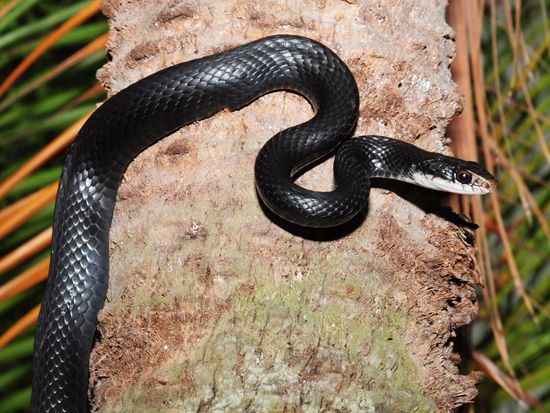
Colubrid
Colubrids, members of the family Colubridae, represent the most common group of snakes, accounting for approximately two-thirds of all known species. They…
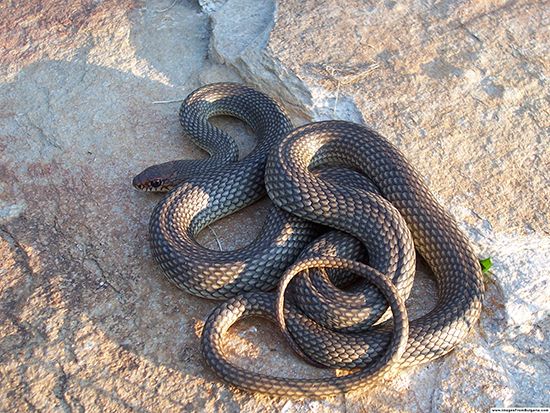
What are the main characteristics of colubrid snakes that distinguish them from other snake families?
Colubrids, members of the family Colubridae, represent the most common group of snakes, accounting for approximately two-thirds of all known species. They are distinguished by several specific anatomical characteristics:
- Skeletal Structure: They completely lack hind limbs and typically possess a loose facial structure with relatively few head scales. Their ventral scales are as wide as their bodies.
- Internal Anatomy: Colubrids are characterized by the absence or significant reduction of the left lung.
- Dentition: They lack teeth on the premaxilla. While most species have solid, conical teeth, some possess grooved teeth at the rear of the upper jaw to deliver venom, and a few species feature short, erect fangs in the front of the mouth.
- Specialized Adaptations: Certain subfamilies, such as the Dipsadinae and Pareatinae, exhibit unique jaw modifications where the connection between the upper jaw and the quadrate is lost, allowing for independent movement of four jaw units to facilitate feeding on slugs and snails.
Most colubrids lay eggs, though some aquatic forms are live-bearing.
How widespread are colubrid snakes, and in which regions can they be found?
Colubrid snakes are the most widespread family of snakes in the world, comprising approximately 1,760 species—about two-thirds of all known snake species. They are incredibly adaptable and occur in virtually all habitats, ranging from forests and grasslands to deserts and aquatic environments.13
Regarding their global distribution, colubrids are found on every continent except Antarctica. While they are highly diverse and common in many parts of the world, their presence varies by region:4
- North America and Eurasia: Colubrids are common in these regions, particularly south of 40° N latitude.5
- Australia: The family is poorly represented in Australia, with fewer than a dozen species present.6
- Tropics: They are highly diverse in tropical regions, where they occupy various ecological niches.7
Because they are so successful at colonizing diverse environments, colubrids remain the most dominant group of snakes globally.1
What are some common examples of colubrid snakes that people might encounter?
The family Colubridae is incredibly diverse, encompassing a wide range of snakes that people may encounter in various environments, from gardens to forests. Because they make up about two-thirds of all snake species, many common snakes fall into this category.1
Some notable examples include:
- Garden and Household Snakes: Many familiar, harmless snakes belong to this family, such as the garter snake, green snake, and ring-necked snake.89
- Rat and King Snakes: The black rat snake, bull snake, and king snake are well-known members often found in North America.8
- Large and Unique Species: The indigo snake is notable for being the largest snake in the United States. Other specialized types include the hognose snake, racer, and water snake.108
- Arboreal Snakes: Many tree snakes, such as flying snakes and vine snakes, are colubrids adapted for life in the branches.811
While most colubrids are harmless to humans, some species possess rear-fanged venom delivery systems, such as the boomslang and mangrove snake.18
Are there any venomous species within the colubrid family, and if so, how dangerous are they to humans?
Yes, there are venomous species within the colubrid family. While most colubrids possess solid, conical teeth and are harmless to humans, some species have grooved teeth at the rear of the upper jaw that produce venom capable of inducing paralysis. A few species even possess short, erect fangs in the front of the mouth.1
For the majority of venomous colubrid species, a bite that does not involve prolonged chewing is rarely harmful to humans. However, there are notable exceptions. Certain species with fangs can deliver a bite that is dangerous or even fatal. A primary example is the boomslang, a rear-fanged snake found in sub-Saharan Africa. Its venom causes severe hemorrhaging and can be fatal to humans even in small amounts.112
It is important to note that snakes generally use their venom for hunting and are often reluctant to waste it on non-prey organisms. Many bites suffered by humans are defensive and may be “dry,” meaning no venom is injected.13
Sources
- colubrid — Encyclopædia Britannica
- snake - Skull and sense organs — Encyclopædia Britannica
- cat snake — Encyclopædia Britannica
- reptile - Distribution and ecology — Encyclopædia Britannica
- reptile - Australia — Encyclopædia Britannica
- snake - Natural history — Encyclopædia Britannica
- reptile - North temperate zone — Encyclopædia Britannica
- List of snakes — Encyclopædia Britannica
- tree snake — Encyclopædia Britannica
- indigo snake — Encyclopædia Britannica
- green snake — Encyclopædia Britannica
- boomslang — Encyclopædia Britannica
- snake - Snakes and humans — Encyclopædia Britannica
Published on · 3 min read