Gayal
The gayal (Bos gaurus frontalis), a large bovine subspecies, plays a significant role in the livelihoods of hill tribes in Assam and Myanmar. Unlike typical…
What role do gayals play in the cultural practices of indigenous people in their native regions?
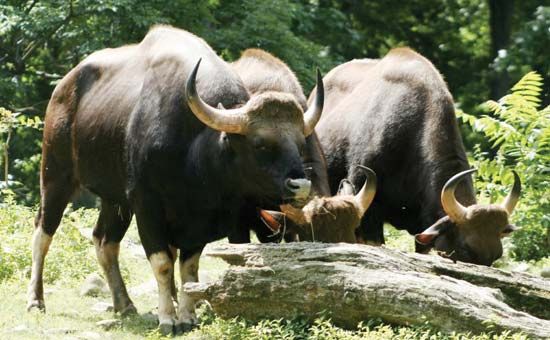
The gayal (Bos gaurus frontalis), a large bovine subspecies, plays a significant role in the livelihoods of hill tribes in Assam and Myanmar. Unlike typical livestock, gayals are not herded in the traditional sense; instead, they exist in a state of self-domestication, foraging in forest clearings near human settlements and returning to these areas at night for protection from predators like tigers.
Indigenous keepers facilitate this arrangement by providing salt, which attracts the animals to the vicinity of villages. Through this process, the gayal has become an essential resource for these communities, serving as a source of food and a commodity for trade. While they are closely related to the wild gaur, their integration into the daily lives of these tribes is a unique example of human-animal interaction where the animals maintain their natural social and mating behaviors while living in close proximity to human populations.
How has the gayal been domesticated and what are its primary uses?
The gayal (Bos gaurus frontalis) is not domesticated through traditional herding methods; rather, it undergoes a process of self-domestication. This unique relationship began as hill tribes in Assam and Myanmar created forest clearings for agriculture, which attracted wild gaurs seeking food.1
These animals found that staying near human settlements provided protection from predators like tigers and access to water predators like tigers and access to water. Keepers further encouraged this proximity by providing salt, a vital dietary component for cattle. Over time, the animals lost their fear of humans, reaching a stage where they could be utilized by the community while maintaining their natural social and mating behaviors.1
The primary uses of the gayal include:
- Food: They serve as a significant source of sustenance for the local tribes.1
- Trade: They function as a valuable commodity for commerce.1
- Breeding: Keepers often promote mating between gayal cows and wild gaur bulls to improve the breed.1
What are the physical characteristics and size of a typical gayal?
The gayal (Bos gaurus frontalis) is a large bovine characterized by several distinct physical features that differentiate it from its wild progenitor, the gaur.
Physical Characteristics
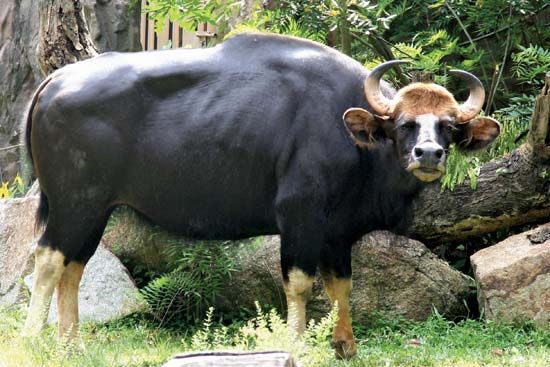
- Stature: The gayal is smaller than the gaur and possesses shorter legs. It stands between 140–160 cm (55–63 inches) at the shoulder.1
- Skull and Horns: Its skull is notably shorter, wider, and flatter than that of the gaur. The horns, present in both sexes, protrude from the sides of the head; they are thicker but shorter than those found on the gaur.1
- Body Features: The gayal lacks the massive shoulder hump characteristic of the gaur. It features a well-developed double dewlap at the chin and throat.1
- Coloration: Bulls are typically black, while females are brown-black. Both sexes display distinctive white stockings. Due to hybridization with cattle, some individuals may appear piebald or white.1
Size
- Weight: Bulls can reach weights of up to one ton, which is 20–25 percent heavier than the cows.1
How are gayals related to other members of the genus Bos?
The gayal (Bos gaurus frontalis) is classified as a subspecies of the gaur, placing it firmly within the genus Bos, which encompasses various wild and domestic cattle.15
The relationship between the gayal and the gaur is evidenced by several biological and behavioral traits:
- Genetic Linkage: The two are so closely related that keepers often encourage the mating of gayal cows with wild gaur bulls to improve the breed.1
- Vocalization: The mating call of the bull gayal is identical to that of the gaur, described as a loud, resonant sound similar to the bass notes of an organ—a trait distinct from other members of the genus Bos.1
- Social Behavior: The gayal retains the same social organization and mating systems as its wild progenitor.1
While the gayal is sometimes referred to by the synonym Bibos frontalis in certain classifications, it remains a member of the subfamily Bovinae, sharing the characteristic stout body and laterally curved horns typical of the genus.165
Sources
- gayal — Encyclopædia Britannica
- pastoral communities in India — Encyclopædia Britannica
- sacrifice - Religions of India — Encyclopædia Britannica
- sacrifice - Blood offerings — Encyclopædia Britannica
- gayal — Merriam-Webster
- Bos — Merriam-Webster
Published on · 3 min read