Geum River
The Geum River is one of the three principal rivers in South Korea, stretching 249 miles (401 km) through the southwestern part of the country.
What is Geum River?
The Geum River is one of the three principal rivers in South Korea, stretching 249 miles (401 km) through the southwestern part of the country.12
Rising east of Jeonju in North Jeolla province, the river flows north-northwest through North Chungcheong before turning southwest to empty into the Yellow Sea at Gunsan. The river is navigable for 81 miles (130 km) up to the city of Buyeo and flows through a region characterized by fertile plains and gold deposits.1
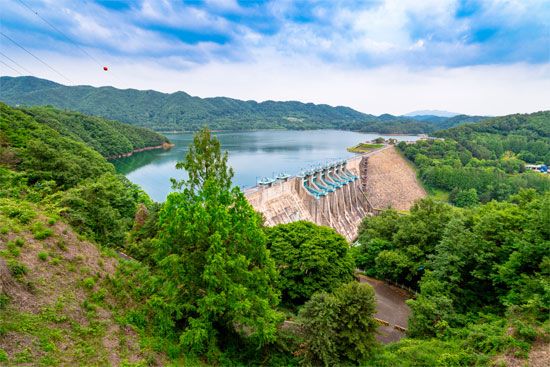
Infrastructure on the river includes the Daecheong multipurpose dam, completed in 1980, which provides electricity and water to cities along its middle course, such as Cheongju. Like other major rivers in the region, its flow is significantly influenced by seasonal rainfall, peaking during the wet summer months.12
What are the other two major rivers in South Korea?
In addition to the Geum River, the other two principal rivers in South Korea are the Han River and the Nakdong River.2
- Han River: Stretching 319 miles (514 km), this river rises in the Taebaek Mountains and flows westward through Seoul to the Yellow Sea. It has served as a vital transportation route for centuries and currently provides essential water for industrial and general use, as well as hydroelectric power.23
- Nakdong River: As South Korea’s longest river at 325 miles (523 km), it flows southward from the Taebaek Mountains to the Korea Strait. It is navigable for 215 miles and supports a significant drainage basin used for crop cultivation and urban water supply.24
All three rivers originate in the Taebaek Mountains and are characterized by highly variable streamflow that peaks during the wet summer months.2
How does the Daecheong Dam impact the local environment?
The Daecheong Dam, completed in 1980, functions as a multipurpose facility on a branch of the Geum River. Its primary impact on the local environment and surrounding region is the regulation of water resources, as it provides a consistent supply of water to cities located along the river’s middle course, including Cheongju, Nonsan, and Ganggyeong.1
Beyond water management, the dam serves as a source of hydroelectric power for these urban areas, supporting regional infrastructure. While the provided information highlights these utility-based impacts, the construction of such large-scale dams typically alters local ecosystems by changing river flow patterns and sediment transport.1
We could dive deeper into the broader ecological consequences of dam construction or explore how other major dams in South Korea compare to the Daecheong facility.
What role do the Taebaek Mountains play in South Korea’s geography?
The Taebaek Mountains serve as the primary geographical backbone of the Korean Peninsula, stretching approximately 300 miles (500 km) along the eastern coast. Their role in South Korea’s geography is multifaceted:
- Hydrological Source: The range acts as the vital headwaters for South Korea’s most significant rivers, including the Han, Nakdong, and Geum rivers, which are essential for the nation’s water supply and agriculture.5
- Topographical Influence: The mountains create a distinct landscape, featuring a steep fault line that drops sharply toward the East Sea (Sea of Japan) to the east, while the western side slopes into a gentle incline with various mountain spurs, such as the Sobaek range, extending southwest.5
- Climate and Precipitation: The range significantly influences regional weather patterns, receiving the heaviest snowfall in South Korea during the winter months.6
- Natural Resources: The mountains are rich in mineral deposits, including iron, coal, tungsten, fluorite, and limestone, and support extensive forest ecosystems.5
Sources
- Geum River — Encyclopædia Britannica
- South Korea - Drainage — Encyclopædia Britannica
- Han River — Encyclopædia Britannica
- Nakdong River — Encyclopædia Britannica
- Taebaek Mountains — Encyclopædia Britannica
- South Korea - Climate — Encyclopædia Britannica
Published on · 3 min read