Glacial Valley
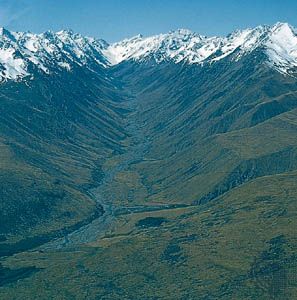
A glacial valley is a stream valley that has been reshaped by the movement of a glacier, typically resulting in a characteristic U-shaped cross-section.
What is a glacial valley and how is it formed?
A glacial valley is a stream valley that has been reshaped by the movement of a glacier, typically resulting in a characteristic U-shaped cross-section.12
Formation Process
Glaciers transform V-shaped river valleys into U-shaped troughs through several mechanisms:
- Erosion: Unlike rivers, which erode a narrow line, glaciers are in contact with a large portion of the valley’s cross-section. They remove loose debris and aggressively erode the bedrock along the base and lower sidewalls to minimize frictional resistance.12
- Smoothing: Because glaciers have high viscosity and a large cross-section, their paths are straighter and smoother than those of rivers, which tend to have more frequent bends.1
- Deepening: The depth of the erosion is largely determined by ice thickness. Smaller tributary glaciers erode their paths less rapidly than the main glacier, leaving them as hanging valleys high above the main valley floor once the ice melts.1
These valleys often feature steep, vertical walls and may contain till or moraines on the valley floor.12
How do glacial valleys differ from river valleys?
Glacial valleys and river valleys differ significantly in their formation, shape, and overall morphology. While most valleys are created by the rivers that flow through them, glacial valleys are formed through the transformation of existing stream valleys by the movement of glaciers.15
Key Differences
- Cross-Sectional Shape: River valleys typically exhibit a V-shaped profile, as the river erodes a narrow line along the valley bottom. In contrast, glacial valleys are characterized by a U-shaped (or catenary) cross-section. This shape occurs because a glacier, having much greater viscosity and a larger cross-section than a river, erodes the valley floor and sidewalls simultaneously to minimize frictional resistance.1
- Path and Alignment: Because glaciers are massive and move with high viscosity, their paths are generally straighter and smoother, featuring fewer and broader bends compared to the more frequent, tighter bends found in river-carved valleys.1
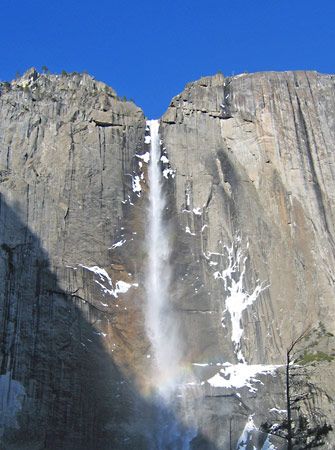
- Tributary Junctions: In glacial landscapes, smaller tributary glaciers erode their troughs less rapidly than the main glacier. When the ice melts, these tributaries are left as hanging valleys high above the main valley floor, often resulting in waterfalls.1
- Erosional Features: Glacial valley walls may be nearly vertical and often feature striations from boulders dragged by the ice. The valley floors are frequently covered with till or moraines, whereas river valleys are typically dominated by floodplains and terraces.16
How do hanging valleys relate to glacial valleys?
Hanging valleys are a direct consequence of the differential erosion that occurs within glacier systems. Large trunk glaciers possess significantly greater ice discharge and erosive capability than the smaller tributary glaciers that feed into them.1213
As the main glacier moves, it deepens and widens the trunk valley much more rapidly than the tributary glaciers can erode their own paths. Over time, the floor of the main valley is carved to a much lower elevation than the floors of the tributary valleys.1213
When the ice eventually retreats, these tributary valleys are left “hanging” high above the floor of the main U-shaped valley. This creates a discordant junction where the tributary valley meets the main valley wall at a substantial height. Consequently, postglacial streams flowing from these hanging valleys often cascade down the steep walls of the main valley, forming waterfalls, such as those famously seen in Yosemite National Park.1213
What are the distinctive features of a U-shaped glacial valley?
A U-shaped glacial valley, or glacial trough, is a distinctive landform created when a glacier reshapes a pre-existing stream valley. These valleys are characterized by several unique features:
- Catenary Cross-Section: Unlike the V-shaped profile of river valleys, glacial valleys exhibit a U-shaped or parabolic cross-section. This occurs because the glacier, having high viscosity and a large cross-section, erodes the valley floor and sidewalls simultaneously to minimize frictional resistance.12
- Straight and Smooth Path: Due to the massive size and movement of glaciers, their courses feature fewer and broader bends than those of rivers, resulting in a straighter, smoother valley alignment.1
- Vertical Walls and Floor Deposits: The valley walls are often nearly vertical and may show striations from boulders dragged by the ice. The valley floor is frequently covered with till or moraines.114
- Hanging Valleys: Because smaller tributary glaciers erode their troughs less rapidly than the main glacier, they are left as hanging valleys high on the main valley walls once the ice melts, often creating waterfalls.1
Sources
- glacial valley — Encyclopædia Britannica
- glacial landform - Cirques , tarns, U-shaped valleys, arêtes, and horns — Encyclopædia Britannica
- U-valley — Merriam-Webster
- valley - Types of valleys — Encyclopædia Britannica
- valley - Valley cross profiles — Encyclopædia Britannica
- river - Valleys and canyons — Encyclopædia Britannica
- river - Rivers as agents of landscape evolution — Encyclopædia Britannica
- glacier - Glacier hydrology — Encyclopædia Britannica
- glacial landform - P-forms and glacial grooves — Encyclopædia Britannica
- valley - Hillslopes — Encyclopædia Britannica
- glacial landform - Glacial erosion — Encyclopædia Britannica
- glacial landform - Hanging valleys — Encyclopædia Britannica
- river - Falls attributable to discordance of river profile — Encyclopædia Britannica
- glacial landform - Moraines — Encyclopædia Britannica
- glacial landform - Depositional landforms of continental glaciers — Encyclopædia Britannica
Published on · 4 min read