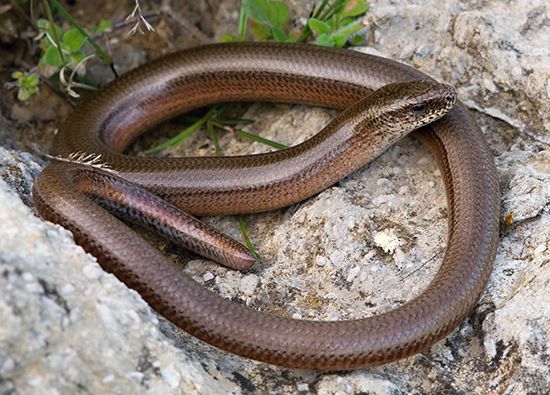
Glass Lizard
Glass lizards, which belong to the genus Ophisaurus, primarily inhabit grassland and open forest environments. Within these ecosystems, they function as…
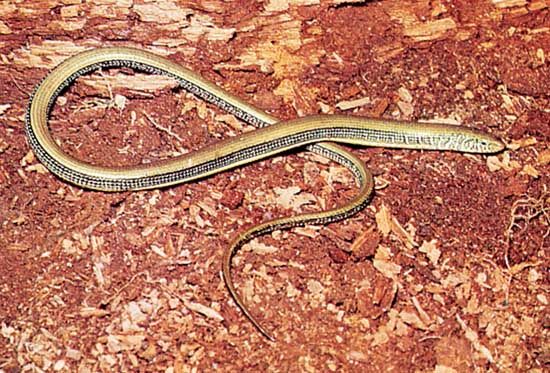
What role do glass lizards play in their ecosystem?
Glass lizards, which belong to the genus Ophisaurus, primarily inhabit grassland and open forest environments. Within these ecosystems, they function as predators that consume a wide variety of invertebrates.1
More broadly, lizards contribute to their ecosystems by providing natural pest control, as many species help regulate populations of insects and other invertebrates. While specific, detailed studies on the ecological impact of glass lizards are limited, their role as insectivores is consistent with the general ecological contributions of many lizard groups. Additionally, glass lizards exhibit a degree of parental care, as females are often observed attending to their clutches of eggs during the incubation period.2314
How did glass lizards get their name, and what unique feature does it refer to?
Glass lizards, which belong to the genus Ophisaurus, are named for their unique ability to easily break off their tails when threatened.1
This defensive mechanism is a form of autotomy, where the lizard voluntarily sheds its tail to escape a predator. While many lizards can shed their tails in one piece, glass lizards are particularly notable because they can break their tails into several pieces. These severed segments often wriggle violently, which serves to confuse the predator and allows the lizard to escape. The stump eventually heals, and the lizard is capable of regenerating a new tail, though the replacement is typically shorter and has simpler scales than the original.56
How do glass lizards reproduce, and what is unique about their breeding habits?
Glass lizards (Ophisaurus) are oviparous, meaning they are egg-laying reptiles. They typically produce modest clutches consisting of 5 to 15 eggs.41
A unique and notable aspect of their breeding habits is the level of parental care provided by the female. Unlike many other lizard species that abandon their eggs immediately after deposition, female glass lizards often remain with their clutch throughout the incubation period4. During this time, the female may curl her body around the eggs to protect them, a behavior that is relatively uncommon among lizards but observed in a few specific groups.421
What are the primary habitats and geographic distribution of glass lizards?
Glass lizards of the genus Ophisaurus are found across several continents, with distinct species occupying different geographic regions. In North America, the Eastern glass lizard is native to the southeastern United States, while the slender glass lizard (O. attenuatus) has a broader range that extends from the Southeast into the upper Mississippi River valley. Additionally, the species O. apodus is distributed across a wide area encompassing southeastern Europe, southwestern Asia, and northern Africa.1
Regarding their habitat, these lizards are primarily found in grassland or open forest environments. They are terrestrial creatures that prefer areas with loose soil, where they can be found sheltering among leaves and grass, or hiding beneath roots and stones.1
Sources
- glass lizard — Encyclopædia Britannica
- lizard - General features — Encyclopædia Britannica
- reptile: Top Questions — Encyclopædia Britannica
- lizard - Parental care — Encyclopædia Britannica
- reptile - Use of the tail — Encyclopædia Britannica
- Autotomy — Encyclopædia Britannica
- reptile - Embryonic development and parental care — Encyclopædia Britannica
Published on · 2 min read