Slowworm
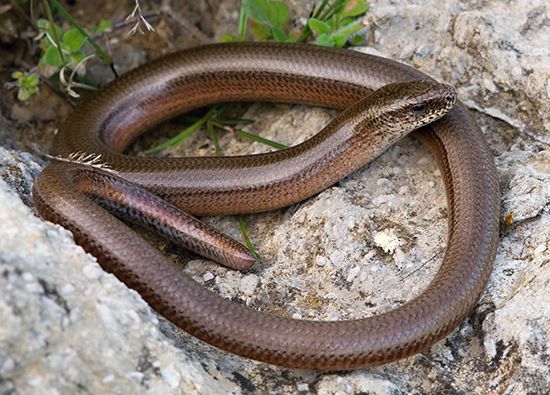
The slowworm (Anguis fragilis) is a legless lizard that is typically found across a wide geographic range, extending from Great Britain and Europe eastward…
Where are slowworms typically found, and what kind of habitats do they prefer?
The slowworm (Anguis fragilis) is a legless lizard that is typically found across a wide geographic range, extending from Great Britain and Europe eastward to the Ural Mountains and the Caspian Sea.1
Regarding their preferred environment, these reptiles favor grassy areas and open woodlands. Despite their snakelike appearance, they are distinct from snakes because they possess eyelids and ear openings.1
What is the diet of a slowworm, and how do they hunt for their food?
The diet of the slowworm (Anguis fragilis) consists primarily of soft-bodied invertebrates, including snails, slugs, and earthworms. In addition to these, they consume other small invertebrates and occasionally some vertebrates.1
The provided search results do not contain specific details regarding the behavioral techniques or methods these lizards use to hunt for their food.
What is the scientific name of the slowworm, and why is it classified as a lizard despite its snake-like appearance?
The scientific name of the slowworm is Anguis fragilis.13
Although the slowworm has an elongated, limbless body that gives it a snake-like appearance, it is classified as a lizard because it retains specific anatomical features that distinguish it from snakes. Unlike snakes, the slowworm possesses eyelids and external ear openings.1
While most lizards are characterized by having legs, limb loss is a known evolutionary trait in several lizard groups, including the slowworm and the glass lizard. Because snakes themselves evolved from lizards, the distinction between the two groups is often based on these specific physiological traits rather than the presence of limbs alone.4
What are the key characteristics that distinguish slowworms from other lizards?
The slowworm (Anguis fragilis) is a legless lizard that is often mistaken for a snake due to its elongated, limbless body. However, several key anatomical characteristics distinguish it from snakes and other lizard species:
- Presence of Eyelids: Unlike snakes, which have fixed, transparent scales over their eyes, slowworms possess movable eyelids that allow them to blink and close their eyes.1
- External Ear Openings: Slowworms have visible external ear openings on the sides of their heads, a feature that snakes lack.1
- Internal Anatomy: While they lack external limbs, slowworms retain an internal remnant of the pelvic girdle, which is a vestigial structure reflecting their evolutionary history as lizards.1
- Family Classification: They belong to the family Anguidae, a group that includes both limbed species, such as alligator lizards, and other limbless forms like glass lizards. This family is characterized by the presence of osteoderms (dermal bone) and specific skull structures.5
Sources
- slowworm — Encyclopædia Britannica
- soil organism — Encyclopædia Britannica
- slowworm — Merriam-Webster
- lizard — Encyclopædia Britannica
- lizard - Annotated classification — Encyclopædia Britannica
- eel - Annotated classification — Encyclopædia Britannica
Published on · 2 min read