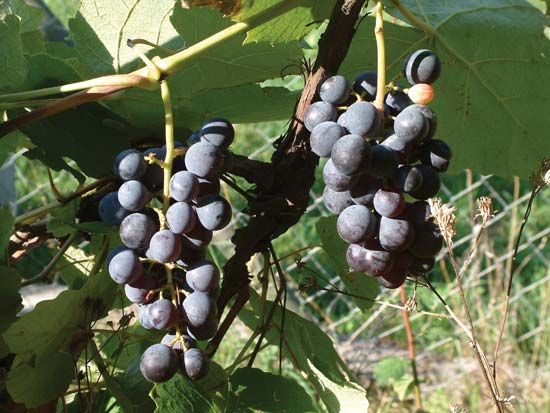
Grape
The genus Vitis includes 60 to 80 species of vining plants, but a few are of primary economic importance for wine, table fruit, and juice production.
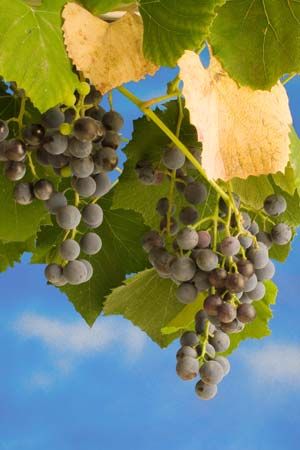
What are the main species of grapes and their characteristics?
The genus Vitis includes 60 to 80 species of vining plants, but a few are of primary economic importance for wine, table fruit, and juice production.12
Major Grape Species
- Vitis vinifera: Originating in the Caucasus Mountains, this is the principal European wine grape. It is favored globally for its high sugar content, which is essential for fermentation, and its moderate acidity. It exhibits a vast range of characteristics, with over 5,000 varieties differing in color, size, flavor, and ripening time.12
- Vitis labrusca: Known as the fox grape, this North American species is often used for table grapes, juice, and jellies. Varieties like the Concord grape are known for a distinct, pronounced flavor often described as “foxy.” These grapes typically require added sugar for winemaking due to lower natural sugar levels and higher acidity.12
- Vitis rotundifolia: The muscadine grape is a thick-skinned species native to the southeastern United States. It is primarily used for artisanal wines and jellies.12
- Vitis aestivalis: Known as the summer grape, it is considered one of the oldest American cultivars. While well-suited for winemaking, the vine is notoriously difficult to cultivate.2
What is the history of grape cultivation and its spread around the world?
The cultivation of Vitis vinifera began in the Middle East by at least 4000 BCE, with early records from Egypt and the Bible highlighting its long-standing significance. The Greeks expanded viticulture through their colonies, while the Romans introduced grape growing to major European river valleys, including the Rhine, Moselle, and Rhône4. Following the fall of the Roman Empire, monastic orders were instrumental in preserving and developing these viticultural regions.4
Global expansion accelerated after the voyages of Columbus. Spanish missionaries introduced grapes to Chile and Argentina in the 16th century, while settlers later established industries in South Africa, Australia, and New Zealand.4
In the late 19th century, the industry faced a near-catastrophic threat from phylloxera, an American root louse that devastated European vineyards. The crisis was resolved by grafting V. vinifera onto resistant American rootstocks. Modern viticulture has since benefited from scientific advancements, including Louis Pasteur’s work on fermentation and 20th-century mechanical innovations.456
How are grapes harvested and processed for different uses?
Grapes are harvested and processed differently depending on their intended use, such as for wine, table consumption, or preserves.
Harvesting
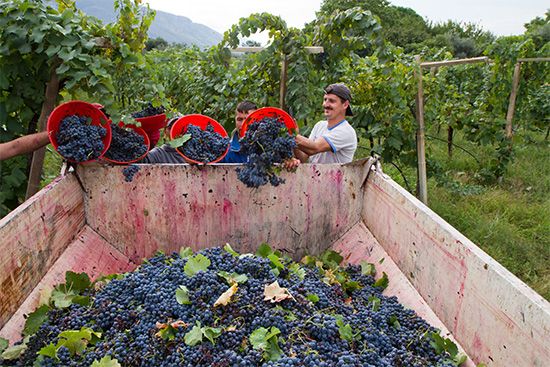
Timing is critical for grape quality. For wine, grapes are harvested when sugar content is at its peak and the skins are coated in a waxy bloom containing natural yeasts containing natural yeasts. In cooler climates, grapes may be picked earlier, requiring the addition of sugar or juice concentrate to ensure proper fermentation. Harvesting can be done manually by cutting clusters or through mechanical systems that shake berries from the vines.37
Processing for Wine
- Crushing and Stemming: Modern production uses a crusher-stemmer to separate berries from stems.3
- Juice Separation: For white wines, juice is typically separated from skins and seeds immediately after crushing using a press. In red wine production, the skins, seeds, and juice are often fermented together to extract color and flavor.8
- Fermentation: The process is carefully managed through temperature control and the use of specific vessels to achieve the desired sweetness and alcohol levels.7
Processing for Other Uses
- Jellies and Jams: Grapes are crushed and cooked with sugar, acid, and pectin to create a shelf-stable gel. Jams include the fruit pulp, while jellies are made from clarified juice.9
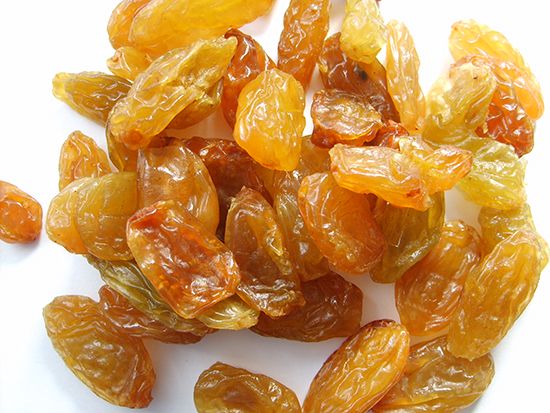
- Raisins: Certain varieties are dried to produce raisins, a process that concentrates natural sugars through moisture loss.710
What is a grape plant?
A grape plant is a woody vine belonging to the genus Vitis, which is part of the Vitaceae family of flowering plants. These plants typically climb using tendrils—modified branches—and can reach lengths of 17 meters (56 feet) or more if left untrained.111
Key characteristics of the grape plant include:
- Leaves: Alternate, palmately lobed, and tooth-edged.1
- Flowers: Small and greenish, growing in clusters.1
- Fruit: Botanically classified as a berry, these fruits vary in color from green and amber to red and black. They often feature a whitish, powdery coating known as a bloom.1
- Species: The most economically significant species is the European wine grape (Vitis vinifera), though North American species like the fox grape (V. labrusca) and muscadine grape (V. rotundifolia) are also widely cultivated.1121
Grapes are primarily grown in temperate zones and are valued for their use as table fruit, for drying into raisins, or for processing into juice and wine.1
Sources
- wine - Species and varieties — Encyclopædia Britannica
- wine - Cultivation — Encyclopædia Britannica
- Grape — Encyclopædia Britannica
- wine - The spread of viticulture — Encyclopædia Britannica
- wine - Enology : scientific winemaking — Encyclopædia Britannica
- Grape phylloxera — Encyclopædia Britannica
- wine - Harvesting — Encyclopædia Britannica
- wine - Crushing — Encyclopædia Britannica
- wine - Juice separation — Encyclopædia Britannica
- fruit processing - Fruit preserves , jams, and jellies — Encyclopædia Britannica
- Vitaceae — Encyclopædia Britannica
- Vitales — Encyclopædia Britannica
- wine - The wine grape — Encyclopædia Britannica
Published on · 4 min read