Great Basin
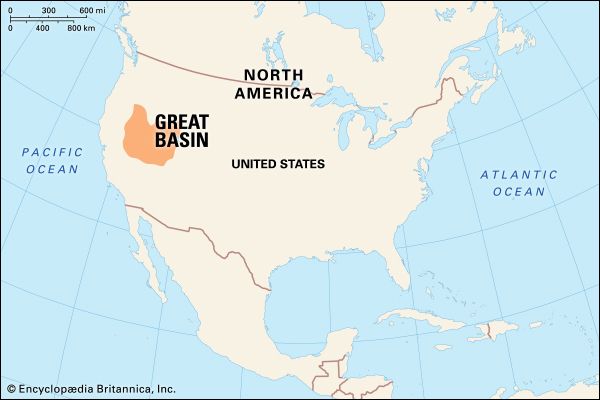
The Great Basin is defined by its internal drainage system, a hydrological condition where precipitation falling within the region does not reach the sea.…
How does the concept of ‘internal drainage’ apply to the Great Basin?
The Great Basin is defined by its internal drainage system, a hydrological condition where precipitation falling within the region does not reach the sea. Because the basin is surrounded by high topography, water is trapped within closed valleys, leaving the area only through evaporation or by seeping into underground reservoirs.12
This system results in several distinct geographical features:
- Closed Basins: Rivers, such as the Humboldt River, flow into terminal sinks or basins rather than oceans.1
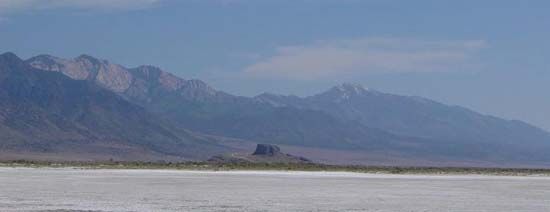
- Saline Environments: As water evaporates, minerals remain, leading to the formation of brackish or salty water bodies, most notably the Great Salt Lake.21
- Aridity: The region’s internal drainage is reinforced by the rain shadow created by the Sierra Nevada, which blocks moisture from the Pacific Ocean.1
The accumulation of water in these low-lying areas has historically shaped the landscape, including the remnants of the prehistoric Lake Bonneville4.
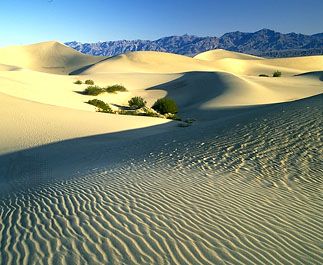
What are some of the major rivers and lakes found in the Great Basin?
The Great Basin is characterized by its internal drainage system, meaning its rivers typically terminate in closed basins or sinks rather than flowing to the ocean. Because the region is arid, these water bodies are often saline or ephemeral.627
Major Rivers
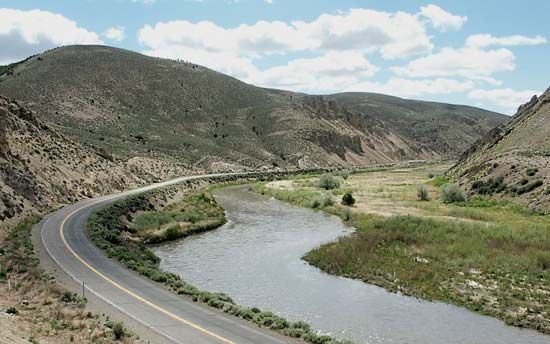
- Humboldt River: The largest river system entirely within the Great Basin, it flows westward across northern Nevada before terminating in the Humboldt Sink.628
- Bear, Weber, and Jordan Rivers: These rivers are the primary tributaries that feed the Great Salt Lake in Utah.1
- Truckee, Carson, and Walker Rivers: Rising in the Sierra Nevada, these rivers provide essential water for irrigation and reclamation projects in western Nevada.6
Major Lakes and Sinks
- Great Salt Lake: Located in northern Utah, it is the largest inland body of salt water in the Western Hemisphere and a primary remnant of the prehistoric Lake Bonneville.51
- Humboldt Sink: A terminal, intermittently dry lake bed that serves as the end point for the Humboldt River.8
- Utah Lake: A freshwater lake in Utah that, along with the Great Salt Lake and Sevier Lake, remains as a remnant of the ancient Lake Bonneville.51
- Pyramid and Walker Lakes: These are also remnants of ancient seas located within the basin.6
How have human settlements and activities impacted the Great Basin ecosystem?
Human settlement and industrial activities have profoundly altered the Great Basin’s delicate ecosystem, primarily through the disruption of water resources and the transformation of land use.
Impact on Water Resources
The Great Basin’s internal drainage system makes it exceptionally vulnerable to water management practices. Urbanization, agriculture, and industry have placed immense pressure on both surface water and groundwater supplies. To support growing populations in areas like Salt Lake City and Reno, water is diverted from mountain streams and extracted from underground reservoirs. Furthermore, the region relies on complex water-sharing agreements and large-scale diversion projects—such as those involving the Colorado River—which have led to ongoing litigation, over-apportionment, and the depletion of natural flows.2101
Land Use and Ecological Disruption
Since the 1840s, the introduction of Euro-American mining, ranching, and farming has significantly impacted the landscape:11
- Resource Extraction: Extensive mining for gold, silver, and other minerals has been a cornerstone of the regional economy, but it has also contributed to environmental degradation.10
- Vegetation Loss: Native piñon groves were historically cleared for firewood, fence posts, and mining timbers, while the influx of livestock disrupted the fragile desert vegetation.11
- Indigenous Displacement: Government policies, including the privatization of land and the forced relocation of Indigenous peoples to reservations, dismantled traditional subsistence economies that had existed in the region for centuries.11
These cumulative human activities have fundamentally changed the region’s natural character, shifting it from a sparsely populated, arid wilderness to a landscape defined by intensive resource management and urban development.1012
What Native American tribes have historically inhabited the Great Basin region?
The Great Basin region has historically been home to diverse Indigenous peoples, primarily categorized by their linguistic affiliations. These groups were traditionally organized into mobile, kin-based bands that adapted to the arid environment by following seasonal food sources.131410
Linguistic and Tribal Groups
- Washoe: Centered around Lake Tahoe, the Washoe are distinct for speaking a Hokan language, unrelated to the other major language family in the region.1314
- Numic-speaking Peoples: The majority of the region was occupied by groups speaking Numic languages, a branch of the Uto-Aztecan family. These include:
While the Comanche originated in the Great Basin, they migrated to the Great Plains during the early colonial period after adopting horses and becoming nomadic buffalo hunters.13
The social structure of these tribes was highly fluid, with leadership based on success in foraging or warfare rather than formal political hierarchies. Following Euro-American settlement in the 1840s, these tribes faced significant displacement, forced assimilation, and the imposition of the reservation system, though many have maintained their cultural traditions into the 21st century.1015
Sources
- Indigenous peoples of the Great Basin — Encyclopædia Britannica
- Great Basin — Encyclopædia Britannica
- United States - The Pacific systems — Encyclopædia Britannica
- Lake Bonneville — Encyclopædia Britannica
- California - Drainage — Encyclopædia Britannica
- Nevada - Drainage — Encyclopædia Britannica
- Humboldt River — Encyclopædia Britannica
- Pleistocene Epoch - Lacustrine environments — Encyclopædia Britannica
- Great Salt Lake — Encyclopædia Britannica
- Indigenous peoples of the Great Basin - Modern developments — Encyclopædia Britannica
- Colorado River - Economic development — Encyclopædia Britannica
- Rocky Mountains - Environmental concerns — Encyclopædia Britannica
- Indigenous peoples of the Great Basin - Language — Encyclopædia Britannica
- Native American - The Great Basin — Encyclopædia Britannica
- Indigenous peoples of the Great Basin - Social organization — Encyclopædia Britannica
Published on · 4 min read