Lake Agassiz
Lake Agassiz was a massive glacial-margin lake that formed during the Pleistocene Epoch when the Laurentide Ice Sheet obstructed the natural drainage of the…
How did Lake Agassiz impact the landscape and geology of North America?
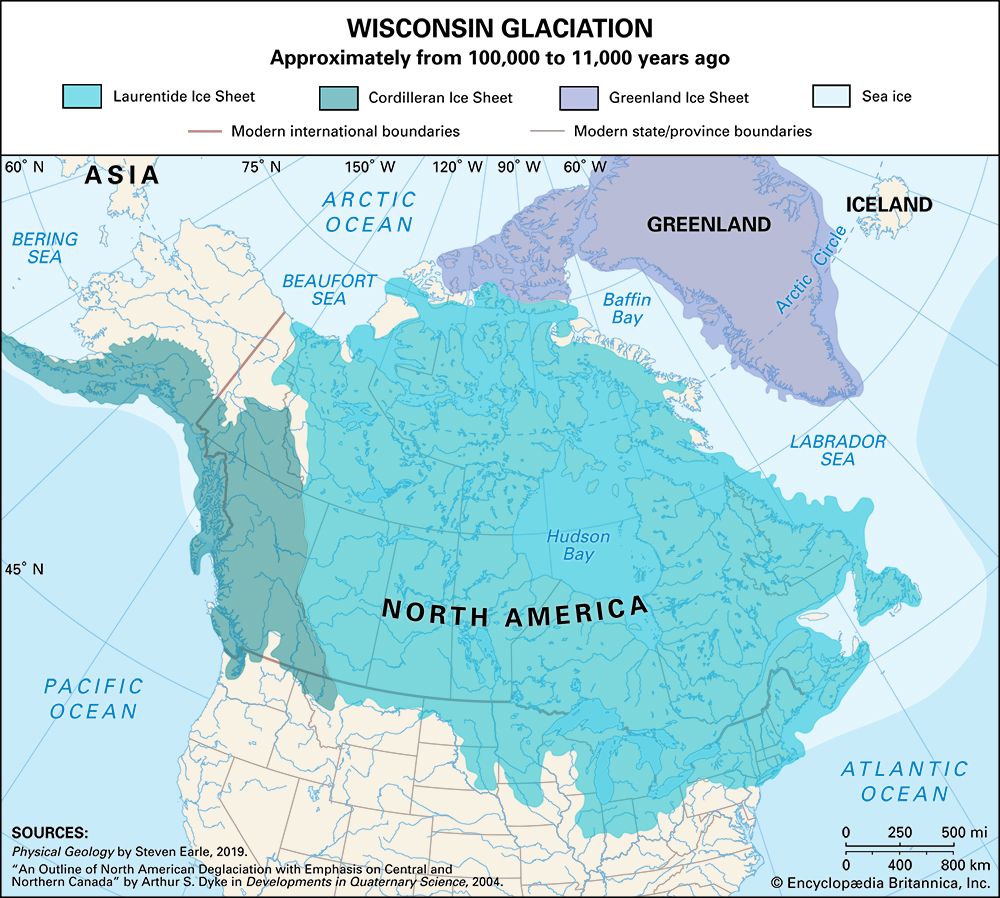
Lake Agassiz was a massive glacial-margin lake that formed during the Pleistocene Epoch when the Laurentide Ice Sheet obstructed the natural drainage of the northern Great Plains.1
Its impact on the North American landscape was profound:
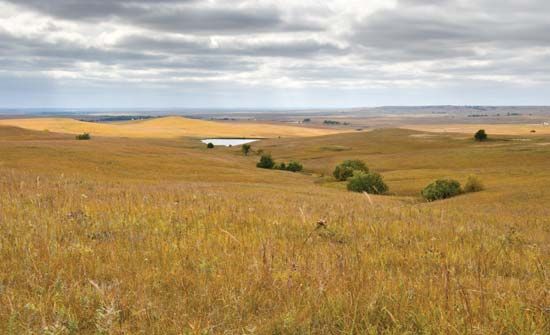
- Sedimentation and Fertility: As the lake occupied the region, it deposited extensive layers of fine, claylike silt and clay on its floor. These sediments are responsible for the exceptional fertility of the Red River of the North and Souris River valleys, which today serve as major agricultural hubs.123
- Hydrological Legacy: When the ice sheet retreated, the lake drained northward via the Nelson River into Hudson Bay. This process left behind several significant modern water bodies, including Lake Winnipeg, Lake Winnipegosis, Lake Manitoba, and Lake of the Woods1.1
What was Lake Agassiz and when did it exist?
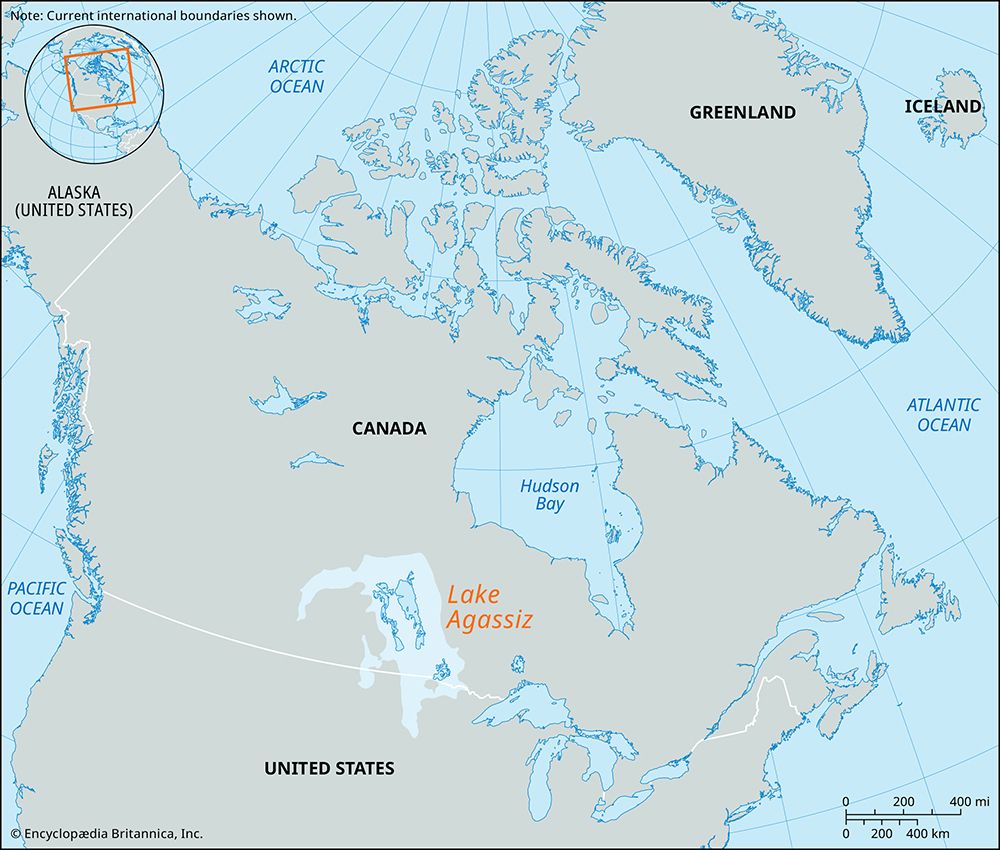
Lake Agassiz was the largest of the ice-margin lakes that occupied parts of present-day Manitoba, Ontario, and Saskatchewan in Canada, as well as North Dakota and Minnesota in the United States.1
The lake existed during the Pleistocene Epoch (approximately 2.6 million to 11,700 years ago), specifically during the final two phases of the Wisconsin glacial age. It formed when the Laurentide Ice Sheet obstructed the natural drainage of the northern Great Plains, causing river waters to back up into a massive basin measuring 1,100 km long by 300 km wide. After nearly 1,000 years, the retreat of the ice sheet allowed the lake to drain northward into Hudson Bay, leaving behind remnants such as Lake Winnipeg.1
What was the extent of Lake Agassiz at its maximum size?
At its maximum size, Lake Agassiz was a massive proglacial body of water that spanned approximately 285,000 square kilometers (110,000 square miles).
In terms of physical dimensions, the lake reached a length of 1,100 kilometers (700 miles) and a width of 300 kilometers (200 miles). It occupied a vast basin across parts of present-day Manitoba, Ontario, and Saskatchewan in Canada, as well as North Dakota and Minnesota in the United States.) and Minnesota in the United States.1
What other giant prehistoric lakes existed in North America besides Lake Agassiz?
Beyond Lake Agassiz, North America hosted several other massive prehistoric lakes during the Pleistocene Epoch. These are generally categorized as either proglacial lakes, formed by melting ice, or pluvial lakes, which developed in arid regions due to increased precipitation.
Major Pluvial Lakes
During the Pleistocene, the Great Basin of the western United States contained approximately 100 basins that held water. The most prominent include:
- Lake Bonneville: Located in present-day Utah, Nevada, and Idaho, this vast lake reached a maximum area of about 52,000 square kilometers (20,100 square miles) and a depth of 370 meters. The Great Salt Lake and Utah Lake are its modern remnants.456
- Lake Lahontan: This ancient lake covered much of western Nevada and extended into California. Pyramid Lake is a well-known remnant of this system.678
Other Notable Relic Lakes
Many modern North American lakes are the diminished remnants of much larger glacial or pluvial bodies. These include:
- Great Lakes: Formed as glaciers scoured out preexisting lowlands, these basins were significantly altered by ice movement.46
- Northern Relics: Lakes such as Lake Athabasca, Great Slave Lake, and Great Bear Lake are remnants of deeper, larger glacial lakes that formed when ice blocked natural drainage.6
- Lake Chapala: Located in Mexico, this modern lake represents only a small portion of a much larger body of water that once occupied the Mexican Plateau.6
Sources
- Lake Agassiz — Encyclopædia Britannica
- Quaternary - Lakes — Encyclopædia Britannica
- Red River of the North — Encyclopædia Britannica
- Pleistocene Epoch - Lacustrine environments — Encyclopædia Britannica
- Bonneville, Lake — Merriam-Webster
- North America - Lakes of North America — Encyclopædia Britannica
- Lahontan, Lake — Merriam-Webster
- Pyramid Lake — Encyclopædia Britannica
Published on · 3 min read