Gui River
The Gui River, a northern tributary of the Xi River in southern China, flows through the Zhuang Autonomous Region of Guangxi. Several notable cities and…
What are the major cities or towns located along the Gui River?
The Gui River, a northern tributary of the Xi River in southern China, flows through the Zhuang Autonomous Region of Guangxi. Several notable cities and towns are situated along its course:
- Guilin: Located in the northeastern part of the region, this city is a leading commercial and educational center. The river’s upper course is known as the Li River, which flows through this area.12
- Pingle: This town is situated along the river’s course and is accessible to shallow-draft junks.1
- Wuzhou: Positioned at the border of Guangxi and Guangdong province, this city serves as the confluence point where the Gui River joins the Xi River and acts as a gateway for regional trade.12
The river serves as a vital transportation route for timber harvested in the forests of northeastern Guangxi, facilitating trade toward the Xi River and eventually to Guangzhou1.
What is the geographical location and course of the Gui River in China?
The Gui River is a northern tributary of the Xi River located in southern China. Its headwaters originate in the Mao’er Mountains, situated north of Guilin within the Zhuang Autonomous Region of Guangxi.1
The river follows a southward course, characterized by numerous dangerous rapids and seasonal water level fluctuations. Its upper reaches are known as the Li River. The river flows through the region before reaching its confluence with the Xi River at Wuzhou, located on the border between Guangxi and Guangdong province.1
Historically and economically, the river is significant; the ancient Ling Canal connects the Gui to the Xiang River in Hunan province, and the river serves as a vital transport route for timber moving toward Guangzhou.1
How does the Gui River contribute to the local ecosystem and biodiversity?
Sorry, the Britannica knowledge base does not contain information regarding the specific contributions of the Gui River to the local ecosystem and biodiversity.
Are there any notable landmarks or tourist attractions along the Gui River?
The Gui River basin and its surrounding areas feature several significant historical and natural landmarks:
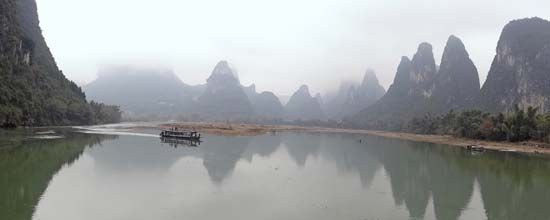
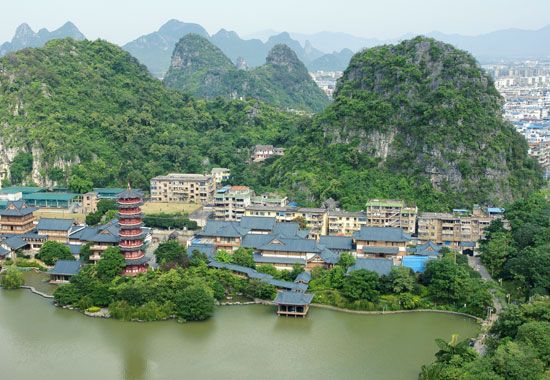
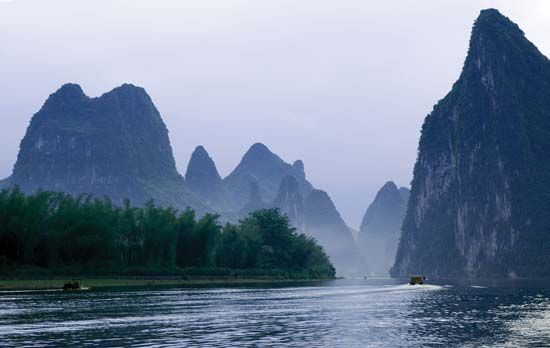
- Guilin: Located along the upper course of the river (where it is known as the Li River), this city is a state-level historical and cultural site renowned for its outstanding natural beauty. It is famous for its dramatic karst formations—tall, needle-shaped limestone pinnacles that have inspired generations of Chinese painting and poetry.1
- Reed Flute Cave: Known locally as Ludiyan, this is the largest and most spectacular of the many caves found in the Guilin area.1
- Ling Canal: Constructed around 215 BCE near the city of Xing’an, this ancient engineering marvel connects the Li River (a tributary of the Gui) with the Xiang River. It served as a vital water route for the Qin dynasty and remains a significant historical site today.561
While the nearby province of Guizhou also hosts famous attractions like the Huangguoshu Falls and Zhijin Cave, these are distinct from the Gui River corridor.7
Sources
- Gui River — Encyclopædia Britannica
- Guangxi - Settlement patterns — Encyclopædia Britannica
- Gui — Merriam-Webster
- Guangxi - Drainage and soils — Encyclopædia Britannica
- Ling Canal — Encyclopædia Britannica
- Guilin — Encyclopædia Britannica
- Guizhou - Cultural life — Encyclopædia Britannica
Published on · 2 min read