Gulf of Euboea
The Gulf of Euboea held significant strategic and economic importance in ancient Greek civilization, primarily by serving as a vital maritime corridor and a…
What is the historical significance of the Gulf of Euboea in ancient Greek civilization?
The Gulf of Euboea held significant strategic and economic importance in ancient Greek civilization, primarily by serving as a vital maritime corridor and a center for regional power struggles.
Strategic and Economic Importance
The gulf’s inshore channels provided a safer alternative for maritime traffic traveling from the north Aegean to Athens, as they allowed sailors to avoid the hazardous waters around Cape Kafirévs. The region was also a hub for trade and industry; the city of Chalcis utilized local iron and copper deposits to establish a lucrative metalworking and export industry.1
Conflict and Political Influence
The fertile Lelantine Plain, located near the gulf, was the site of the Lelantine War (c. 700 BCE). This conflict between the Euboean cities of Chalcis and Eretria was one of the earliest “general” wars in Greek history, drawing in distant allies. Additionally, the Euripus strait, which divides the gulf, became a focal point for military engineering, with dikes and towers constructed as early as 411 BCE.213
Are there any myths or legends associated with the Gulf of Euboea in Greek mythology?
While the Gulf of Euboea and the Euripus strait are central to the geography and history of ancient Greece, they are not primarily defined by major myths or legends in the way that other regions of the Aegean are.
However, the Euripus strait is associated with a famous piece of intellectual folklore. According to popular tradition, the ancient Greek philosopher Aristotle was so distressed by his inability to solve the mystery of the strait’s complex, rapidly reversing tidal currents that he drowned himself there. While this story is a well-known legend, the phenomenon—now called the “euripus phenomenon”—remains a subject of scientific interest, as the exact cause of these violent and uncertain currents is still not fully understood today.21
Beyond this, the region is more noted for its historical and archaeological significance, such as the Lelantine War and the ancient temple of Apollo Daphnephoros in Eretria, rather than being the setting for primary mythological narratives.64
How does the Gulf of Euboea impact the local climate and ecosystem?
The Gulf of Euboea plays a distinct role in the regional environment, primarily through its unique hydrographic features and its influence on local geography.
Hydrographic and Tidal Impact
The most significant environmental feature of the gulf is the Euripus strait, which separates the northern and southern sections of the gulf. This narrow channel is famous for the “euripus phenomenon,” characterized by violent and uncertain tidal currents that reverse direction frequently. These complex water movements are of significant scientific interest and distinguish the gulf’s marine environment from the more stable tidal patterns found in the broader Aegean Sea.17
Ecosystem and Climate
While the Aegean Sea is generally considered an impoverished body of water with low nutrient content, the gulf’s sheltered, indented coastline provides diverse habitats for marine life. The surrounding landscape, particularly on the island of Euboea, is defined by mountain ranges that create fertile lowlands and valleys. Historically, these areas supported extensive forests and pastures, though land-use practices have significantly altered the local vegetation over time. The gulf also serves as a critical maritime corridor, which has influenced human settlement patterns and land use along its shores for millennia.761
How deep is the Gulf of Euboea, and how does its depth affect maritime activities?
The Gulf of Euboea is divided into northern and southern sections by the narrow Euripus strait. While the gulf itself is a significant maritime arm of the Aegean Sea, the depth of the Euripus strait is specifically noted as being between 20 and 27 feet (6 to 8 meters).1
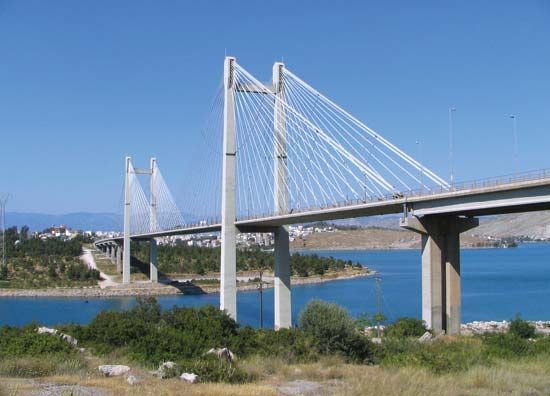
This shallow depth at the Euripus strait significantly restricts maritime activity, as the channel is navigable only by small vessels. Furthermore, the strait is famous for the “euripus phenomenon,” where violent and uncertain tidal currents can reach velocities of up to 12 knots and reverse direction seven or more times a day. These challenging conditions, combined with the limited depth, have historically necessitated the use of specialized infrastructure, such as the dike and tower systems used in antiquity and the modern movable bridge at Chalkída, to manage passage and trade.127
Sources
- Gulf of Euboea — Encyclopædia Britannica
- Euripus — Encyclopædia Britannica
- ancient Greek civilization - The Lelantine War — Encyclopædia Britannica
- Eretria — Encyclopædia Britannica
- ancient Greek civilization - The Euboean revolt — Encyclopædia Britannica
- Euboea — Encyclopædia Britannica
- Aegean Sea — Encyclopædia Britannica
- Central Greece — Encyclopædia Britannica
Published on · 3 min read