Gulf of Paria
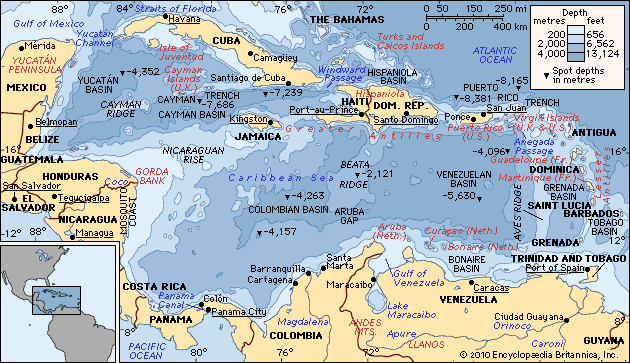
The Gulf of Paria is an inlet of the Caribbean Sea situated between the coast of Venezuela and the island of Trinidad. Measuring approximately 100 miles…
What is Gulf of Paria?
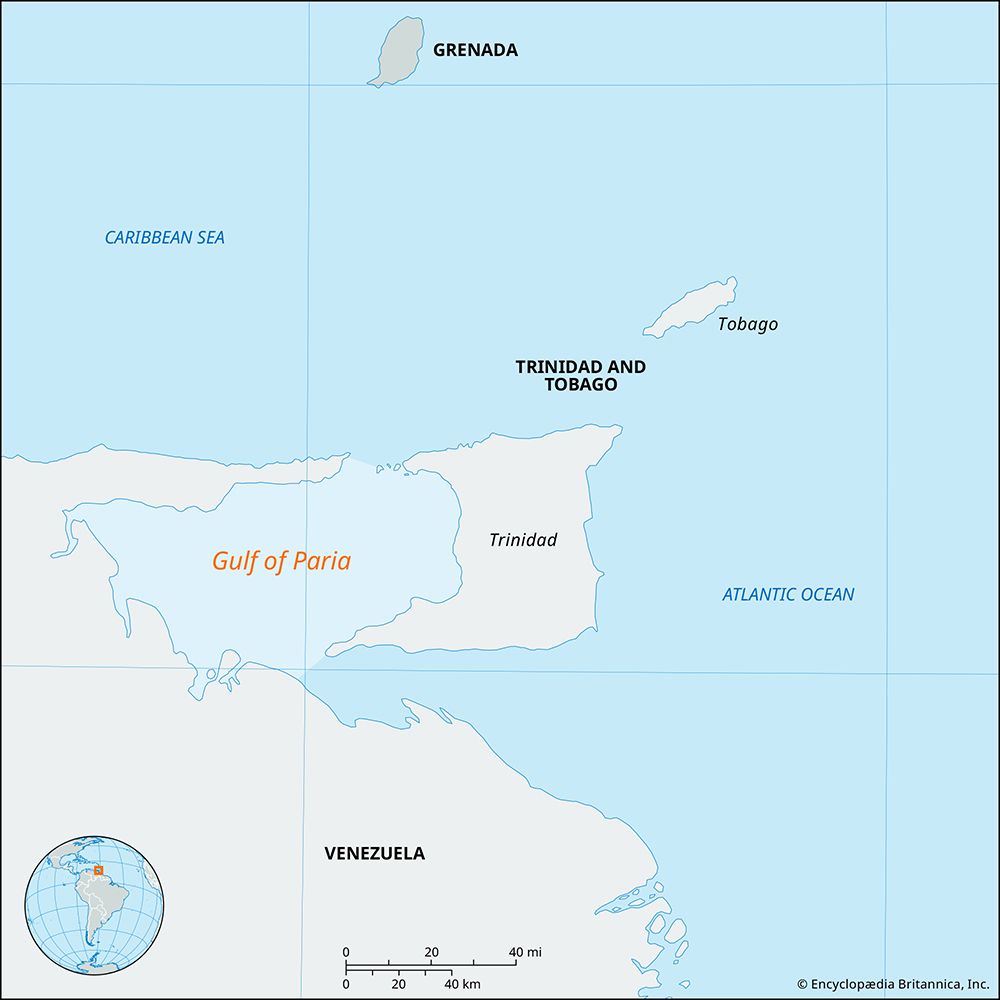
The Gulf of Paria is an inlet of the Caribbean Sea situated between the coast of Venezuela and the island of Trinidad. Measuring approximately 100 miles east-west and 40 miles north-south, the gulf serves as a vital maritime connection, linking to the Caribbean via the Dragon’s Mouths in the north and to the Atlantic Ocean via the Serpent’s Mouth in the south.12
The region is ecologically and economically significant, receiving freshwater from the San Juan River and various distributaries of the Orinoco River delta. Major ports, such as Port of Spain, facilitate the transport of essential commodities including petroleum, iron ore, and bauxite. Historically, the gulf is notable as the site where Christopher Columbus likely first sighted South America during his third voyage in 1498.1
How does the Orinoco River delta affect the gulf’s ecosystem?
The Orinoco River delta significantly shapes the ecosystem of the Gulf of Paria by acting as a primary source of freshwater, nutrients, and sediment.13
- Salinity and Water Dynamics: As a major source of runoff, the river freshens the gulf’s waters. This influx of freshwater lowers the salinity, creating a distinct environment compared to the adjacent Caribbean Sea.31
- Nutrient Enrichment: The river delivers organic matter and essential nutrient salts into the gulf. These inputs support high biological productivity, which often leads to the concentration of specific marine life, such as shrimp and oyster populations, making the area vital for fisheries.3
- Sedimentation: The deltaic system transports large volumes of sediment into the gulf. This high rate of accumulation influences the bottom topography, often resulting in silt-covered floors that define the gulf’s physical character.13
What are the Dragon’s Mouths and the Serpent’s Mouth?
The Dragon’s Mouths and the Serpent’s Mouth are two vital straits that connect the Gulf of Paria to the surrounding seas, effectively separating the island of Trinidad from the mainland of South America.61
- Dragon’s Mouths: Located to the north, this channel is approximately 12 miles (20 km) wide and links the gulf to the Caribbean Sea. It derives its name from the numerous teethlike rocky islets found within the passage. Due to these formations and powerful currents, the channel has historically been considered hazardous for navigation.61
- Serpent’s Mouth: Situated off the southwestern coast of Trinidad, this strait is roughly 10 miles (16 km) wide. It serves as the southern gateway, connecting the Gulf of Paria to the Atlantic Ocean.17
Together, these passages facilitate maritime access to the gulf, which serves as a significant hub for the transport of commodities such as petroleum, iron ore, and bauxite.1
Why was Christopher Columbus’s third voyage historically significant?
Christopher Columbus’s third voyage (1498–1500) was historically significant for several key geographical and political reasons:
- Discovery of the South American Mainland: By observing the massive torrents of fresh water flowing into the Gulf of Paria from the Orinoco River delta, Columbus realized he had encountered a continent rather than just islands, famously describing it as “another world.”8
- Navigational Advancements: During the crossing, Columbus discovered the principle of compass variation—the difference between magnetic north and geographic north—demonstrating his exceptional skill as a navigator.8
- Political and Administrative Failure: The voyage marked a turning point in Columbus’s career. Due to internal rebellions and harsh governance on Hispaniola, the Spanish crown sent Francisco de Bobadilla to investigate. Columbus and his brothers were arrested and returned to Spain in chains, leading to his removal from the governorship of the colony.8
Sources
- Gulf of Paria — Encyclopædia Britannica
- Paria, Gulf of — Merriam-Webster
- river - Morphology of deltas — Encyclopædia Britannica
- Orinoco River - Physiography of the Orinoco — Encyclopædia Britannica
- gulf - Factors that affect the characteristics of gulfs — Encyclopædia Britannica
- Dragons Mouths — Encyclopædia Britannica
- Serpent's Mouth — Merriam-Webster
- Where did Columbus land? — Encyclopædia Britannica
- Christopher Columbus - The second and third voyages of Christopher Columbus — Encyclopædia Britannica
Published on · 3 min read