Gzhelian Stage
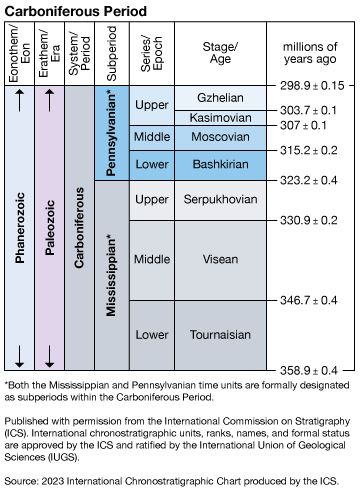
The Gzhelian Stage is the final stage of the Pennsylvanian Subsystem within the Carboniferous System. It is named after the Russian city of Gzhel, located…
How was the Gzhelian Stage first defined, and by whom?
The Gzhelian Stage is the final stage of the Pennsylvanian Subsystem within the Carboniferous System. It is named after the Russian city of Gzhel, located southeast of Moscow in the Moscow Basin.1
Historically, the base of the stage was defined by the first appearance of specific advanced fusulinid species, including Rauserites rossicus, R. stuckenbergi, Jigulites jigulensis, and Daixina sokensis. Currently, however, working groups of the International Commission on Stratigraphy (ICS) suggest that the first appearance of the conodont Idiognathodus simulator provides a more effective marker for global correlation. Notably, no Global Stratotype Section and Point (GSSP) has yet been officially submitted or ratified for the base of the Gzhelian Stage.1
The provided information does not specify an individual who first defined the stage.
How does the Gzhelian Stage compare to the stages immediately before and after it?
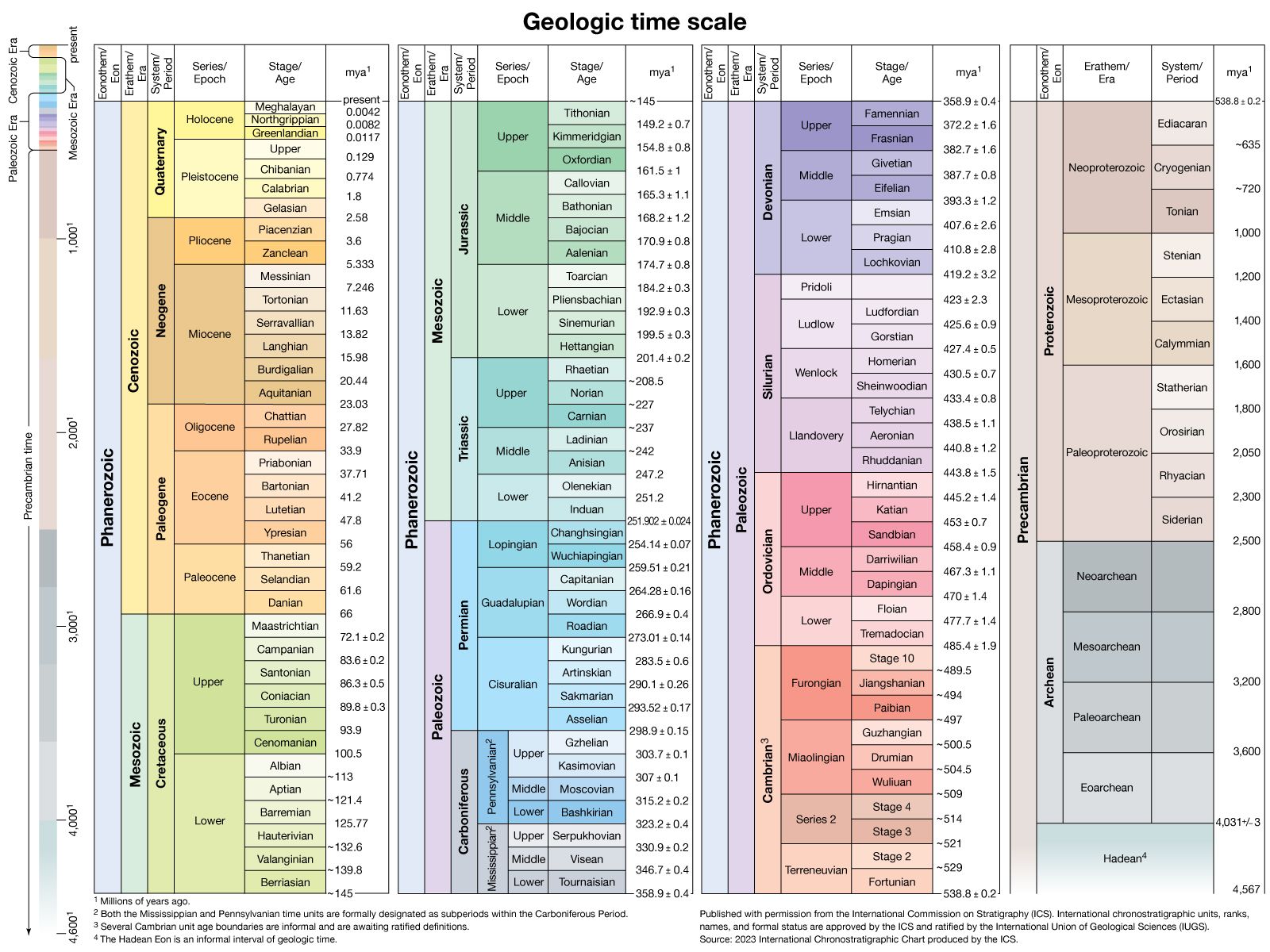
The Gzhelian Stage represents the final interval of the Pennsylvanian Subsystem, serving as a bridge between the preceding Kasimovian Stage and the succeeding Asselian Stage of the Permian System.11
Comparison of Stages
Stage
Position
Time Interval (approx.)
Key Characteristics
Kasimovian
Precedes Gzhelian
307–303.7 Ma
Composed of limestones and dolomitic mudstones; base defined by
Protriticites
and
Obsoletes
fusulinids
.
Gzhelian
Middle
303.7–298.9 Ma
Composed of dolomite, marls, and siltstones; marks the end of the
Carboniferous System
.
Asselian
Follows Gzhelian
298.9–295.5 Ma
Composed of shales and limestones; base defined by the
conodont
Streptognathodus isolatus
.
While the Kasimovian and Gzhelian stages are both part of the Pennsylvanian Subsystem, the Gzhelian is distinguished by its role as the terminal phase of the Carboniferous Period. The boundary between the Gzhelian and the Asselian is particularly significant, as it marks the transition from the Carboniferous to the Permian, a boundary formally demarcated by a Global Stratotype Section and Point (GSSP) at Aidaralash Creek, Kazakhstan.21
What significant geological or climatic events occurred during the Gzhelian Stage?
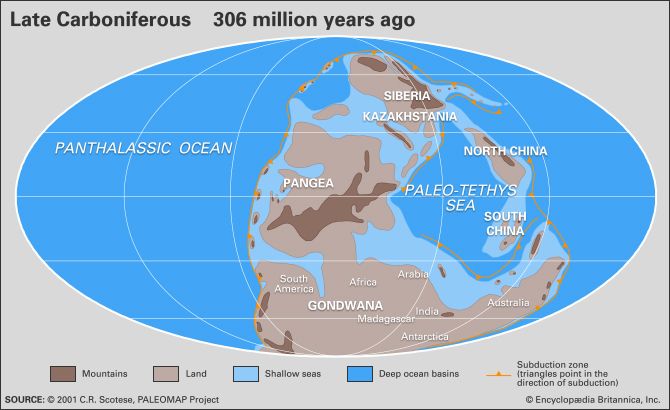
During the Gzhelian Stage (303.7 to 298.9 million years ago), the Earth experienced significant geological activity driven by the ongoing formation of the supercontinent Pangea.15
Geological and Climatic Context
- Orogenic Activity: The Pennsylvanian Subsystem, which includes the Gzhelian, concluded with the major Ouachita-Alleghenian-Hercynian orogeny. This mountain-building event resulted from the collision of the major landmasses of Laurussia and Gondwana, creating mountain ranges such as the Appalachians and the Hercynide Mountains in southern Europe.5
- Climatic Cycles: The period was characterized by persistent glaciations in Gondwana. The expansion and contraction of these massive ice sheets drove fluctuations in sea level, which in turn produced the cyclic sedimentary deposits known as cyclothems. These cycles are responsible for the extensive coal deposits found throughout the Northern Hemisphere.5
- Sedimentary Environment: Gzhelian strata reflect these environmental conditions, consisting primarily of dolomite, dolomitic marls, and siltstones deposited in cyclic patterns.1
What are some important locations or stratigraphic sections that represent the Gzhelian Stage?
The Gzhelian Stage is named after the Russian city of Gzhel, located southeast of Moscow in the Moscow Basin, which serves as the type area for the stage.1
While the Moscow Basin provides the historical context for the stage, the International Commission on Stratigraphy (ICS) has not yet established a Global Stratotype Section and Point (GSSP) for the base of the Gzhelian Stage. Consequently, researchers often rely on biostratigraphic markers, such as the first appearance of the conodont Idiognathodus simulator, to correlate Gzhelian strata globally.1
In contrast, the top of the Gzhelian Stage—which marks the boundary between the Carboniferous System and the Permian System—is formally defined by a GSSP located at the Aidaralash Creek section in northern Kazakhstan, which was ratified by the ICS in 1996.1
Sources
- Gzhelian Stage — Encyclopædia Britannica
- Carboniferous Period — Encyclopædia Britannica
- Asselian Stage — Encyclopædia Britannica
- Kasimovian Stage — Encyclopædia Britannica
- Carboniferous Period - Significant geologic events — Encyclopædia Britannica
- Europe - Uralian orogenic belt — Encyclopædia Britannica
Published on · 3 min read