Asselian Stage
The Asselian Stage, which marks the beginning of the Permian Period, is notably well-developed in the Perm region of Russia.
What are some notable rock formations or locations where Asselian Stage deposits can be found?
The Asselian Stage, which marks the beginning of the Permian Period, is notably well-developed in the Perm region of Russia.1
These geological deposits were formed in shallow marine environments along the eastern edge of the Russian Platform and the upper slope of the Uralian geosyncline. The strata consist of a mix of shales and limestones, which are interbedded with thin layers of sandstones and conglomerates.1
These formations are significant for their fossil content, including the first appearance of the conodont Streptognathodus isolatus, as well as various fusulinids and ammonites that allow for the global correlation of Lower Permian rock layers.1
How does the Asselian Stage compare to the stages immediately before and after it?
The Asselian Stage serves as the critical transition between the Carboniferous Period and the Permian Period. Its stratigraphic position and characteristics are defined by its relationship to the stages immediately preceding and following it:
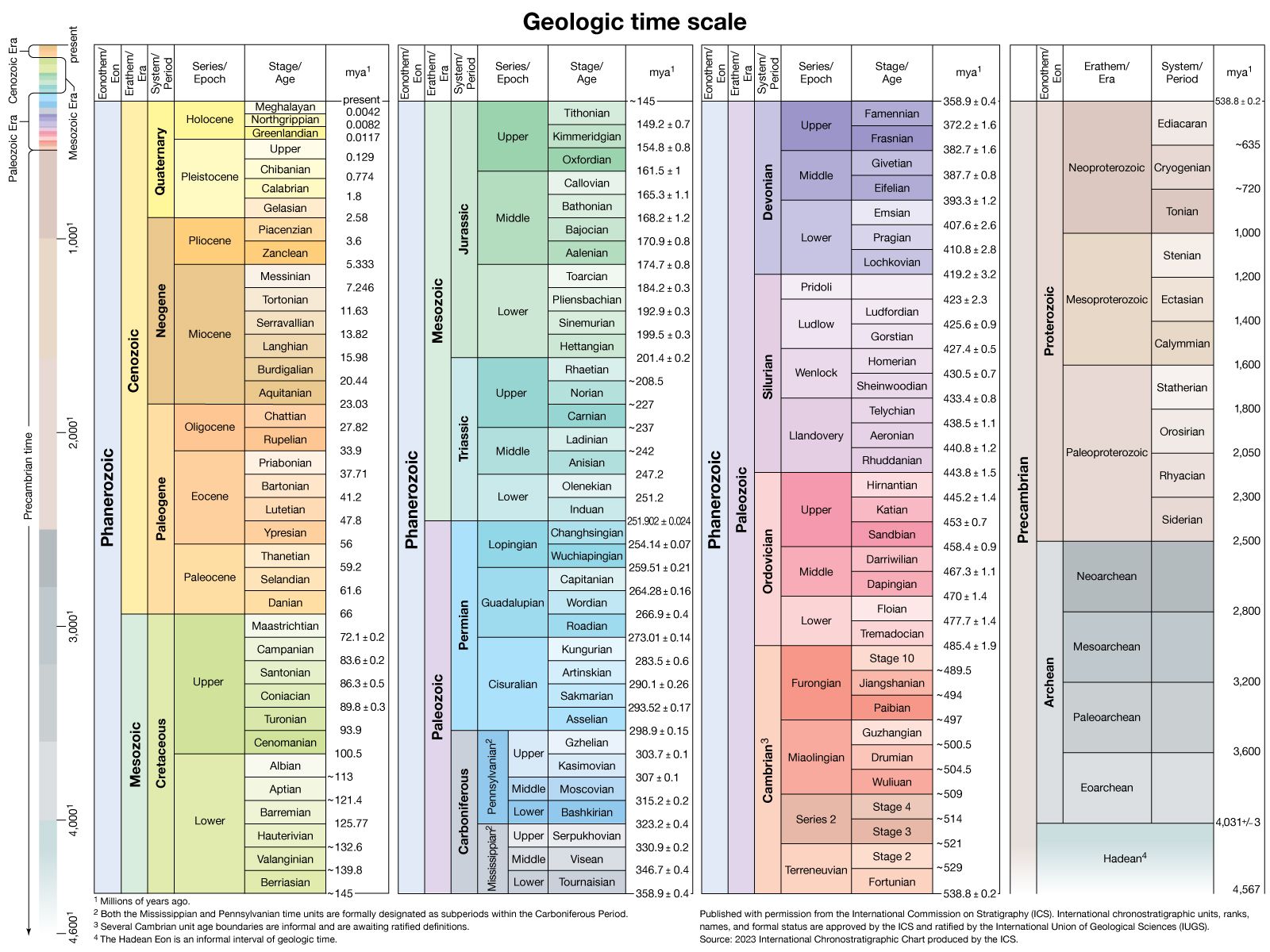
- Preceding Stage (Gzhelian): The Gzhelian Stage is the final stage of the Pennsylvanian Subsystem. The boundary between the Gzhelian and the Asselian marks the Carboniferous-Permian transition, which is formally demarcated by a Global Stratotype Section and Point at Aidaralash Creek, Kazakhstan.12
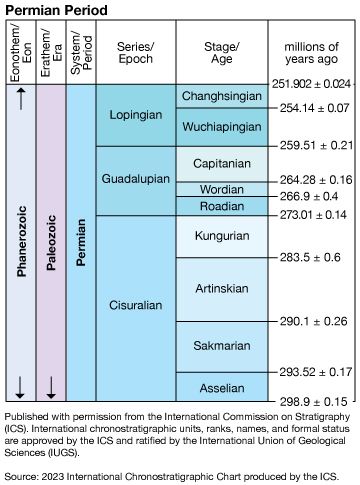
- Asselian Stage: Spanning 298.9 to 295.5 million years ago, the Asselian Stage is the first stage of the Lower Permian. It is distinguished by the first appearance of the conodont Streptognathodus isolatus.1
- Succeeding Stage (Sakmarian): The Sakmarian Stage follows the Asselian. Its base is defined by the first appearance of the conodont Sweetognathus merrilli. While both stages share certain fusulinid and ammonite fossil zones, the Sakmarian is characterized by a broader range of marine sedimentary facies, including significant sandstones and siltstones.13
How does the Asselian Stage relate to major geological or climatic events in Earth’s history?
The Asselian Stage (298.9 to 295.5 million years ago) represents a pivotal interval in Earth’s history, serving as the bridge between the Carboniferous Period and the Permian Period.1
Climatic Context
The Asselian Stage is notable for the persistence of glaciation that originated in the Carboniferous. During this initial phase of the Early Permian, vast regions—including parts of modern-day Antarctica, Australia, southern India, and northeastern Siberia—remained under ice. This period was characterized by strongly developed latitudinal climatic belts, which began to shift as the Earth transitioned toward the warmer, more arid conditions that defined the later Permian.45
Geological and Tectonic Events
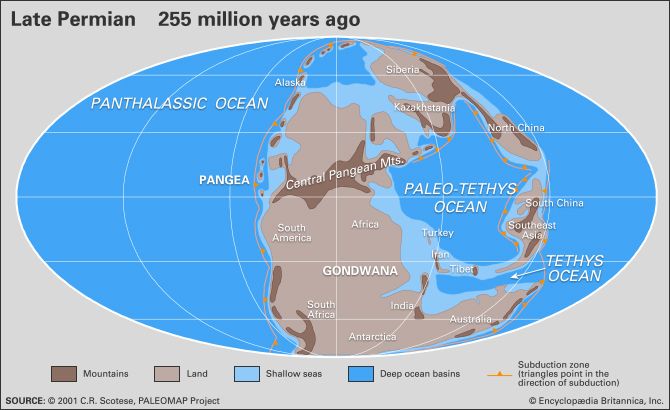
The Asselian occurred during the ongoing assembly of the supercontinent Pangea. The collision of major landmasses during this time triggered significant mountain-building events (orogenies) and the closure of low-latitude seaways. These tectonic shifts fundamentally altered global ocean currents and atmospheric circulation, setting the stage for the dramatic environmental changes that would eventually lead to the mass extinctions at the end of the Permian.45
How has our understanding of the Asselian Stage changed over time with new geological discoveries?
Our understanding of the Asselian Stage has evolved significantly as geologists moved from regional observations to a standardized global framework.
Initially, the Permian Period was defined by Roderick I. Murchison in the 1840s based on rock successions in the Ural Mountains. Early efforts relied on broad lithologic units, which often led to confusion regarding age equivalents and sedimentary gaps between regions like northwestern Europe and Russia.1
Modern refinement of the Asselian Stage has shifted toward precise biostratigraphy:
- Standardization: The definition of the Asselian is now anchored by a Global Stratotype Section and Point (GSSP) at Aidaralash Creek, Kazakhstan, ratified in 1996 to formally mark the Carboniferous-Permian boundary.6
- Biostratigraphic Markers: While early geologists used various fossils, current consensus prioritizes the first appearance of the conodont Streptognathodus isolatus to define the base of the stage.7
- Global Correlation: The use of specific fusulinid and ammonite zones has replaced older, less precise methods, allowing scientists to correlate Lower Permian strata across the globe with greater accuracy.7
Sources
- Asselian Stage — Encyclopædia Britannica
- Sakmarian Stage — Encyclopædia Britannica
- Gzhelian Stage — Encyclopædia Britannica
- Permian Period - Paleoclimate — Encyclopædia Britannica
- A Journey Through Time Since the Precambrian - Permian Period: 298.9 million to 252.2 million years ago — Encyclopædia Britannica
- Permian Period - Early work — Encyclopædia Britannica
- Triassic Period - The Permian-Triassic boundary — Encyclopædia Britannica
Published on · 3 min read