Kasimovian Stage
The Kasimovian Stage is the third of four internationally defined stages within the Pennsylvanian Subsystem, which is the younger of the two major subperiods…
How does the Kasimovian Stage relate to other stages in the Carboniferous period?
The Kasimovian Stage is the third of four internationally defined stages within the Pennsylvanian Subsystem, which is the younger of the two major subperiods of the Carboniferous Period.
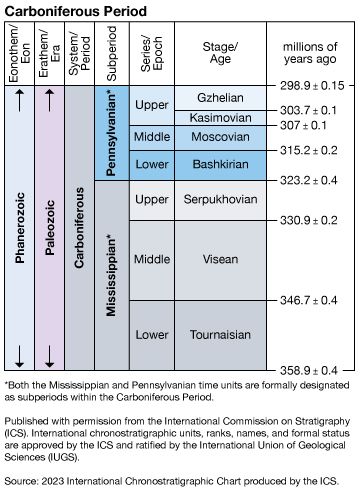
Chronostratigraphically, the Kasimovian is positioned between two other stages of the Pennsylvanian:
- Underlain by: The Moscovian Stage.1
- Overlain by: The Gzhelian Stage.1
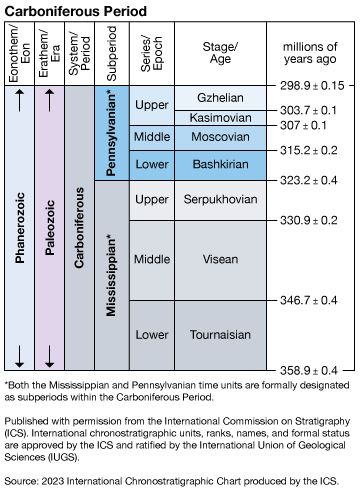
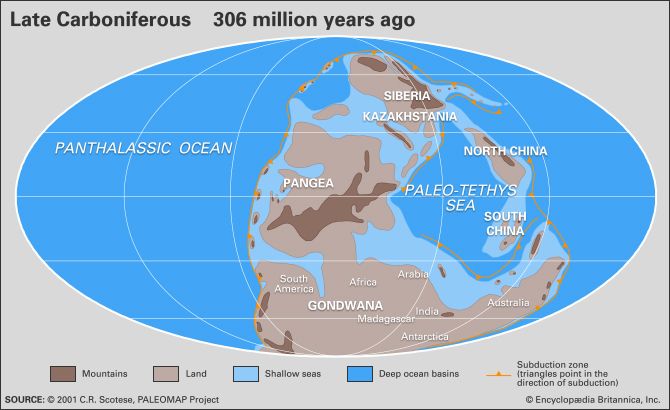
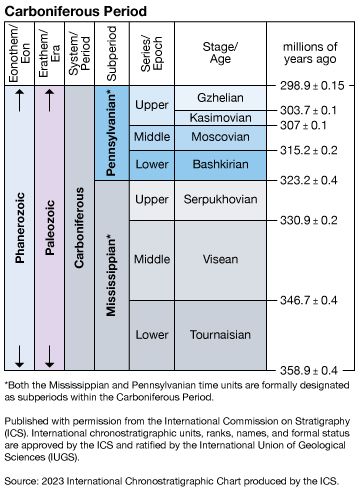
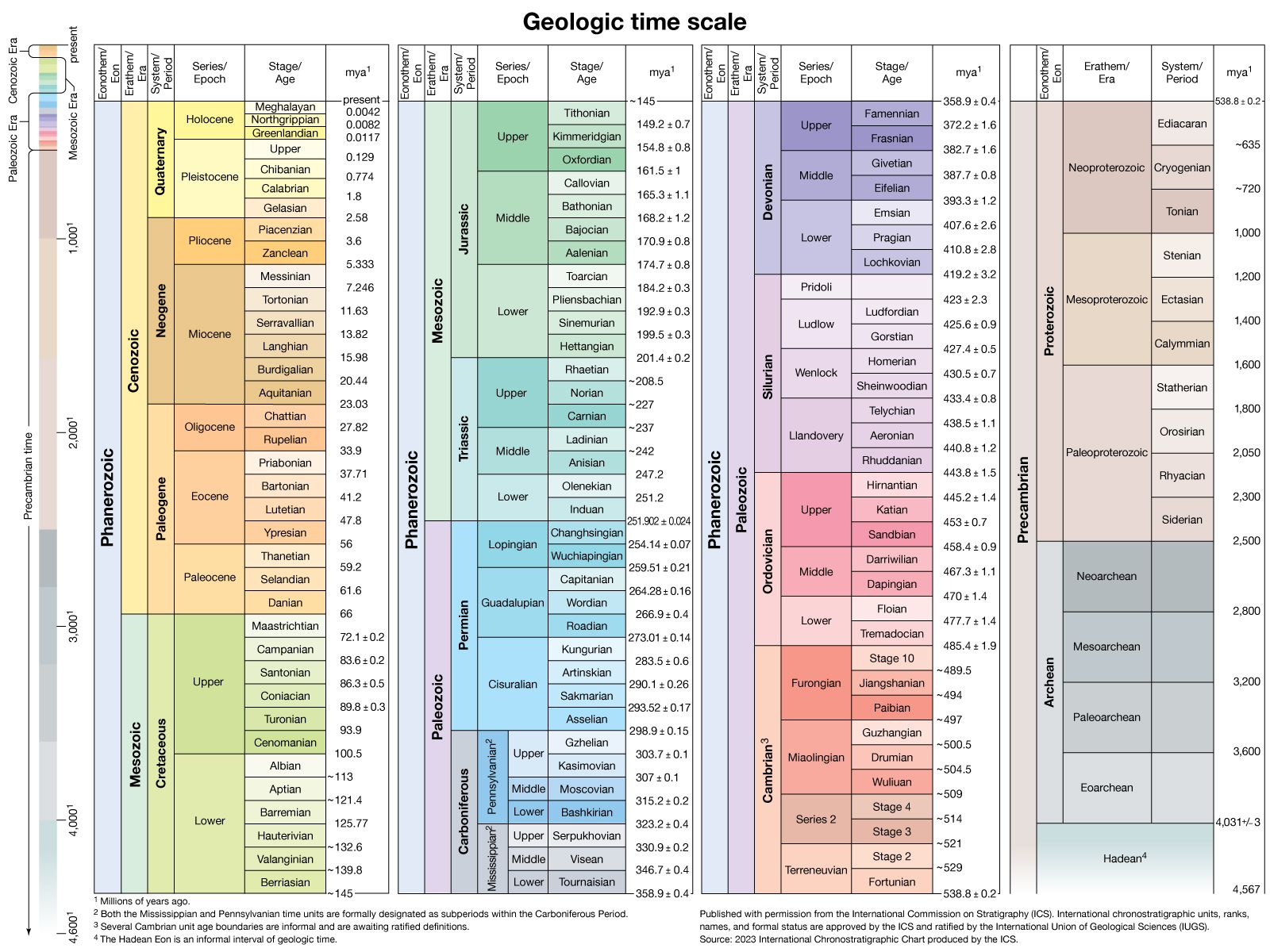
The Kasimovian represents the time interval from approximately 307 million to 303.7 million years ago. Its base is correlated with the boundary between the Westphalian and Stephanian series in western Europe, as well as the Desmoinesian-Missourian boundary in the North American midcontinent. While the Carboniferous Period is broadly divided into the Mississippian and Pennsylvanian subperiods, the Kasimovian specifically marks a segment of the later, coal-forming Pennsylvanian era.12
What are the global correlations for the Kasimovian Stage in different parts of the world?
The Kasimovian Stage, which spans from approximately 307 million to 303.7 million years ago, serves as a critical chronological marker within the Pennsylvanian Subsystem. While the International Commission on Stratigraphy has not yet established a formal Global Standard Section and Point for its base, geologists correlate the stage globally using specific fossil assemblages and regional stratigraphic boundaries.1
The base of the Kasimovian is identified by the appearance of advanced fusulinids, specifically the species Protriticites pseudomontiparus and Obsoletes obsoletus, alongside the ammonoid zone defined by the genus Parashumardites. These biological markers allow for the following regional correlations:1
- Western Europe: The base of the Kasimovian corresponds to the boundary between the Westphalian and Stephanian series.1
- North America: The base aligns with the boundary between the Desmoinesian and Missourian stages in the midcontinent region.1
These correlations help synchronize the geological record across different continents, despite the stage being originally defined by sections in the Moscow Basin of Russia.14
What is the Kasimovian Stage and where does it fit in the geological time scale?
The Kasimovian Stage is the third of four internationally recognized stages within the Pennsylvanian Subsystem. It encompasses the geological time interval from approximately 307 million to 303.7 million years ago.
In the broader geological time scale, the Kasimovian is part of the Carboniferous Period, which spanned from 358.9 to 298.9 million years ago. Within the Pennsylvanian Subsystem, the Kasimovian is positioned between the older Moscovian Stage and the younger Gzhelian Stage.
The stage is named after the city of Kasimov in the Moscow Basin, Russia, where its characteristic rock sequences—primarily limestones, mudstones, and siltstones—are found. While the International Commission on Stratigraphy has not yet established a formal Global Standard Section and Point for its base, it is correlated globally using specific fusulinid and ammonoid fossils.
How has the understanding of the Kasimovian Stage changed over time with new research?
The understanding of geological stages, including the Kasimovian Stage, has evolved as researchers move toward more precise, globally applicable methods of correlation.
Historically, the definition of the Kasimovian base has relied on the first appearance of specific fusulinid species, such as Protriticites pseudomontiparus and Obsoletes obsoletus, alongside ammonoid zones. While these biological markers remain central, the lack of a formal Global Stratotype Section and Point (GSSP) for the Kasimovian highlights an ongoing shift in stratigraphy.
Modern research in other stages of the Carboniferous Period and beyond suggests that reliance on single fossil groups can be limited by geographic provinciality. Consequently, scientists are increasingly exploring supplementary techniques:
- Conodont Biostratigraphy: As seen in the Gzhelian Stage, there is a growing preference for using conodont species, which are often considered more effective for global correlation than traditional fusulinids.
- Sequence Stratigraphy: Researchers now utilize depositional sequences—rock packages bounded by unconformities—to identify changes in global sea level.
- Isotope Stratigraphy: Geochemical analysis of carbon, oxygen, and strontium isotopes provides a way to track climate shifts and seawater chemistry, offering a powerful tool for correlating strata where fossils may be absent or endemic.
Sources
- Kasimovian Stage — Encyclopædia Britannica
- Carboniferous Period — Encyclopædia Britannica
- A Journey Through Time Since the Precambrian - Carboniferous Period: 358.9 million to about 298.9 million years ago — Encyclopædia Britannica
- Moscovian Stage — Encyclopædia Britannica
- Ordovician Period - Correlation of Ordovician strata — Encyclopædia Britannica
- Silurian Period - Isotope stratigraphy — Encyclopædia Britannica
- Gzhelian Stage — Encyclopædia Britannica
Published on · 3 min read