Hatchetfish
Deep-sea hatchetfishes (family Sternoptychidae) have evolved specialized physical and physiological traits to survive in the challenging conditions of the…
How do hatchetfish adapt to their deep-sea environment?
Deep-sea hatchetfishes (family Sternoptychidae) have evolved specialized physical and physiological traits to survive in the challenging conditions of the ocean’s twilight zone, typically at depths of 200–1,000 meters.1
Their primary adaptations include:
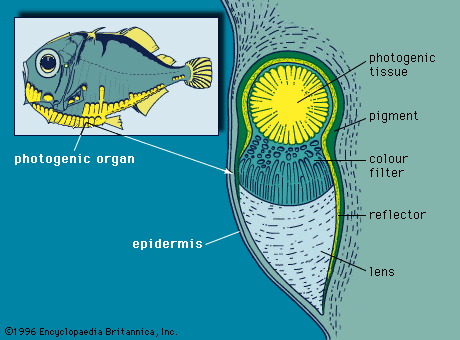
- Counter-illumination: These fish possess rows of light-producing organs called photophores along their lower bodies. By emitting light downward, they match the intensity of sunlight filtering from above, which obliterates their silhouette and conceals them from predators lurking below.123
- Specialized Vision: To navigate the darkness, they have evolved large eyes, which in some species are mounted on upward-pointing tubes to better detect prey or threats from above.1
- Body Morphology: Their deep-bodied, laterally flattened shape is a hallmark of their adaptation to deep-sea life.1
- Communication: The distinct arrangement of their photophores may also serve as essential signals for species and sex recognition.2
Are there different species of hatchetfish, and how do they differ?
There are two distinct, unrelated groups of fish commonly referred to as hatchetfish, which differ significantly in their habitat, anatomy, and behavior.1
Deep-Sea Hatchetfishes (Family Sternoptychidae)
These are small, carnivorous, deep-sea dwellers found in warm and temperate oceans at depths of 200–1,000 meters.1
- Physical Traits: They are characterized by a deep, laterally flattened body, a slender tail, and rows of light-producing organs along their lower sides.1
- Specialization: None of the approximately 15 species exceed 10 cm in length. Some, such as those in the genus Argyropelecus, possess large eyes mounted on upward-pointing tubes to aid in hunting.1
Freshwater Hatchetfishes (Family Gasteropelecidae)
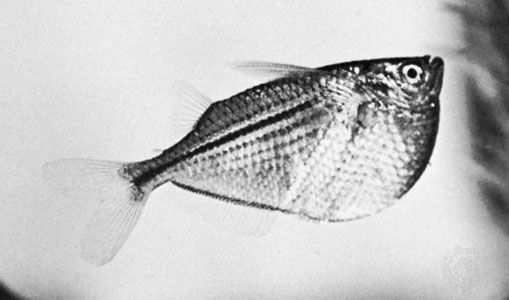
Also known as flying hatchetfishes or flying characins, these South American species inhabit the water’s surface to feed on insects.1
- Behavior: They are known for their ability to glide and hydroplane across the water surface by flapping their large pectoral fins.1
- Diversity: There are about nine species, ranging from 3 to 10 cm in length. Popular aquarium varieties include the marbled hatchetfish (Carnegiella strigata) and the silver hatchetfish (Gasteropelecus sternicula).1
What is the taxonomic classification of hatchetfish?
The term “hatchetfish” refers to two unrelated groups of fish, each with its own distinct taxonomic classification:
- Deep-sea hatchetfishes: These belong to the family Sternoptychidae.1
- Freshwater (or flying) hatchetfishes: These are members of the family Gasteropelecidae. They are allied to the characins within the order Characiformes.15
While deep-sea hatchetfishes are distinct, the freshwater varieties are sometimes categorized by authorities within the broader characin family, Characidae.1
How do scientists study hatchetfish given their deep-sea habitat?
Scientists study deep-sea hatchetfish by employing specialized marine biology techniques designed to access and observe organisms in their extreme, high-pressure habitats. Because these fish reside at depths of 200–1,000 meters, traditional collection methods are often supplemented by advanced technology.18
Sampling and Collection
- Midwater Trawls: Researchers use specialized nets, such as the Isaacs-Kidd midwater trawl, to capture specimens at great depths. These trawls are designed to move at high speeds, preventing fast-swimming fish from escaping, and often include a perforated canister at the end to retain samples in relatively undamaged condition.9
- Quantitative Samplers: Devices like the Clark-Bumpus sampler allow scientists to collect specimens from specific depths while simultaneously measuring the volume of water filtered, providing data on the concentration of organisms.9
Observation and Analysis
- Direct Observation: Since World War II, the use of underwater cameras, television, and remotely operated vehicles (ROVs) has enabled scientists to observe these fragile creatures in their natural environment without the need for physical capture.108
- Acoustic Sensing: Biologists use acoustic technology to record and analyze the distribution and behavior of deep-sea life, as many organisms scatter sound or create distinct acoustic signatures.9
- Laboratory Study: Once collected, specimens are often transferred to coastal biological stations where they can be maintained in specialized, temperature-controlled seawater systems for physiological and behavioral research.8
Sources
- hatchetfish — Encyclopædia Britannica
- Bioluminescence - The role of bioluminescence in behavior — Encyclopædia Britannica
- Bioluminescence: Top Questions — Encyclopædia Britannica
- coloration - Countershading — Encyclopædia Britannica
- gasterosteiform - Annotated classification — Encyclopædia Britannica
- ostariophysan - Annotated classification — Encyclopædia Britannica
- hatchetfish — Merriam-Webster
- undersea exploration - Collection of biological samples — Encyclopædia Britannica
- ROV — Merriam-Webster
- Bioluminescence - The range and variety of bioluminescent organisms — Encyclopædia Britannica
- Marine biology — Encyclopædia Britannica
- luciferase — Encyclopædia Britannica
Published on · 3 min read