Dealfish
A dealfish is a slender, silvery marine fish belonging to the genus Trachipterus within the family Trachipteridae. As a member of the ribbonfish group, it is…
What is dealfish?
A dealfish is a slender, silvery marine fish belonging to the genus Trachipterus within the family Trachipteridae. As a member of the ribbonfish group, it is characterized by a long, laterally compressed body, a short head, and a narrow mouth with weak teeth.12
These fish inhabit deep-sea middle waters, typically at depths of around 400 meters (1,300 feet), and are distributed worldwide. While they can reach lengths of up to 2.5 meters (8.2 feet), they possess small pectoral fins and lack an anal fin. A notable feature of young dealfish is the presence of extraordinarily long, hornlike projections on some of their fin rays. The most common species is the northern dealfish, T. arcticus.12
What are other types of ribbonfish?
The family Trachipteridae, commonly known as ribbonfishes, consists of three distinct genera of deep-sea, marine fishes. These slender-bodied, laterally compressed fish are characterized by their lack of anal fins and upward-pointing caudal fins.3
The three genera within the family Trachipteridae are:
- Trachipterus: This genus includes the dealfishes, such as the northern dealfish (T. arcticus), which can reach lengths of up to 2.5 meters.341
- Desmodema: One of the three primary genera that constitute the ribbonfish family.3
- Zu: The third genus within the Trachipteridae family.3
While the term “ribbonfish” is specifically applied to the family Trachipteridae, the order Lampridiformes—to which these fish belong—also includes other ribbonlike or elongated species that are sometimes associated with the group, such as the oarfish (Regalecus glesne) of the family Regalecidae. Oarfishes are significantly larger than typical ribbonfishes, reaching lengths of up to 9 meters, and are distinguished by their toothless jaws and elongated, red pelvic fins.3562
How do deep-sea fish adapt to living in middle waters?
Deep-sea fish inhabiting middle waters (the twilight zone, approximately 200–1,000 meters deep) have evolved specialized physiological and structural traits to survive in a dark, cold, and food-poor environment.78
Physical and Structural Adaptations
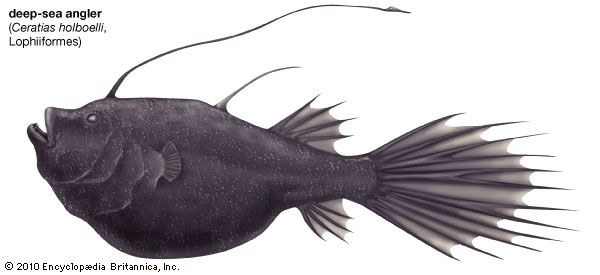
To conserve energy in an environment where food is scarce, many mid-water species have evolved bodies that are feebly developed, often appearing gelatinous with reduced skeletons and muscles. These fish frequently possess huge mouths and enlarged eyes, which help them capture prey and maximize light sensitivity in the darkness. Some species, such as the anglerfish, have adapted their anatomy to include specialized lures, such as an extended dorsal fin spine, to attract prey directly to their jaws.879
Bioluminescence
Many mid-water fish utilize bioluminescence—light generated through chemical reactions—to navigate and survive. This light, often blue-green to match the transmission of seawater, serves several critical functions:710
- Predation: Luminous organs act as lures to attract prey.79
- Defense: Photophores on the ventral and lateral surfaces can emit light to match the intensity of sunlight from above, effectively concealing the fish’s shadow from predators below.9
- Communication: Light patterns serve as species-recognition and mating signals.9
What does it mean for a fish to be laterally compressed?
For a fish, being laterally compressed means that its body is flattened from side to side. This body shape is a common adaptation among various fish species, particularly those that inhabit quiet, weedy lakes, ponds, and backwaters, such as many characins and cyprinids.13
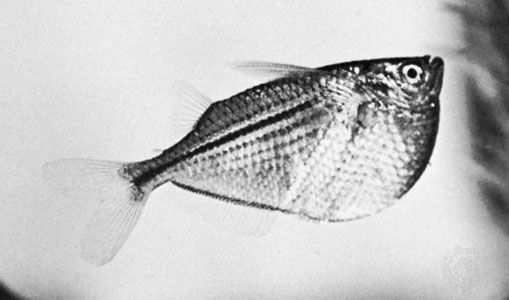
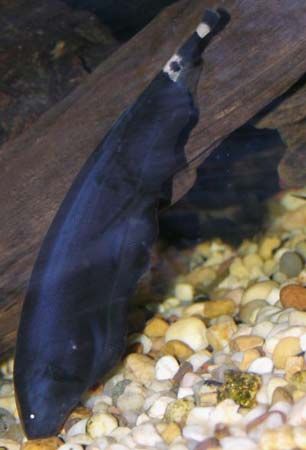
In some species, this compression is extreme, resulting in a very thin profile, as seen in hatchetfishes and knifefishes. In other instances, such as with shrimpfishes (also known as razor fishes), the body is compressed to such a sharp edge ventrally that it resembles the blade of a razor. This structural adaptation is distinct from a “depressed” body form, which refers to a fish being flattened from top to bottom, a trait often found in bottom-dwelling species like catfishes.1314
Sources
- dealfish — Encyclopædia Britannica
- dealfish — Merriam-Webster
- ribbonfish — Encyclopædia Britannica
- atheriniform - Annotated classification — Encyclopædia Britannica
- oarfish — Encyclopædia Britannica
- ribbonfish — Merriam-Webster
- deep-sea fish — Encyclopædia Britannica
- Marine bioluminescence — Encyclopædia Britannica
- fish - Structural diversity — Encyclopædia Britannica
- protacanthopterygian - Ecology — Encyclopædia Britannica
- Senses - Electric sense — Encyclopædia Britannica
- Bioluminescence - The role of bioluminescence in behavior — Encyclopædia Britannica
- lungfish - General features — Encyclopædia Britannica
- ostariophysan - Swimming — Encyclopædia Britannica
- gasterosteiform - Form and function — Encyclopædia Britannica
Published on · 3 min read