Wyandotte Cave
Wyandotte Cave, located in southern Indiana, is renowned for its extensive passages and impressive geological formations. Among its most notable features are:
What are some of the unique geological features found in Wyandotte Cave?
Wyandotte Cave, located in southern Indiana, is renowned for its extensive passages and impressive geological formations. Among its most notable features are:
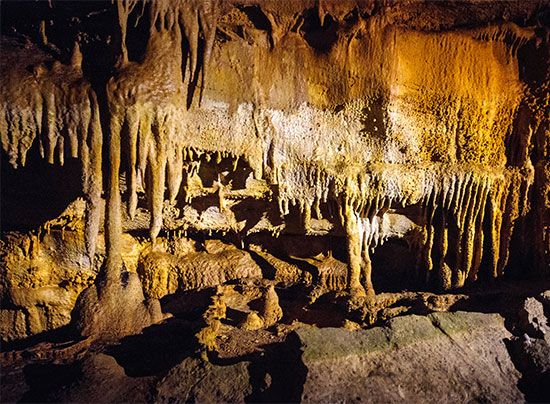
- Rothrock Cathedral: An enormous room measuring nearly 1,300 feet in circumference, featuring a 175-foot-tall central rock pile known as Monument Mountain.1
- Senate Chamber: An elliptical amphitheatre that houses the Pillar of the Constitution, a massive, fluted white calcite column. This structure, which combines a stalactite and a stalagmite, exceeds 70 feet in circumference.1
- Helictites: The cave contains numerous fine examples of these helictites, which are irregular, twisting speleothems that grow in defiance of gravitational pull.12
These features are formed within Mississippian limestones, where percolating waters deposit chemical sediments like calcite to create the cave’s decorative structures.12
Where is Wyandotte Cave located in Indiana, and how large is it?
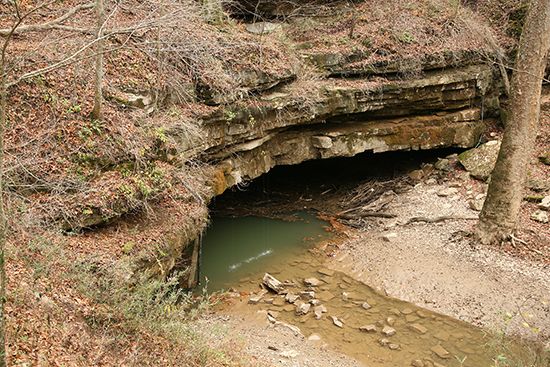
Wyandotte Cave is situated in Crawford County, southern Indiana, approximately 30 miles (48 km) west of New Albany.
Regarding its size, the cave is remarkably extensive, featuring 25 miles (40 km) of passages spread across five distinct levels. It is recognized as the largest among the numerous caves formed within the Mississippian limestones of the region.1
What Native American tribes were associated with Wyandotte Cave in the past?
While historical records confirm that Wyandotte Cave was utilized by Native Americans and is believed to have been inhabited during prehistoric times, specific tribal affiliations are not identified in the available records. The cave served as a significant site for these early populations, who left behind evidence of their presence within the extensive passages of the cave system.1
How does Wyandotte Cave compare to other famous caves in the United States?
Wyandotte Cave is a significant geological site in the United States, but it differs substantially in scale and status from the country’s most famous cave systems.
Comparison to Mammoth Cave
While Wyandotte Cave is the largest of the caves formed within the Mississippian limestones of southern Indiana, it is significantly smaller than the Mammoth Cave system in Kentucky1.
- Scale: Wyandotte Cave features 25 miles (40 km) of mapped passages. In contrast, the Mammoth-Flint Ridge system is the longest in the world, with at least 400 miles (650 km) of explored and mapped passages.134
- Designation: Mammoth Cave is a National Park and a UNESCO World Heritage site, reflecting its global significance and massive scale.54
- Geological Context: Both systems were formed by the dissolution of limestone by water, but Mammoth Cave’s vast, interconnected network—which includes the Flint Ridge Cave System—represents a much more extensive subterranean environment.164
Unique Features
Despite the difference in size, Wyandotte Cave is noted for its impressive individual chambers and formations, such as the Rothrock Cathedral and the Pillar of the Constitution, a massive column of white calcite. Like other major American caves, it also holds historical importance due to evidence of prehistoric human use.14
Sources
- Wyandotte Cave — Encyclopædia Britannica
- cave - Depositional materials and features — Encyclopædia Britannica
- 7 Wonders of America — Encyclopædia Britannica
- cave - Major caves and cave systems — Encyclopædia Britannica
- Flint Ridge Cave System — Encyclopædia Britannica
- Mammoth Cave National Park — Encyclopædia Britannica
Published on · 2 min read