Hister Beetle
A hister beetle is any of approximately 3,900 species of beetles belonging to the family Histeridae. These insects are typically shiny black, oval-shaped…
What is hister beetle?
A hister beetle is any of approximately 3,900 species of beetles belonging to the family Histeridae. These insects are typically shiny black, oval-shaped, and range in size from 0.5 to 10 mm (0.02 to 0.4 inch).1
Hister beetles are carnivorous and are commonly found in decaying organic matter, such as carrion, dung, or fungi. Some species inhabit mammal burrows, termite nests, or sand, while others are found under the bark of dead trees. They are known for their short wing covers (elytra), which leave the last two abdominal segments exposed. When disturbed, these beetles often remain motionless, appearing like tiny black seeds. As predators, they primarily feed on fly larvae or the larvae of other beetles living in excrement or carrion.123
How do hister beetles help in the decomposition process?
Hister beetles contribute to the decomposition process primarily through their role as predators rather than as direct scavengers of decaying matter. While they are commonly found in environments undergoing decomposition—such as carrion, dung, or rotting organic material—they do not typically consume the decaying matter itself.12
Instead, hister beetles act as biological regulators within these habitats by preying on fly larvae and the larvae of other beetles that are actively feeding on the excrement or carrion. By controlling the populations of these primary decomposers, hister beetles influence the dynamics of the decomposition process.2
What are some other types of predatory beetles found in nature?
Many beetles in the order Coleoptera are highly effective predators that play a significant role in controlling insect populations. Here are some notable types of predatory beetles found in nature:
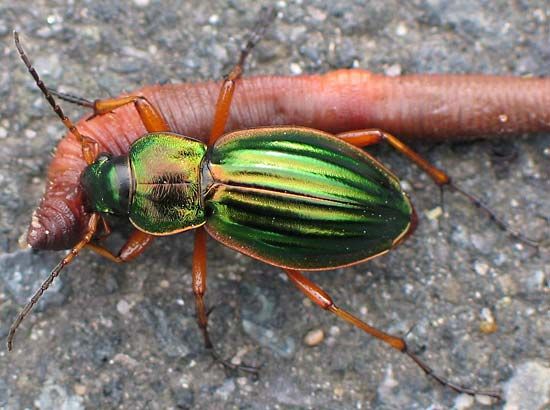
- Ground Beetles (Family Carabidae): One of the largest beetle families, these nocturnal hunters are typically shiny and dark. Both adults and larvae are predatory, feeding on a variety of prey including caterpillars, snails, and other small insects. Some species, such as the searcher (Calosoma scrutator), are known for climbing trees to hunt caterpillars.472
- Rove Beetles (Family Staphylinidae): These beetles are easily recognized by their slender bodies and short wing covers (elytra). They are predominantly predatory, both as larvae and adults, and are frequently found in decaying organic matter where they hunt other insects.489
- Ladybugs (Family Coccinellidae): Highly beneficial to humans, most ladybugs are voracious predators. Both larvae and adults feed on plant-sucking insects like aphids, scale insects, and mites, making them valuable for natural pest control in gardens and agriculture.410
- Tiger Beetles (Family Cicindelidae): Known for their speed and aggressive hunting habits, these beetles possess keen vision and long, sickle-like mandibles. Both the larvae, which wait in vertical burrows to ambush prey, and the adults are fierce predators.117
- Soldier Beetles (Family Cantharidae): These soft-bodied beetles are predatory as larvae, often found in soil or under bark hunting worms and other insect larvae, while the adults are commonly seen on flowers.87
How do beetles defend themselves from predators?
Beetles employ a diverse array of defensive strategies to survive encounters with predators. Their primary defense is a tough, sclerotized exoskeleton, which provides a rigid, protective barrier against many threats.1314
Beyond physical armor, beetles utilize several sophisticated tactics:
- Chemical Defense: Many species produce foul-smelling or distasteful secretions from specialized glands to repel attackers. The bombardier beetle, for instance, ejects a hot, noxious gas from its anal end when threatened.1516
- Camouflage and Mimicry: Some beetles blend into their environment; for example, certain species resemble moss or twigs. Others use mimicry, such as the wasp beetle, which imitates the appearance and movements of a wasp to deter predators.15
- Behavioral Tactics: Many beetles feign death when alarmed, folding their limbs to resemble inanimate objects like seeds or soil particles. Others rely on agility, such as the rapid running of ground beetles or the leaping ability of flea beetles.15
- Warning Signals: Some beetles use aposematic (warning) coloration—often combinations of red, black, and yellow—to signal their toxicity or inedibility to experienced predators.17
Sources
- hister beetle — Encyclopædia Britannica
- Coleoptera - Feeding habits and habitats — Encyclopædia Britannica
- Coleoptera - Larvae — Encyclopædia Britannica
- Coleoptera - As predators — Encyclopædia Britannica
- Histeridae — Merriam-Webster
- Coleoptera - As scavengers — Encyclopædia Britannica
- tiger beetle — Encyclopædia Britannica
- Coleoptera - Annotated classification — Encyclopædia Britannica
- ladybug — Encyclopædia Britannica
- ground beetle — Encyclopædia Britannica
- rove beetle — Encyclopædia Britannica
- rove beetle — Merriam-Webster
- Coleoptera - Protection — Encyclopædia Britannica
- mimicry - The selective advantage of warning — Encyclopædia Britannica
- Chemoreception - Defensive odors — Encyclopædia Britannica
- Coleoptera - Beetles as prey — Encyclopædia Britannica
- coloration - Warning, or aposematic , coloration — Encyclopædia Britannica
- Integument - Arthropods — Encyclopædia Britannica
Published on · 3 min read