Java Man
The Java man fossils were discovered by Dutch anatomist Eugène Dubois in the early 1890s along the Solo River at a site called Trinil on the island of Java…
Where exactly were the Java Man fossils found, and what was the significance of this location?
The Java man fossils were discovered by Dutch anatomist Eugène Dubois in the early 1890s along the Solo River at a site called Trinil on the island of Java, Indonesiaica.com/place/Java-island-Indonesia), Indonesia.1
The location is historically significant because it provided the first known fossils of the species Homo erectus. By analyzing the partial cranium and a modern-looking femur found in the same pit, Dubois argued he had discovered a “missing link”—a creature exhibiting an evolutionary transition between apes and humans, characterized by a small brain but an upright, human-like posture. While Dubois initially classified the find as Pithecanthropus erectus, subsequent scientific investigation confirmed its status as a pivotal member of the human lineage.1
What tools or artifacts, if any, were found associated with Java Man?
While the original discovery of Java Man by Eugène Dubois at the Trinil site in the 1890s consisted primarily of a skullcap and a femur, subsequent research at the location has provided further insight into the capabilities of Homo erectus.
Regarding artifacts and cultural evidence at the Trinil deposit, researchers have identified a significant find: zigzag etchings made on a shell. Dating to between 430,000 and 540,000 years ago, these markings are considered by some to be the world’s oldest known geometric engravings, suggesting that Homo erectus may have been the first species to create art.1
More broadly, while Homo erectus remains found at open sites like Trinil, Sangiran, and Mojokerto are often associated with proximity to water, these locations have revealed evidence of human activity, including abundant stone implements and stone chips resulting from manufacture. Although Homo erectus is associated with the Chopper chopping-tool family of industries in various parts of the world, there is no evidence that they buried their dead, as no graves, grave goods, or ritualistic items have been found associated with their remains.1
Who discovered Java Man, and what led to this important find?
Java man was discovered by the Dutch anatomist and geologist Eugène Dubois in the early 1890s.13
Driven by a strong interest in human evolution, Dubois traveled to Southeast Asia in 1887 as a military surgeon to search for the ancestors of modern humans. After initial excavations on the island of Sumatra proved unsuccessful, he moved to Java in 1890.13
In August 1891, working with a team of laborers along the Solo River at Trinil, Dubois unearthed a skullcap and a femur (thighbone) from the same pit. By combining the evidence of a small brain from the cranium with the modern, upright-walking posture indicated by the femur, Dubois argued he had discovered a “missing link” between apes and humans. He originally classified the find as Pithecanthropus erectus, though it was later confirmed to be a member of the species Homo erectus.13
What were the key physical characteristics of Java Man?
Java Man, a member of the species Homo erectus, possessed a distinct set of physical characteristics that reflect its evolutionary position. Key features of its anatomy include:
- Cranial Capacity: The skull had an average capacity of approximately 900 cubic cm, which is smaller than that of later H. erectus specimens and significantly smaller than that of modern Homo sapiens.15
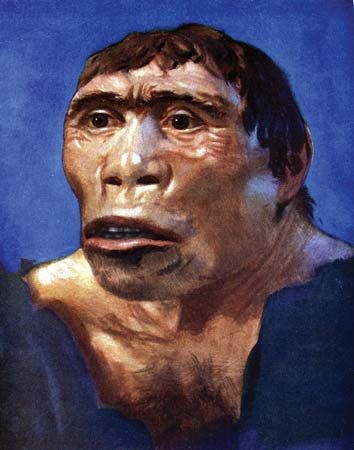
- Skull Structure: The skull was characterized by a low, flat profile with little forehead. It featured very thick bones, heavy browridges (supraorbital torus), and a crest along the top of the head that served as an attachment point for powerful jaw muscles.15
- Jaw and Teeth: The jaw was massive and robust, notably lacking a chin. While the teeth were essentially human, they retained some apelike features, such as large, partly overlapping canines.15
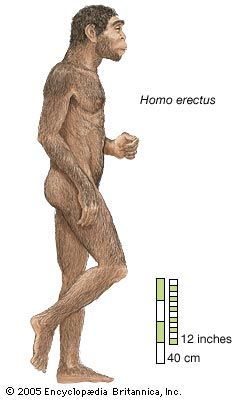
- Stature and Posture: Analysis of the femur indicates that Java Man walked fully erect, similar to modern humans. Individuals attained a height of approximately 170 cm (5 feet 8 inches).1
Sources
- Java man — Encyclopædia Britannica
- Homo erectus - Behavioral inferences — Encyclopædia Britannica
- Eugène Dubois — Encyclopædia Britannica
- Cultural anthropology - 19th-century beginnings — Encyclopædia Britannica
- Homo erectus - Body structure — Encyclopædia Britannica
- Solo man — Encyclopædia Britannica
Published on · 3 min read