Homo Sapiens
The study of Homo sapiens has fundamentally reshaped our understanding of human origins and diversity by integrating fossil evidence with molecular genetic…
How has the study of Homo sapiens contributed to our understanding of human origins and diversity?
The study of Homo sapiens has fundamentally reshaped our understanding of human origins and diversity by integrating fossil evidence with molecular genetic data.12
Current scientific consensus, supported by mitochondrial DNA and Y chromosome analysis, strongly favors the “out-of-Africa” model. This research indicates that modern humans emerged as an anatomically distinctive species in Africa approximately 315,000 years ago before migrating globally. Genetic studies have been crucial in demonstrating that genomic differences between diverse populations are minuscule, confirming that race is a cultural construct rather than a biological reality.231
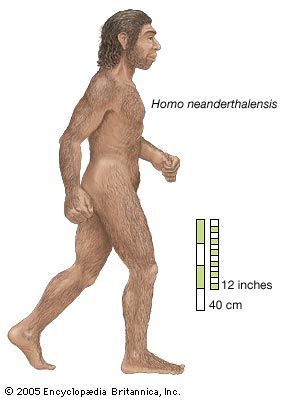
Furthermore, genetic analysis has revealed that while H. sapiens replaced other archaic hominin groups, limited interbreeding occurred with populations such as Neanderthals and Denisovans. These interactions left genetic traces that influenced the development of immune systems in modern non-African populations. Ultimately, these studies affirm the ethical principle that all present-day human populations share the same biological potential and common ancestry.21
How did Homo sapiens evolve from earlier hominin species?
The evolutionary origins of Homo sapiens remain a subject of active scientific debate, as the fossil record does not provide a single, definitive lineage. While it is generally agreed that the human family tree traces back to apelike primates of the Miocene Epoch, the specific path from earlier hominins to modern humans is complex and often contested.15
Evolutionary Models
Several models attempt to explain how H. sapiens emerged between approximately 315,000 and 30,000 years ago:1
- African Replacement (“Out of Africa”): This model, which has gained the widest acceptance due to genetic data, posits that H. sapiens evolved solely in Africa before migrating to Eurasia and replacing indigenous hominin species with little to no interbreeding.1
- Multiregional Evolution: This model suggests that discrete archaic populations evolved locally in Africa, Asia, and Europe, interbreeding with contemporaries across regions to maintain species unity.1
- Hybridization and Assimilation: These intermediate models suggest that while H. sapiens originated in Africa, their expansion involved varying degrees of interbreeding with archaic populations, such as Neanderthals and Denisovans.16
Ancestral Candidates
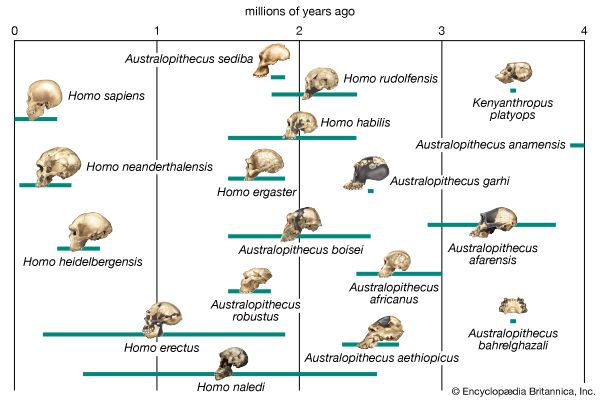
Paleoanthropologists continue to evaluate various species as potential ancestors. While H. ergaster is frequently proposed as an ancestor to later Pleistocene Homo species, the relationships between H. heidelbergensis, H. antecessor, and modern humans remain unclear. Recent discoveries, such as a 2.8-million-year-old mandible from the Ledi-Geraru area, suggest that dental features characteristic of later Homo appeared much earlier than previously thought, potentially pointing toward an as-yet-unidentified ancestor.17
Conversely, some species once considered potential ancestors have been reclassified. For example, the redating of H. naledi to approximately 300,000 years ago indicates that it likely evolved in parallel with H. sapiens rather than serving as a direct ancestor.17
When and where did the earliest Homo sapiens appear in the fossil record?
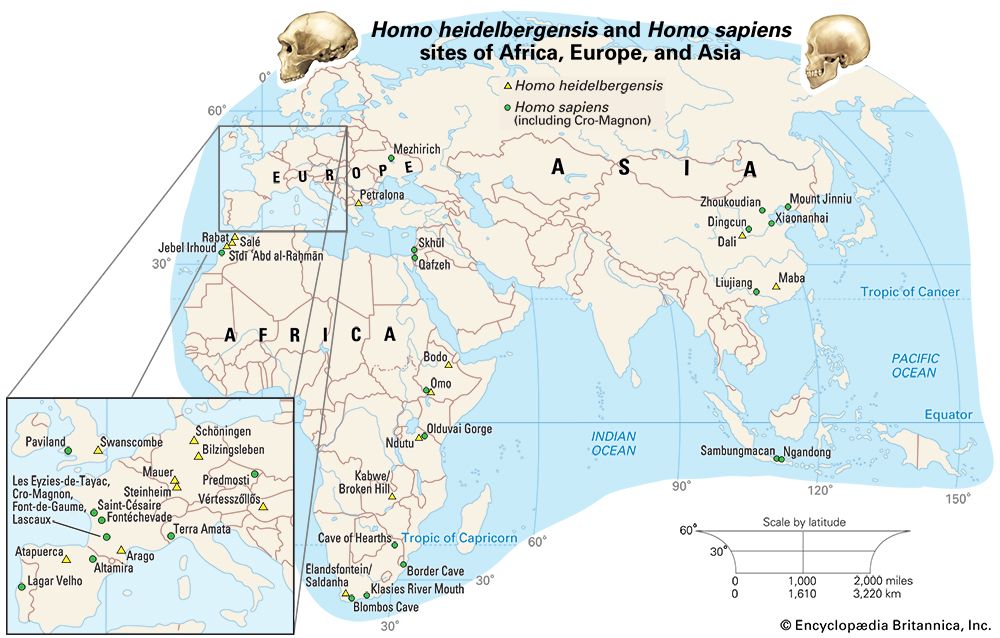
The earliest known fossils of Homo sapiens have been identified at Jebel Irhoud in Morocco. These remains, which include skull fragments, a complete jawbone, and associated stone tools, have been dated to approximately 315,000 years ago.58
Prior to this discovery, the oldest evidence of the species was attributed to remains found in the Omo Valley of Ethiopia. While these fossils were historically dated to roughly 195,000 years ago, more recent analysis involving argon-dating of overlying volcanic layers suggests they may be at least 233,000 years old.58
The presence of 315,000-year-old remains in North Africa suggests that Homo sapiens may have been widely dispersed across the African continent much earlier than previously assumed. While East Africa has long been considered the primary “cradle of humankind,” these findings indicate that the species’ origins and early expansion may have involved a broader geographic range within Africa.58
What are the key anatomical features that distinguish Homo sapiens from other hominin species?
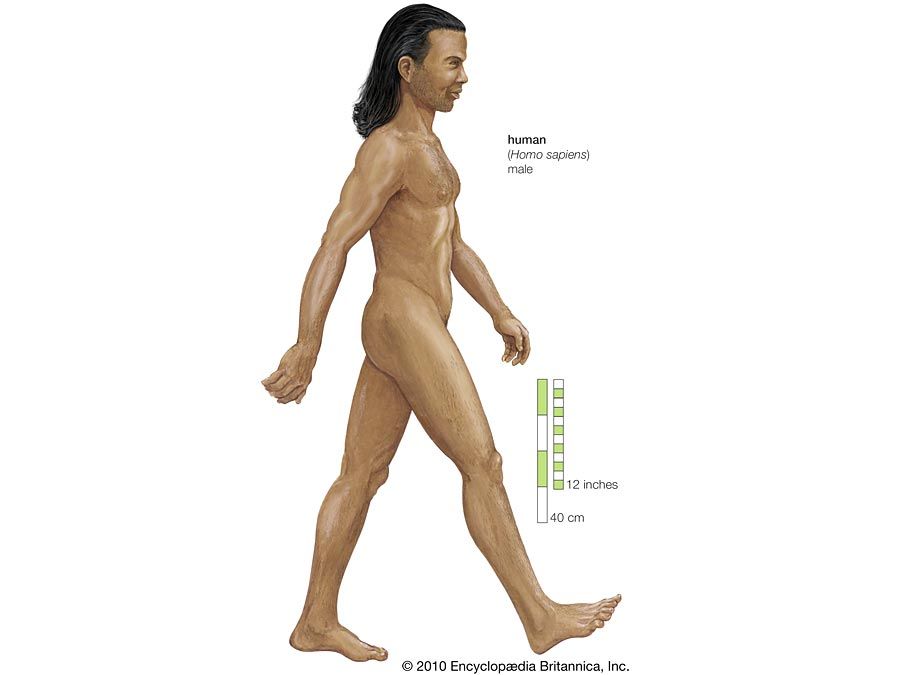
Homo sapiens is distinguished from other hominin species by a suite of unique anatomical characteristics, particularly within the skeletal structure. These features reflect a distinct evolutionary trajectory compared to archaic groups like Neanderthals or Homo erectus.12
Cranial and Facial Features
The most notable differences are found in the skull:
- Braincase: H. sapiens possesses a high, rounded, and thin-boned braincase, which houses a significantly larger average brain mass of approximately 1,350 grams.123
- Face: The face is greatly reduced in size and is not expanded by large air sinuses. It is topped by small or only modestly pronounced brow ridges that are uniquely divided into distinct central and lateral halves.12
- Chin: A defining feature of H. sapiens is the presence of a complex, distinctive chin. Unlike the simple midline swelling found in some other hominins, this structure is unique to our species.12
Skeletal Structure
In its overall bony structure, H. sapiens is characterized by a relatively lightly built skeleton. This contrasts with the more robust skeletal frames of earlier or contemporaneous species like H. erectus and Neanderthals, which often featured thicker skull bones, more pronounced brow ridges, and larger areas for neck muscle attachment.121314
While these traits define anatomically modern humans, paleoanthropologists note that the fossil record shows a gradual emergence of these features, with “protomodern” specimens—such as those from Jebel Irhoud—displaying a mix of primitive and modern characteristics.12
Sources
- human evolution - The emergence of Homo sapiens — Encyclopædia Britannica
- Anthropology - Overview — Encyclopædia Britannica
- Homo sapiens - Bodily structure — Encyclopædia Britannica
- genetics - Population genetics — Encyclopædia Britannica
- Australopithecus - Transition to Homo — Encyclopædia Britannica
- Neanderthal - Genetics — Encyclopædia Britannica
- human evolution - Background and beginnings in the Miocene — Encyclopædia Britannica
- Just How Old Is Homo sapiens? — Encyclopædia Britannica
- Homo habilis - Dating the fossils — Encyclopædia Britannica
- Australopithecus - Early species and Australopithecus anamensis — Encyclopædia Britannica
- Homo sapiens - The genus Homo — Encyclopædia Britannica
- Neanderthal - Craniofacial features — Encyclopædia Britannica
- human evolution - Increasing brain size — Encyclopædia Britannica
- Heidelberg jaw — Encyclopædia Britannica
- Australopithecus - Quality of the fossil record — Encyclopædia Britannica
- Homo habilis - Evolutionary implications — Encyclopædia Britannica
- Homo erectus - Body structure — Encyclopædia Britannica
Published on · 4 min read