Honeycreeper
Hawaiian honeycreepers are a group of passerine birds in the family Drepanididae that evolved through adaptive radiation on the Hawaiian Islands. Derived…
What are some of the most notable species of honeycreepers, and how do they differ?
Hawaiian honeycreepers are a group of passerine birds in the family Drepanididae that evolved through adaptive radiation on the Hawaiian Islands. Derived from a single ancestral cardueline finch, these birds diversified to exploit various ecological niches.12
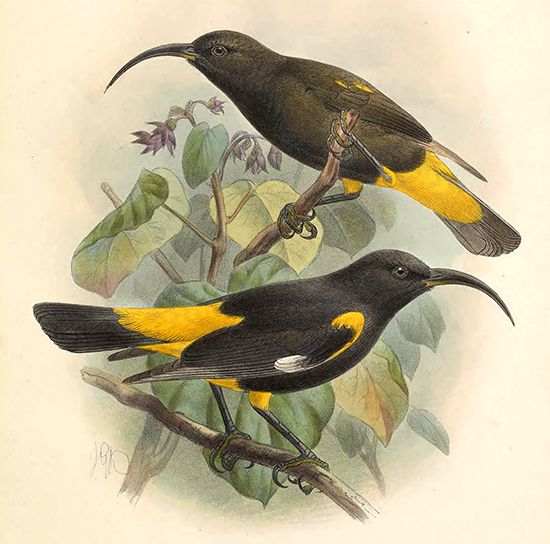
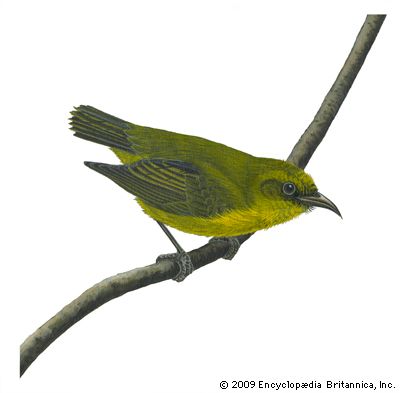
Notable species include the amakihi, apapane, iiwi, and mamo. They are primarily distinguished by their bill shapes and plumage, which reflect their specific diets:1
- Nectar-feeders: These species typically possess thin, curved bills and often display red-and-black plumage. Both sexes generally look alike.1
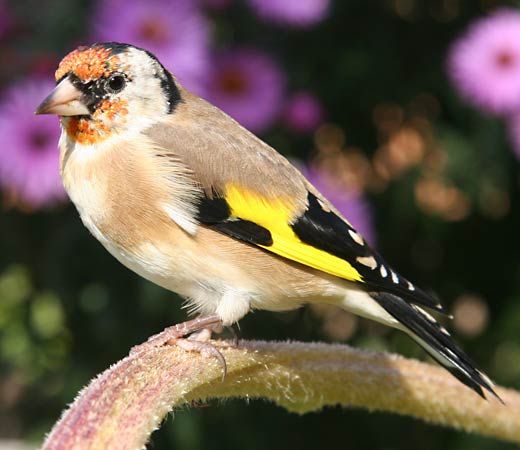
- Seed- and insect-eaters: These birds have finchlike, sturdier bills adapted for crushing or probing. Their plumage is usually greenish, with males often featuring yellow or orange markings.1
- Intermediate species: Some honeycreepers exhibit traits that fall between these two primary types.1
Most species share a troughlike, brush-tipped tongue, which is highly effective for nectar feeding. Unfortunately, habitat loss and invasive species have led to the extinction of at least 8 of the original 23 species, with most survivors currently endangered.13
How do honeycreepers get their name, and what is the significance of their relationship with nectar?
The name “honeycreeper” is derived from the feeding habits of these birds, specifically their tendency to forage for nectar from flowers, which is often referred to as “honey” in a colloquial sense.14
The relationship between honeycreepers and nectar is a primary driver of their physical evolution, particularly regarding their bill morphology. Through a process of adaptive radiation, many species developed thin, pointed, or decurved (downward-curved) bills specifically adapted for probing flowers to extract nectar. To facilitate this diet, these birds typically possess a specialized, troughlike, and brush-tipped tongue that allows them to efficiently collect nectar.154
While many honeycreepers are nectar-specialists, others have evolved different bill types—such as heavy, seed-cracking bills—to exploit alternative food sources like insects, fruits, and seeds. This diversity highlights how bill shape is an evolutionarily plastic trait that responds to the specific ecological niches the birds occupy.15
Where are honeycreeper birds primarily found, and what are their preferred habitats?
The term “honeycreeper” refers to two distinct groups of birds found in different regions of the world, each with specific habitat preferences:
Hawaiian Honeycreepers (Drepanididae)
These birds are endemic to the Hawaiian Islands, meaning they are found nowhere else on Earth. They evolved within the islands’ native forests, where they underwent significant adaptive radiation to occupy various ecological niches. Their survival is currently threatened by habitat destruction and the introduction of non-native species.1
Tropical Honeycreepers (Thraupidae)
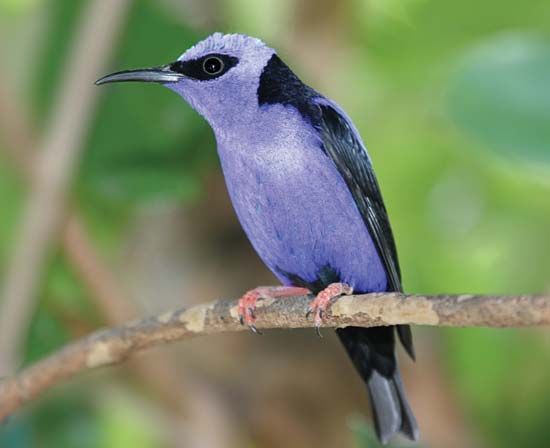
The four species of honeycreepers belonging to the family Thraupidae are found throughout the tropical regions of the Western Hemisphere. Their range spans from Mexico, Cuba, and Central America down through northern South America to southern Brazil. These birds are typically found in woodlands and gardens, where they build well-concealed, cup-shaped nests in trees.6
What are the main threats to honeycreeper populations, and are any species endangered?
Hawaiian honeycreepers face severe threats that have already led to the extinction of at least 8 of the original 23 known species, with most survivors currently considered endangered. The primary drivers of this decline include:1
- Avian Malaria: Introduced in the 1820s via mosquitoes, this disease has been devastating to native bird populations that lack natural immunity. While many honeycreepers retreated to high-elevation forests to escape malaria-carrying mosquitoes, rising temperatures due to climate change have allowed these mosquitoes to reach higher altitudes, further encroaching on the birds’ remaining habitat.7
- Habitat Destruction: The loss of native forests, often driven by the introduction of non-native herbivores like goats and pigs, has decimated the food sources upon which these birds rely. For example, the endangered palila depends almost exclusively on the seeds of the mamane tree, which is frequently overgrazed by introduced mammals.18
- Invasive Species: Beyond disease-carrying mosquitoes, the introduction of foreign birds and mammalian predators has placed additional pressure on native populations.1
- Specialization: Many honeycreepers are highly specialized feeders, making them particularly vulnerable to the loss of specific plants or insects within their ecosystem.8
Sources
- Hawaiian honeycreeper — Encyclopædia Britannica
- evolution - Adaptive radiation — Encyclopædia Britannica
- Hawaii - Plant and animal life — Encyclopædia Britannica
- Passeriform - Bill — Encyclopædia Britannica
- honeycreeper — Merriam-Webster
- Honeycreeper — Encyclopædia Britannica
- avian malaria — Encyclopædia Britannica
- conservation - Secondary extinctions — Encyclopædia Britannica
Published on · 3 min read