Apapane
The apapane (Himatione sanguinea) is a songbird native to the Hawaiian Islands. It is a member of the Hawaiian honeycreeper family (Drepanididae), a group of…
What is Apapane?
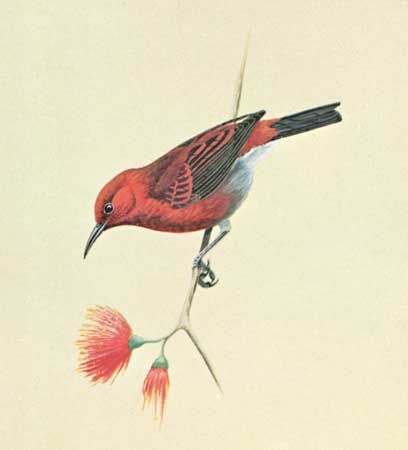
The apapane (Himatione sanguinea) is a songbird native to the Hawaiian Islands. It is a member of the Hawaiian honeycreeper family (Drepanididae), a group of birds known for their remarkable evolutionary radiation.12
Measuring approximately 13 centimeters (5 inches) in length, the apapane is characterized by its vibrant red plumage, contrasted by dark wings, a dark tail, and a white vent. It possesses a relatively short, slightly curved bill, which it uses to feed primarily on the nectar of ohia flowers in upland forests.1
Like many other Hawaiian honeycreepers, the apapane is part of a unique group of birds that evolved in isolation, diversifying in a manner similar to Darwin’s finches. While the apapane remains common on the larger Hawaiian islands, many of its relatives have faced significant threats from habitat destruction and the introduction of non-native species.2
What are Hawaiian honeycreepers?
Hawaiian honeycreepers are a group of birds belonging to the family Drepanididae that are found exclusively in the Hawaiian Islands. They are closely related to cardueline finches, such as canaries and goldfinches.2
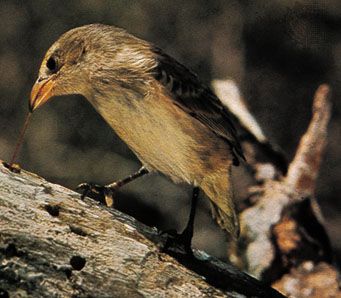
These birds serve as a classic example of adaptive radiation, having evolved from a single ancestral immigrant into a diverse array of species that occupy various ecological niches. Their physical characteristics vary significantly based on their diet:23
- Nectar-feeders: Often possess thin, curved bills and vibrant red-and-black plumage.2
- Seed- and insect-eaters: Typically have finchlike bills and greenish plumage, sometimes with yellow or orange markings.2
Most species feature a brush-tipped, troughlike tongue and range from 10 to 20 cm (4 to 8 inches) in length. Unfortunately, the introduction of non-native species and habitat destruction have severely impacted these birds; at least 8 of the original 23 species are extinct, and most survivors are considered endangered.2
How did the Apapane adapt to its environment?
The apapane (Himatione sanguinea) has adapted to its environment in the Hawaiian upland forests primarily through specialized physical traits that facilitate its role as a nectar-feeder.
Key adaptations include:
- Specialized Bill: The bird possesses a relatively short, slightly curved bill, which is specifically suited for accessing the nectar of ohia flowers, its primary food source.1
- Evolutionary Radiation: As a member of the Hawaiian honeycreeper family, the apapane is a product of adaptive radiation. Like Darwin’s finches, these birds diversified from a single ancestral immigrant to occupy specific ecological niches within the isolated Hawaiian Islands.2
- Anatomical Features: Like most honeycreepers, the apapane features a troughlike, brush-tipped tongue, an adaptation that assists in efficiently extracting nectar from flowers.2
While these adaptations have historically allowed the apapane to thrive in its forest habitat, the species remains vulnerable to environmental changes, including habitat destruction and the introduction of non-native species.12
What threats do native Hawaiian birds face today?
Native Hawaiian birds, particularly the Hawaiian honeycreepers, face severe threats that have led to the extinction of approximately one-third of their known species. These threats are multifaceted and often interconnected:
- Avian Malaria: This infectious disease, caused by Plasmodium parasites and transmitted by non-native mosquitoes, has been devastating. While many honeycreepers historically survived by retreating to high-elevation forests where mosquitoes could not survive, rising temperatures due to climate change have allowed these vectors to reach higher altitudes, encroaching on the birds’ last refuges.5
- Introduced Species: The introduction of non-native animals has had catastrophic effects. Feral cats act as efficient predators, while introduced herbivores like goats, pigs, and sheep destroy native plant communities. This habitat degradation removes essential food sources, such as the nectar-producing plants or specific trees like the koa and mamane, upon which specialized birds like the akiapolaau and palila depend.367
- Habitat Loss: Beyond the impact of invasive herbivores, general habitat destruction and overharvesting have significantly reduced the ecosystems necessary for survival.57
Sources
- Apapane — Encyclopædia Britannica
- Hawaiian honeycreeper — Encyclopædia Britannica
- Hawaii - Plant and animal life — Encyclopædia Britannica
- evolution - Adaptive radiation — Encyclopædia Britannica
- avian malaria — Encyclopædia Britannica
- conservation - Introduced species — Encyclopædia Britannica
- conservation - Secondary extinctions — Encyclopædia Britannica
Published on · 3 min read