Hookworm
A hookworm is a parasitic nematode (roundworm) belonging to the family Ancylostomatidae, primarily of the genera Necator and Ancylostoma. These worms are…
What is a hookworm?
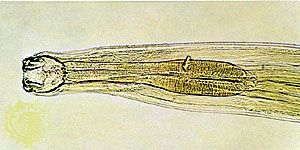
A hookworm is a parasitic nematode (roundworm) belonging to the family Ancylostomatidae, primarily of the genera Necator and Ancylostoma. These worms are characterized by strong buccal hooks or plates used to attach themselves to the lining of a host’s small intestine, where they feed on blood.123
The life cycle typically begins when eggs are passed in human feces into soil. Upon hatching, the larvae can penetrate human skin—often through the feet—travel through the bloodstream to the lungs, and eventually reach the intestine to mature.32
Infestation, known as hookworm disease, is most prevalent in tropical and subtropical regions where warm, moist soil and poor sanitation facilitate transmission. Chronic infection can lead to significant health issues, most notably secondary anemia caused by the worms’ bloodsucking activity, as well as fatigue, abdominal pain, and stunted growth. Treatment involves the use of anthelmintic medications and iron supplementation, while prevention relies on sanitary waste disposal and the use of footwear.32
What kind of organism is a nematode?
A nematode, also known as a roundworm, is any worm belonging to the phylum Nematoda. These organisms are among the most abundant animals on Earth, existing as either free-living forms in environments like soil and water or as parasites of animals and plants.45
Nematodes are bilaterally symmetrical, elongate, and typically tapered at both ends. They possess an external cuticle that is periodically shed through molting, a trait they share with arthropods within the taxonomic category Ecdysozoa. While some species are microscopic, others can reach lengths of up to 7 meters.4
Their life cycles vary; many nematodes have direct life cycles, spending their adult lives in a single host, while others have indirect life cycles requiring intermediate hosts. Because many species are parasitic, they are of significant medical and economic importance, causing various diseases such as filariasis, ascariasis, and trichinosis.64
How do hookworms infect humans or animals?
Hookworms typically infect humans and animals through contact with contaminated soil. The infection process follows these primary stages:
- Environmental Exposure: Adult worms living in a host’s small intestine produce eggs that are expelled in the host’s feces. If these eggs reach warm, moist, and loose soil, they hatch into larvae.31
- Skin Penetration: After developing into an infective stage, the larvae can penetrate human skin upon contact, most commonly through the feet. They often enter the body via hair follicles or sweat glands, frequently causing an itchy skin irritation known as “ground itch.”31
- Migration: Once inside, the larvae invade the blood vessels and lymph system. They are carried to the lungs, migrate up the respiratory tract to the mouth, and are subsequently swallowed.31
- Maturation: Upon reaching the small intestine, the larvae anchor themselves to the mucosal lining, mature into adult worms, and begin feeding on the host’s blood, completing the cycle.31
While rare, infection can also occur if infective larvae are swallowed directly, though this is not the standard mode of transmission in nature.3
What are common symptoms of a hookworm infection?
Symptoms of a hookworm disease infection vary depending on the severity of the infestation, with many light infections remaining asymptomatic. When symptoms do occur, they typically progress through the following stages:17
- Initial Skin Reaction: As larvae penetrate the skin, they often cause “ground itch,” an itchy irritation characterized by papules and vesicles, frequently appearing between the toes.17
- Respiratory Symptoms: During the migration of larvae through the lungs, individuals may experience coughing and fever.1
- Gastrointestinal and Systemic Effects: In the small intestine, adult worms feed on blood, which can lead to secondary anemia. Heavy infestations (often involving more than 500 larvae) may result in:
Sources
- hookworm disease — Encyclopædia Britannica
- hookworm — Merriam-Webster
- hookworm — Encyclopædia Britannica
- nematode — Encyclopædia Britannica
- nematode — Merriam-Webster
- parasitic disease - Parasite life cycles — Encyclopædia Britannica
- digestive system disease - Hookworms — Encyclopædia Britannica
Published on · 3 min read