Hornbill
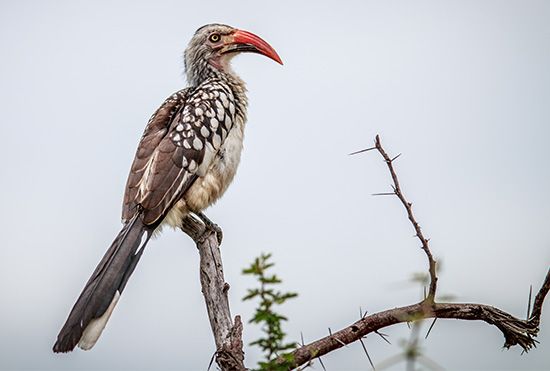
Hornbills (family Bucerotidae) play a significant role in seed dispersal within their tropical habitats. As fruit-eating birds, they are classified as…
How do hornbills contribute to seed dispersal in their habitats?
Hornbills (family Bucerotidae) play a significant role in seed dispersal within their tropical habitats. As fruit-eating birds, they are classified as ornithochores—plants that rely on birds to spread their seeds.1
These birds are attracted to conspicuous, fleshy fruits that often feature bright colors, such as red or orange, which help them locate food sources. When a hornbill consumes these fruits, it typically swallows the seeds along with the edible flesh. The bird’s digestive system is adapted to process the fruit while leaving the hard, embryo-containing seeds unharmed. As the hornbill travels through the forest, it eventually excretes or regurgitates these seeds at a distance from the parent plant.1
This process is vital for the survival and distribution of various plant species, as it allows seedlings to escape competition with the parent tree and helps the plants colonize new areas. By transporting seeds away from the immediate vicinity of the parent, hornbills also help seeds evade specialized seed predators that often congregate beneath parent trees.21
How do hornbills communicate with each other?
Hornbills communicate through a variety of vocalizations and behavioral displays. While their vocalizations are generally classified as calls rather than songs, they are well-endowed with voices that range from harsh to soft, whistled, or hissed notes. These sounds may be delivered as single notes or as series, such as trills, rattles, or hooting, and are often used during daily activities or to facilitate social interactions.2
When moving through the forest in small parties, hornbills are known to emit conversational notes. These vocalizations are often accompanied by physical movements; for instance, pairs may form through simple posturing displays combined with a series of calls.42
Beyond vocal communication, hornbills utilize visual signals. Their broad wings produce a characteristic loud “whooshing” noise during flight, which serves as an auditory signal to others. Furthermore, display behavior—ritualized actions that provide specific information to other members of the species—is a common feature among higher animals, including birds, to manage territorial boundaries, courtship, and warnings regarding potential predators.45
How long do hornbills typically live, and how does this vary between species?
The provided search results do not contain information regarding the typical lifespan of hornbills or how longevity varies between different species.
Where are hornbills typically found in the wild?
Hornbills are members of the family Bucerotidae, which consists of approximately 60 species of Old World tropical birds. They are found across various regions in the tropics of Africa and Asia.28
Specific distribution details include:
- Africa: Many species, such as the crowned hornbill (Tockus alboterminatus), are found in southern Africa.2
- Southeast Asia: Species like the bushy-crested hornbill (Anorrhinus galeritus) inhabit this region.2
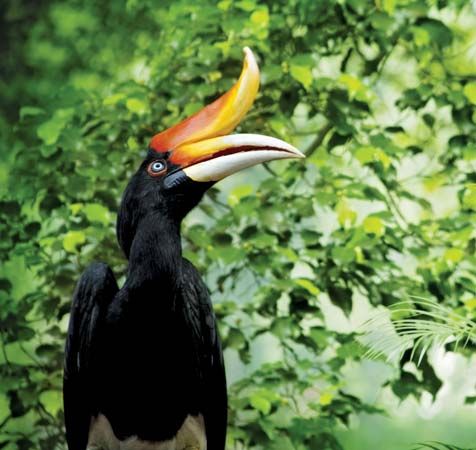
- Specific Islands: Some hornbills have highly restricted ranges. For example, the rhinoceros hornbill (Buceros rhinoceros) is found on the Malay Peninsula and islands of Indonesia. Others are endemic to specific islands in the Philippines, such as the Mindoro hornbill on Mindoro and the Visayan hornbill on Panay Island2.5
While many species maintain vast geographic ranges, some populations are currently threatened by deforestation and hunting pressure.2
Sources
- Tropical rainforest - Relationships between the flora and fauna — Encyclopædia Britannica
- Hornbill — Encyclopædia Britannica
- Seed - Dispersal by birds — Encyclopædia Britannica
- Coraciiform - Relationships with other species — Encyclopædia Britannica
- Coraciiform - Life history — Encyclopædia Britannica
- Coraciiform - Social behaviour — Encyclopædia Britannica
- Display behaviour — Encyclopædia Britannica
- rhinoceros hornbill — Merriam-Webster
Published on · 2 min read