Eohippus
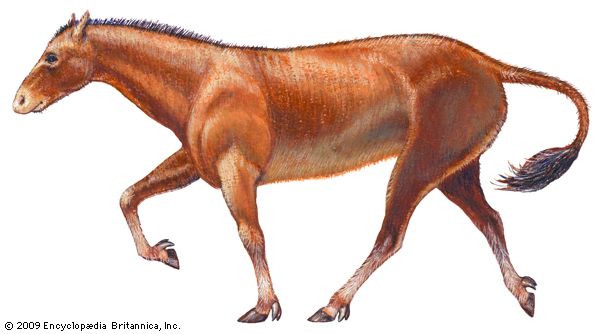
Eohippus, commonly known as the dawn horse, is an extinct genus of small, primitive mammals recognized as the earliest known horses. While frequently…
What is Eohippus and when did it live?
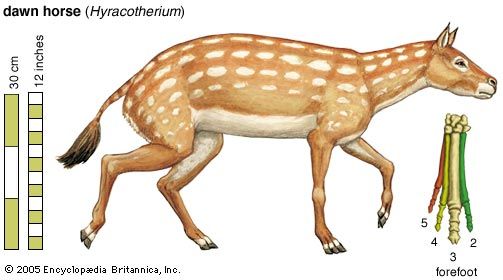
Eohippus, commonly known as the dawn horse, is an extinct genus of small, primitive mammals recognized as the earliest known horses. While frequently referred to as Eohippus, these animals are scientifically classified within the genus Hyracotherium.12
These creatures lived during the early part of the Eocene Epoch, which occurred approximately 56 million to 33.9 million years ago. They inhabited regions of North America and Europe. Physically, they stood about 30–60 cm (1–2 feet) tall at the shoulder and were browsers that fed primarily on leaves. They possessed four toes on their front feet and three on their hind feet, each ending in a small hoof.12
How does Eohippus relate to modern horses in terms of evolution?
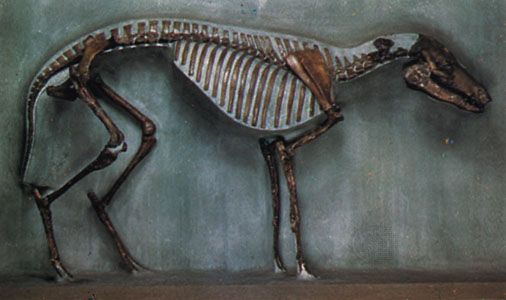
Eohippus (properly classified as Hyracotherium) represents the earliest known ancestor in the well-documented evolutionary lineage of the horse family, Equidae. While Eohippus was so physically distinct from modern equines that its relationship was initially unrecognized, it serves as the starting point for a series of evolutionary trends that led to the modern horse, Equus.13
The transition from Eohippus to modern horses involved several significant adaptations:
- Size and Anatomy: Over millions of years, descendants increased in size, elongated their muzzles, and developed larger, more complex brains.3
- Locomotion: The limbs lengthened, and the independent bones of the lower legs fused to support swift running. The feet evolved from the multi-toed, padded structure of Eohippus (four toes on the front, three on the back) to the single-hoofed foot of modern equines.34
- Dentition: Early forms were browsers with low-crowned teeth. As grasslands expanded, later ancestors developed high-crowned, crested teeth capable of grinding abrasive grasses.34
It is important to note that this evolution was not a single, steady line; Eohippus gave rise to many now-extinct branches, and some traits, such as grazing dentition, appeared abruptly in the fossil record.3
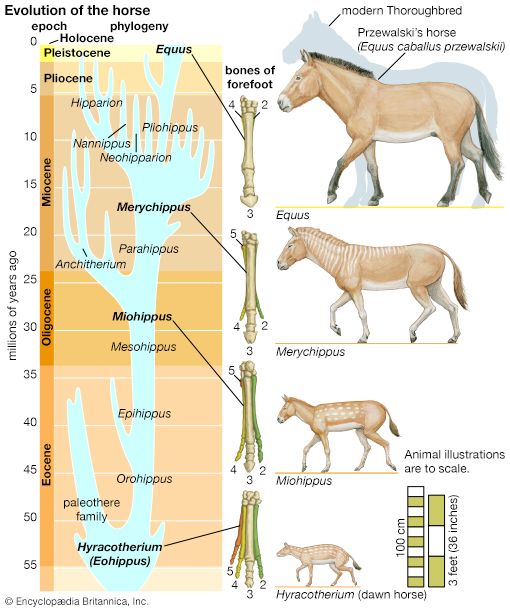
How did the feet and legs of Eohippus differ from those of modern horses?
The feet and legs of Eohippus (also known as Hyracotherium) differed significantly from those of modern horses in several key ways:
- Toes and Hooves: Eohippus possessed four functional toes on each forefoot and three on each hind foot, each ending in a small hoof. In contrast, modern equines have a single-hoofed foot.132
- Footpads: The feet of Eohippus were padded, whereas modern horses have unpadded, single-hoofed feet.3
- Leg Structure: The limbs of Eohippus were slender and relatively short. Over the course of evolution, the legs of horse ancestors lengthened, and the independent bones of the lower legs fused to support the swift running characteristic of modern horses.13
- Adaptation: While Eohippus was adapted for running to escape predators, its anatomy was far less specialized for speed than that of the modern horse, which utilizes a sophisticated spring mechanism in its feet and legs to facilitate efficient movement.13
How did the diet of Eohippus compare to that of modern horses?
The diet of Eohippus (also known as Hyracotherium) differed fundamentally from that of modern horses due to distinct dental adaptations. Eohippus was a browser that fed primarily on leaves rather than grass. Its teeth were characterized by low crowns and distinct cusps, which were well-suited for a general browsing diet but lacked the durability required for consuming abrasive vegetation.13
In contrast, modern equines are specialized grazers. As grasslands expanded over millions of years, the ancestors of the modern horse evolved high-crowned, crested teeth capable of grinding tough grass blades teeth capable of grinding tough grass blades. These teeth are designed to withstand significant wear; as the grinding surface is worn down, more of the long crown emerges from beneath the gumline to maintain an effective chewing surface throughout the animal’s life. While Eohippus relied on a succulent, leaf-based diet, the modern horse’s dentition and associated jaw mechanics are specifically adapted to the side-to-side grinding motion necessary to process coarse grasses.3
Sources
- Eohippus — Encyclopædia Britannica
- eohippus — Merriam-Webster
- horse - Evolution of the horse — Encyclopædia Britannica
- perissodactyl - Horses — Encyclopædia Britannica
Published on · 3 min read