Horseshoe Crab
While the provided search results confirm that humans have traditionally used horseshoe crabs as a source of food, they do not specify which particular…
What indigenous cultures have traditionally used horseshoe crabs, and for what purposes?
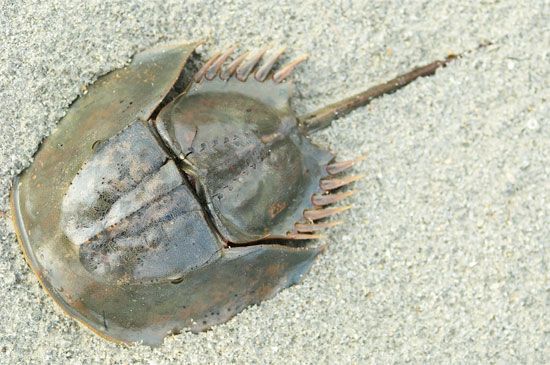
While the provided search results confirm that humans have traditionally used horseshoe crabs as a source of food, they do not specify which particular indigenous cultures have historically utilized them or the specific traditional purposes for which they were used.
The available information focuses on modern human interactions with the species, noting that they are harvested by the commercial fishing industry for use as bait and by the biomedical industry to extract coagulogen for the Limulus amoebocyte lysate (LAL) test, which detects harmful bacteria in medical products.
Sorry, the Britannica knowledge base does not contain this information regarding specific indigenous cultural practices.
How are horseshoe crabs being studied to potentially develop new antibiotics or other medical treatments?
Horseshoe crabs are primarily studied and utilized in the medical field for their unique blood chemistry rather than as a direct source for new antibiotics. Their significance lies in a primitive clotting protein called coagulogen, which is essential for modern safety testing.12
The LAL Test
In the 1960s, researchers Frederick Bang and Jack Levin discovered that coagulogen reacts to the presence of gram-negative bacteria or endotoxins—toxic substances found in bacterial cell walls. This discovery led to the development of the Limulus amoebocyte lysate (LAL) test.12
- Function: When LAL comes into contact with bacterial contamination, the coagulogen forms a clot (or “gel”) around the bacteria, even at concentrations as low as one part per trillion.12
- Medical Application: The LAL test is used to ensure that injectable drugs, intravenous solutions, and medical instruments are free from harmful bacterial contamination. It is highly valued for its speed, providing results in approximately 45 minutes.12
While this process is vital for public health, it involves harvesting blood from live horseshoe crabs, which carries a mortality rate of nearly 30 percent.12
How do horseshoe crabs molt, and how does this process change as they age?
Horseshoe crabs, like other arthropods, must periodically shed their rigid exoskeleton to accommodate growth, a process known as molting or ecdysis.31
The Molting Process
The process begins with a preparatory phase where the animal’s underlying cells secrete enzymes to digest the base of the old exoskeleton. Simultaneously, a new, soft, and flexible exoskeleton is secreted beneath the old one.3
When the animal is ready to molt, the old cuticle splits along specific lines—typically around the margin of the cephalothorax—and the horseshoe crab pulls itself out of the old shell. Immediately following this exit, the animal increases its size by approximately 25 percent by stretching the new, flexible exoskeleton through elevated blood pressure and the intake of water. The new shell then hardens over several hours through a process of tanning.31
Changes with Age
The frequency of molting changes significantly throughout the horseshoe crab’s life cycle:
- Larval Stages: Molting occurs frequently between early developmental stages. Larvae hatch without a tail-spine (telson), and subsequent molts allow them to develop this feature and grow in size.1
- Maturation: Horseshoe crabs reach sexual maturity after approximately 16 molts, a process that takes about 9 to 12 years.1
- Growth Intervals: As with other arthropods, the interval between molts—known as an instar—is short early in life but grows progressively longer as the animal ages.3
How is the horseshoe crab’s blue blood used in medical science?
The medical significance of the horseshoe crab lies in its unique, copper-based blood, which contains a primitive clotting protein known as coagulogen.152
The LAL Test
In the 1960s, researchers Frederick Bang and Jack Levin utilized this protein to develop the Limulus amoebocyte lysate (LAL) test, which was cleared by the U.S. Food and Drug Administration in 1973.12
- Function: The LAL test is used to detect the presence of gram-negative bacteria and endotoxins in injectable drugs, intravenous solutions, and on medical instruments.12
- Mechanism: When the blood comes into contact with bacterial contamination, the coagulogen reacts by forming a clot—or “gel”—around the bacteria, even at concentrations as low as one part per trillion.12
- Efficiency: The test is highly valued in medical science for its speed, providing results in approximately 45 minutes.12
While this process is essential for ensuring the safety of medical treatments, it requires harvesting blood from live horseshoe crabs, an industry practice that results in a mortality rate of nearly 30 percent.12
Sources
- horseshoe crab — Encyclopædia Britannica
- Horseshoe Crab: A Key Player in Ecology, Medicine, and More — Encyclopædia Britannica
- arthropod - The exoskeleton and molting — Encyclopædia Britannica
- crustacean - Exoskeleton — Encyclopædia Britannica
- coloration - Hemocyanins — Encyclopædia Britannica
Published on · 3 min read